Underbody Coating
REPORT ON UNDERBODY COATING AND ITS PURPOSE
UNDERBODY COATING :
- Underody coating is usually a dense cladding upplied uniformly to the undercarriage of the automobile.
- Underbody coating proves long term protection from corrosion to car's underbody.
- It is also protects paert like internal body panel, frame rails and other inner cavities that are not physically accessible but are prone to corrosion.
- Underbody coating also make it easier to you to clean car. Besides these, coating provides a bit of themal insulation making traelling by road easier even during summer.
TYPES OF UNDERBODY COATING :
Conversion Coatings :
- Phosphate conversion coatings are employed to enhance paint adhesion. By enhancing paint adhesion, they indirectly enhance corrosion resistance. There are several varieties of phosphate coatings, e.g., iron, zinc or manganese.
- Prior to the application of a conversion coating, the metal surfaces must be free of shop soils, oil, grease, lubricants and rust. The metal surfaces must be receptive to the formation of a uniform, adherent chemical film or coating. Surfaces may be cleaned by mechanical methods or, more commonly, by immersion or spray cleaner systems.
- A phosphate coating is applied by immersing a clean metal part in a hot processing solution for 4-6 minutes, depending on the bath chemistry. The weight (thickness) of the conversion coating is dependent upon the manner in which the part is cleaned, the immersion time, the composition of the processing bath and the chemical composition of the metal itself.
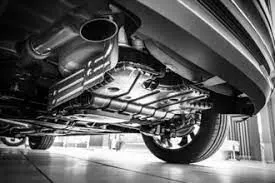
Hot Melt Wax Coatings :
- Hot melt wax coatings are thermoplastic corrosion prevention compounds. They have a solvent or waterborne formulation.
- Since the 1970’s, hot melt waxes have been used extensively on underbody structural components to provide corrosion protection and enhance vehicle durability. Hot melt waxes are usually applied through a dipping process. The wax is preheated to a temperature between 125 and 195 degrees C (257 and 383 degrees F).
- Following an alkali cleaning and water rinsing operation, parts are immersed in the molten wax.
- The thickness of the wax deposited on the parts is controlled through a preheat of the parts prior to dipping and the actual time of immersion in the hot melt wax.
- Following the immersion process, the coated parts are allowed to return to ambient temperature through a process that controls the uniformity and finish of the hot melt wax. Hot melt wax thickness is commonly specified as 75-125 micrometers (3-5 mils). Typically, hot melt wax coatings can withstand temperatures up to 143 degrees C (290 degrees F) without dripping.
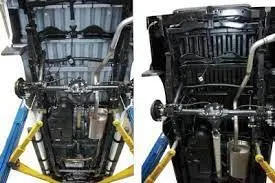
Electrocoat (E-coat) :
- Electrophoretic deposition is a process in which electrically charged particles are deposited out of a water suspension to coat a conductive part.
- The process is more commonly known as electrocoating or E-coating. The idea of electrically discharging polymers to coat an object was first
considered in the 1930’s. Most of the basic research was conducted in Europe in the 1960’s. North American companies began electrocoating
in the late 1960’s, and the process has been widely used for coating metal parts ranging from simple stampings to complex auto bodies. - The process requires a coating tank in which to immerse the part, as well as temperature control, filtering and circulation equipment. Electrocoating
systems are known as anodic or cathodic depending upon whether the part is the anode or cathode in the electrochemical process. Cathodic
systems are more common since they require less surface preparation and provide better corrosion resistance. - Electrocoating requires that the coating binder, pigment and additives be given an electrical charge. These charged materials, under the influence of an electric field, migrate through water to the part surface.
- Once at the part, the charged materials give up their charge due to neutralization by electrochemically generated OH- ions (cathodic process). Upon giving up their charge, the coating materials drop out of the water suspension and coalesce as a coating on the part surfaces.
- Electrocoat thickness typically ranges from 10 to 30 micrometers (0.4 to 1.2 mils). Automotive parts that are electrocoated usually receive a zinc or iron phosphate treatment prior to deposition. This treatment enhances the application of the E-coat.
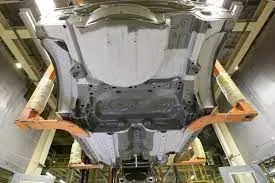
Metallic Coatings :
Various types of metallic coatings can be applied to ferrous and non-ferrous substrates to inhibit corrosion and/or provide a decorative finish. The
choice of a particular coating material is dependent upon the severity of the corrosive environment, whether the part is subject to wear and abrasion,
and the degree of visibility of the part in service.
Four common methods for applying metallic coatings are:
• Electroplating :
The coating is deposited onto the substrate metal by applying an electrical potential between the substrate metal (cathode) and a suitable anode in the presence of an electrolyte. The electrolyte usually consists of a water solution containing salt of the metal to be deposited and various other additions that contribute to the plating process.
• Mechanical plating :
Finely divided metal powder is cold welded to the substrate by tumbling the part, metal powder and a suitable media such as glass beads, in an aqueous solution containing additional agents. Mechanical plating is commonly used to apply zinc or cadmium to small parts such as fasteners.
• Electroless :
In this non-electric plating system, a coating metal, such as cobalt or nickel, is deposited on a substrate via a chemical reaction in the presence of a catalyst.
• Hot dipping :
A coating metal is deposited on a substrate by immersing the substrate in a molten bath of the coating metal. Many underbody structural components are manufactured from sheet steel with a metallic coating. The steel mills supply hot or cold rolled sheet in coil form with metallic coatings applied by either electroplating or hot dipping. The most commonly supplied coatings include zinc, zinc-iron, zinc-nickel, aluminum, aluminum-zinc, tin and lead-tin.
ADVATAGES OF UNDERBODY COATING :
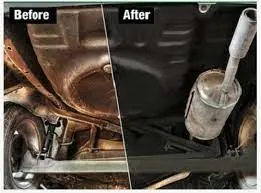
1. Portect against Rust and Corrosion :
It's play an important role in keeping corrosion at bay. Underbody coating can come in handy especially if you leave near sea, where there is too much humidity, and rusting is just one of those things. You should also seriously consider underbody coating if you residein a place where it snows in winter. The primary objecting of underbody coating done is preventing metal componenet that are exposed on the bottom side of the car to damage from corrosion. You can shut out the adverse effect of corrosion on yopur by simply applying a rubberised anti-rust coating all over the beely of car.
2. Reduse Noise Vibration Harshness (NVH) Levels :
Underbody coating shockinglly helps to reduce or soften the noises that reach the cabin. Since the underbody coating is often made up of rubber it absorbs some of the car could spare themselves of the road noises, at least upto a certain extend. It minimizes the sound from underneath the car resulting a noiseless, smooth driving experience.
3. Reinforcement :
If car is come with stock underbody coating, using another coating on top of it, is not going to hurt. It will offer additional reinforcement. Protecting the underbody from water, road debris, gravel and samll pebbles. There would also be a lesser chance for a factory coat to flake away.
4. Prolong car's life :
Good underbody coating not only defends the underbody fropm corrosion but also protects the engine and transmission as well. Less rusting coupled eith slower wear and tear can surely add years to the life span of vehicle.
5. Heat Insulation :
It insulate the interior of the car from extreme temperature from beneth the vehicle providing a comfortable cabin experience.
6. Anti-Shipping property :
If any stone hits the coating it does not get chipped away hense protect the underbody from exposure to water.
DISADVANTAGE OF UNDERBODY COATING
1. Add Weight
Although the layering of underbody coating is in micrometer but underbody coating may add some minimal amount of weight to the vehicle body.
2. Fails to protect Existed Rust :
Underbody coating will work best on new vehicles that have not been exposed to road conditiobn. A used vehicle may already have residue on the bottom of the car or even have spot of rust and corrosion.
3. High Cost :
Applying underbody coatingon a vehicle can be expensive.
4. Damage Risk :
There can be chances of risk of damage during application, that the coating should br applied carefully otherwise the coating can get into moving part such as CV- joint in propeller shaft and can cause failure of the parts.
5. Re-application is required after time :
The life span of the coating generaly about 3-5 years, to get benefit need to re-apply the costing after a tiime period.