Challenge

Underbody Coating

Underbody coating and Process

Underbody coating :

Underbody coating is usually a dense cladding (often based on rubber) applied uniformly to the undercarriage of the automobile. It is normally sprayed or painted on when the car is just out of the dealership and is clean. But even if you are getting the undercoating applied after a couple of years, it’s fine too.

The underbody coating that is most commonly used on cars in India and supplied by companies such as 3M is a thick, rubberized paint that forms a 2-3 mm thick coating all along the underside of the car when sprayed on. You also get a thinner clear coat underbody coating which is like a lacquer that coats the entire underside of the car.
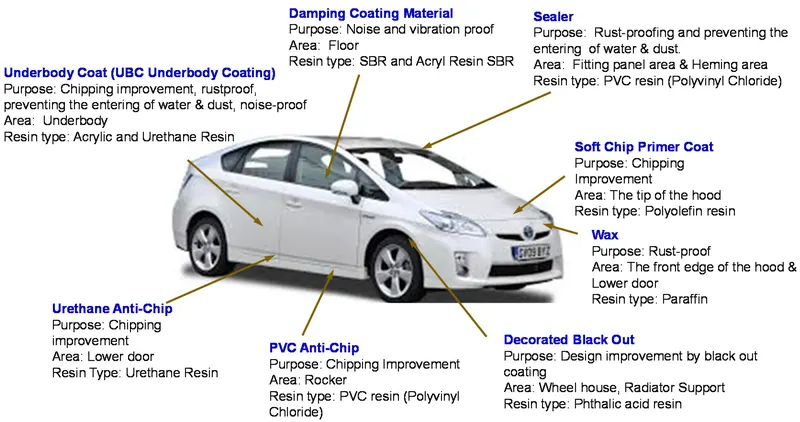
Underbody coating steps :

1. Pretreatment

2. Electrodeposition (ED)

3. sealer (Poly Vinyl Chloride)

4. primer

5. Topcoats

Pretreatment :

When the automobile body sheet metal components are welded together, the resulting structure is referred to as the body-in-white (BIW). The first sequence in preparing the BIW for subsequent coating is pretreatment—see Figure 3. Pretreatment consists of cleaning the body surface to remove remaining oils from the stamping process and welding residues through three primary liquid dip processes of degreasing, conditioning, and phosphating
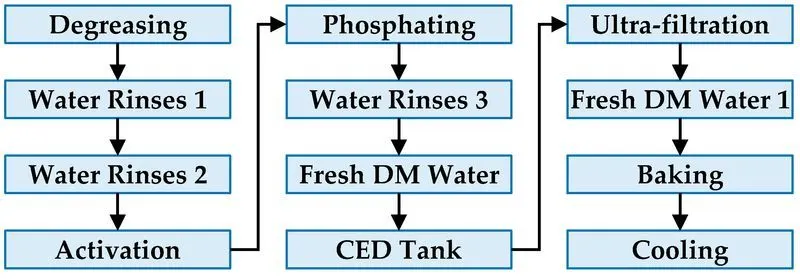
Pretreatment steps :

1. Precleaning

2. Degreasing

3. Activation

Electrodeposition (ED) :
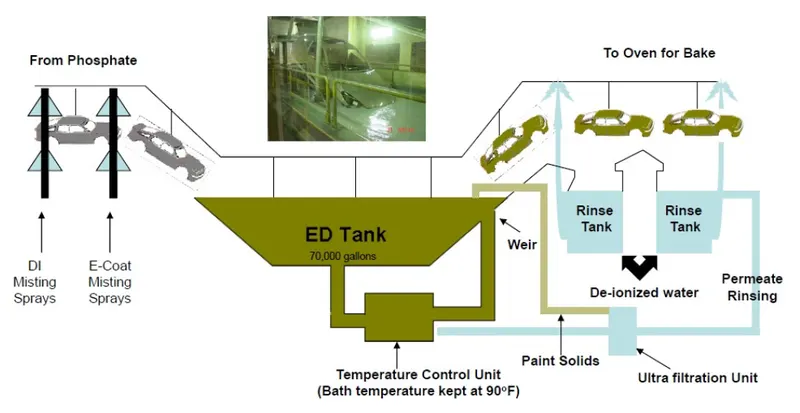
1. Electrocoat paints are water soluble (suspensions of binders and pigments in d.i.(deionized) water) with only low proportions of organic solvents (approximately 3%).

2. Electrocoating covers all dip painting processes, where the paint precipitates on the workpie ce owing to chemical conversion and associated coagulation of the binder.

3. These conversions are caused by an electric current flow from an

Sealing :
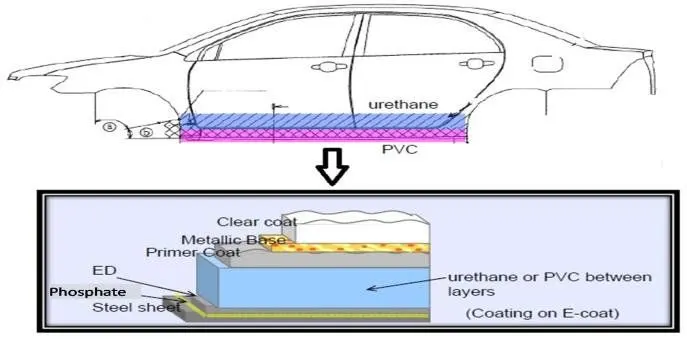
The overlapping, sp ot-welded metal sheets must be sealed in such a way that no humidity can penetrate between the metal sheets and water in the vehicle interior,which may lead to corrosion.

On the weld seams, high viscous polyvinylchloride (PVC) material is mostly sprayed as paths with airless application or extruded by flat stream no

The underbody protection also serves as protection from corrosion, mostly for areas exp osed to a high strain because of stone chips. It is applied partially two­ dimensionally, for instance, in wheel arches and in the rocker panel area .

Primer :

1. Before applying the fina l pa int, primer is applied so that the top coat can adhere strongly

2. Initia lly solvent wiping and tag rack wiping is done manually so as to remove a ll accumulated dirt prior to paint a pplication

3. The inner parts of the car body undergo primer a pplication manually using electro static spray gun

4. The outer parts of the ca r body a re applied with primer by the help of robots

5. The last stage is flash off where the primer is dried and finally sent to primer oven for ba king

Topcoat :

The final step in the body coating process is to apply the topcoat, which consists of two layers—the basecoat and clearcoat. The basecoat contains the primary coloring pigment, and the clearcoat provides a protective coating against environmental effects, corrosion, and UV light degradation, promotes unmatched color retention, and provides a smooth, unblemished, and even finish [25]. The body is first coated with either a water-borne or solvent-borne basecoat. If the manufacturer is using a wet-on-wet process, then the clearcoat is applied onto the basecoat after a short flash-off, before curing in an oven. In the absence of a wet-on-wet process, the basecoat is cured before the clearcoat is applied. Independent of which process is employed, typical thermal cure times and temperatures are 30 to 40 min at 125 ˝C, respectively

Pros of under body coating

Protects Against Rust & Corrosion :

The primary objective of getting underbody coating done is preventing metal components that are exposed on the bottom side of the car to damage from corrosion. You can shut out the Adverse effects of corrosion on your car by simply applying a rubberised anti-rust coating all over the belly of your car.

Reduces NVH (Noise Vibrations Harshness) Levels :

Our country is filled with roads having uneven patches and potholes and while we manoeuvre our cars through such sections, the unpaved crumbs, and pebbles hit the car from underneath or get stuck in the wheel wells. The underbody coating’s consistency is so thick that the layer it creates absorbs all the unpleasant noises and vibrations and marginally improves the driving experience.

Prevents Paint Chipping :

Running on the highway or while pacing through a city road, you will often encounter sharp gravel or any other unattended object hitting the belly of your car with high momentum. This scrapes and chips off the metal from down below. A thick layer of Underbody Coating definitely comes to aid and minimises the effects of such contacts on the body.

Protects Vital Components:

Underneath a car is somewhere a lot of indispensable parts of a car are left exposed like the Engine, silencer, etc. One simply can’t afford to let these parts go bad due to rusting and hence in order to save yourself from a hefty repair bill, a considerably less expensive Anti-Rust Coating is a must.

Cons of under body coating :

1. It is less helpful if corrosion is already present.

2. It works best on new cars.

3. High cost

4. Not long-lasting

Your portfolio, next

Ship work like this
in your own course.

Talk to a career counsellor

Free 20-minute call. We'll map the right course to where you want to work.

By submitting you agree to our Terms and Privacy Policy.

Talk to a career counsellor

Free 20-minute call. We'll map the right course to where you want to work.

By submitting you agree to our Terms and Privacy Policy.