Underbody Coating
Automotive Under Body Car Coating Process on BIW
Automotive coatings and the processes used to coat automobile surfaces exemplify the Avant-grade of technologies that are capable of producing durable surfaces, exceeding customers’ expectations of appearance, maximizing efficiency, and meeting environmental regulations. Overall, the critical performance factors driving the development and use of advanced automotive coatings and coating technologies are (a) aesthetic characteristics; (b) corrosion protection; (c) mass production; (d) cost and environmental requirements; (e) appearance and durability. Although the relative importance of each of these factors is debatable, the perfection of any one at the expense of another would be unacceptable. Hence, new developments in automotive coatings are described and discussed in the following review, and then related to improvements in production technologies& paints. Modern automotive coating procedure are also discussed in details.
Modern automotive coating methods consists of five main steps. They include the following:
PRETREATMENT:
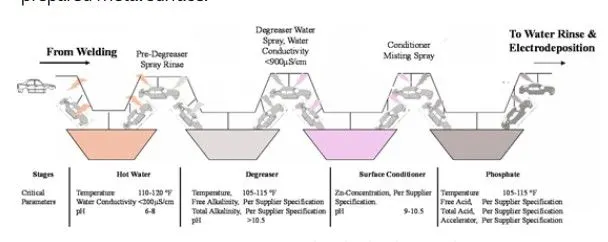
- Pre-treatment removes & clean excess metal & forms an appropriate surface structure enabling bonding of a corrosion protection layer.
- It consists of cleaning the body surface to remove remaining oils from the steaming process & welding residues through three primary liquid dip processes of degreasing, conditioning, & phosphating.
- Pre-treatment helps the primer to bond onto the metal.
ELETRODEPOSITION:
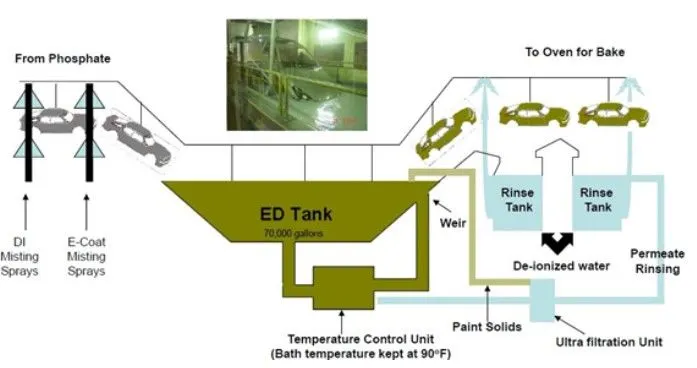
- E-coating involves dipping automobile bodies into the coating solution & passing an electric current through the body & the liquid ED paint solution.
- During operation, a mixture of resin, binder, & a paste containing the pigments is fed into the ED tank. The automobile body is lowered into the tank, & an electric current applied; the solution in the tank consists of 80-90% deionised water & 10-20% paint solids.
- The resin is the backbone of the final paint film & provides corrosion protection, durability, & toughness. Pigments are used to provide colour & gloss.
- After E-coat, the automobile body enters a bake oven, in which heating & keeping at a temperature of 160_C for 10 min causes film curing to promote maximum performance properties.
RUST-PROOF MATERIALS: SEALER/PVC
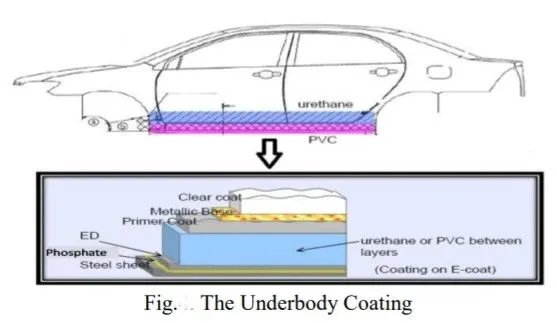
- The lower door sections & rocker panel locations where PVC or urethanes are applied as an anti-chipping protection, & shows the cross section of this layer with respect to the other coatings on the body parts.
- It is also typical to apply a soft tip primer coat that improves the chipping resistance. This layer is applied to the front edge of the hood, which is an area prone to chipping shock, using a high elastic resin that resides between the ED & primer coats.
- The radiator supports, wheel housing, & under rare areas of the body are coated with a relatively dull black pigment called a blackout coating.
PRIMER
- It can be water-borne, solvent-borne, or a powder. The primer fills & smoothest minor imperfections & scratches that may be created during prior steps & by the intermediate sanding or grinding used to remove small imperfections.
- It also provides additional protection against corrosion & maximizes adhesion between it & the E-coat & basecoat; thereby, the primer increases paint durability
TOPCOAT
- The final step in the body coating process is to apply the topcoat, which consists of two layers the basecoat & clearcoat.
TYPES OF UNDERBODY COATING
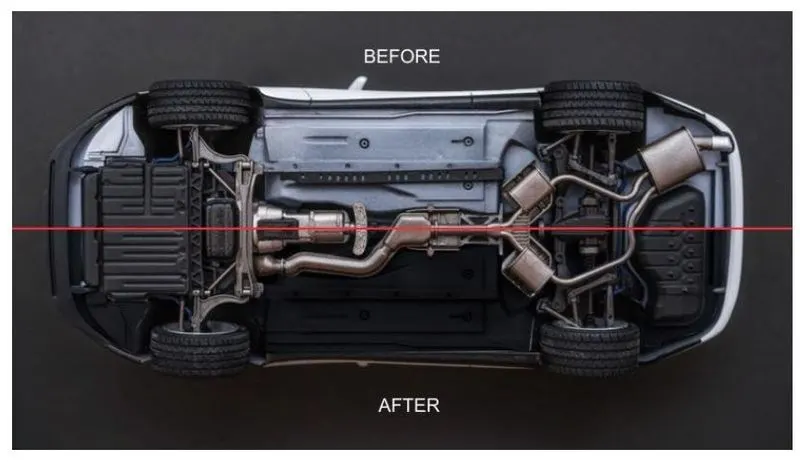
- RUBBERIZED UNDERCOATING
Rubberized undercoating is easy to apply, and offers the best protective coating for car’s undercarriage. It cushions surfaces against moisture, rust, dings, and dents. Rubberized undercoating is safe to use on wheel wells, quarter panels and dries with a soft rubbery finish.
- ASPHALT-BASED UNDERCOATING
It has higher level of protection suitable for lorry's, Trucks or heavy machinery vehicles. It’s made up with some bits of rubberized material to aid in noise reduction. It offers extra protection against chips and moisture but is not paintable.
- POLYURETHANE UNDERCOATING
this type of underbody coating requires some surface preparation work before application, like degreasing, and applying an etching primer to the bare metal.It is easy to apply and works by sealing up cracks. The compound displaces salt and moisture and protects the unoxidized metal from rust. It’s often sold in canisters that are ready to preload into an application gun.
- WAX OR PARAFFIN-BASED UNDERCOATING
Wax or paraffin-based undercoating sprays are the cheapest and quickest options available. However, their results don’t last long, and you may have to apply a fresh coat after only a few months. In addition, the wax isn’t very adhesive on a metal surface. Its main advantage is that it seeps quickly into cracks and seams, and offers moderate protective properties against moisture
Pros and Cons of Underbody coating
Pros - This treatment is designed to provide long-term protection from rust to the under chassis. It protects the underbody substrates from
- Environmental conditions
- Dampens sound and vibration
- Insulates against cold and heat
- Protects against Corrosion
- Seals off seams
- Hides welds, repairs & bodywork with spray
Cons –
- High cost
- Risk of damage during application
Conclusion -
Modern automotive coating procedures were discussed in details. Finally, the discussion covered recent trends in automotive coating processes & potential future developments.