Underbody Coating
Under-Body Coating : OR ED-Coating : ED-Coating means Electro-Deposition Coating which is also known as E-Coating. ED-Coating is a method of painting which uses electrical current to deposit the paint. The process works on the principle of " opposite attaraction". In Electro-Deposition charged particle from the paint emulsion moves to cathode or anode under electrical force. Depending on the polarity of the part and paint particle , electro-coating is classified as either Cathode Electro-Deposition ( CED) or Anode Electro-Deposition (AED).
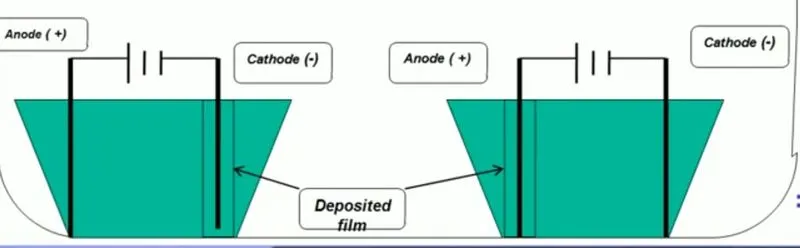
In automobile industry generally CED method is used. A brief discription about Cathode Electro-Deposition is as follow :
Cathode Electro-Deposition ( CED ) :
In this process charged particle from the paint emulsion moves to cathode under electrical force .The direct current (DC) established through the bath makes the pigment & resin base of the paint attract towards the component surface . The electro deposition continuous until the resistance builds, giving the desired level of coating thickness evenly across every surface. The coated part is then cured in an oven at 160 - 180 degree celsius for 20-30 minutes to promote cross linking.
The major steps in Cathode Electro Deposition (CED) process are :
1) Pre-Treatment
2) Cathode Electro Deposition ( CED)
3) Ultra filtration
4) Curing
Purpose Of Under-Body Coating :
1) Environmental condition
2) Impacts
3) Dampens sound and vibration
4) Insulates against cold and heat
5) Protects against corrosion
6) Seals off Seams
Types Of Under-Body Coating :
1) Pretreatment
2) Electrodeposition (ED)
3) Poly Vinyl Chloride (PVC)
4) Adhesion between the surface and the basecoat
5) Basecoat and the clear coat
1) Pretreatment :
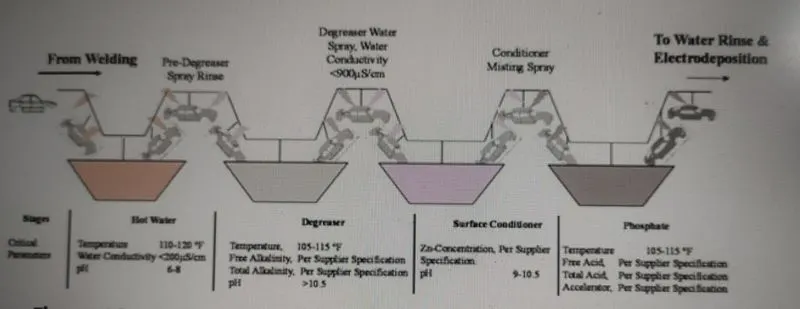
The pretreatment removes and clean axcess material and forms an appropriate surface enabling bonding of a corrosin protection layer. When the automobile sheet metal componenet welded together the resulting structure is reffered to as the Body-In-White ( BIW) . The first sequence in preparing the BIW for subsequent coating is pretreatment. Pretreatment consist of cleaning the body surface to remove the remaining oils from the stamping process and welding residues through three primary liquid dip processes of degreasing, conditioning and phosphating. An additional pretreatment cleaning that emplyos almost ph 9 hot water can also be used.
2) Electro Deposition :
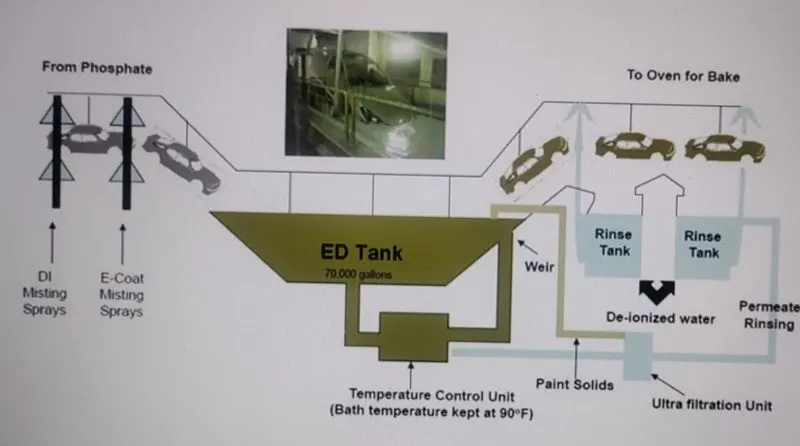
- Electrodeposition solution having a 90% Zn–10% Fe composition (GA material) is the primary coating used in modern automobiles to prevent corrosion. In comparison to the SGC solution, i.e., GI material, with 100% Zn during electrodeposition, the GA material minimizes ED gas pin (paint quality defects) and maximizes spot welding performance; however, the SGC process is still used in Europe. The SCGM corrosion protection method was used in previous decades, and it did enable the minimization of the ED gas pin. However, its cost was higher than the GA material coating.
- The E-coat solution consists of a mixture of resin, binder, a paste containing the pigments, and a solvent. During anodic electrodeposition, metal parts are positively charged while the paint is negatively charged; because small amounts of metal ions migrate into the paint film, it limits the performance properties of the coating. Hence, anodic coatings are mainly used for interiors and offer excellent color and gloss control.
- In cathodic electrodeposition, the metal part is negatively charged while the paint is positively charged. In contrast to the anodic process, the cathodic process reduces the amount of iron that can enter into the paint film. Hence, cathodic coatings offer high performance and excellent corrosion resistance and have mostly replaced anodic coatings in North America. The E-coat process is considered to be relatively environmentally friendly; it uses only a 0.5% solvent solution.
3) Polyvinyl Chloride Coating :
- and minimization of chipping and vibrational noise.
- The sealant is applied aroud and inside the doors, hood , trunk and front dash and onto the exterior and interior of metal joints and outer area of back wheel well. Application of the sealant is accomplished either mannualy or with robots and prevents air and water ingress and inhibits rust formation.
- Recently, PVC and acryl/urethane sealants have also been used in the underbody areas, a process called the Dampening Coat (DC), to impart noise-proofing and vibration-deadening. The noise and vibration are transferred from the engine, drive train, suspension system, road noise of the tires, and flowing air, and the underbody sealants reduce noise transfer into the passenger compartment of the automobile.
PROS AND CONS OF UNDERBODY COATING :
PROS :
- The obvious pros of undercoating are the protection it provides to the carriage of our vehicle. If you live in an area where salt and sand are used on the roadways in cold weather, these material can be corrosive to your vehicle . Undercoating gives you an extra layer of protection against rust and corrosion, protecting your car. Undercoating will eventually wear out, but we can get years of protection from it . Even vehicles in warmer climates gain protection as debris is repelled and kept away from eating at the vehicle.
- Better corrosion and chip resistence
- Aqueous process,hence free of fire risk
- Superior in anti-pollution ,safety , hazards
- Fully automatic operation , film thickness can be control
- More uniform coating and coverage in interior surfaces and sharp edges for protection.
CONS :
- When examining the vehicle undercoating pros and cons , we do want to look at potential downsides to getting undercoating . Undercoating will work best on new vehicles that have not been exposed to road conditions. A used vehicle may already have residue on the bottom of the car or even have spots of rust and corrosion. Undercoating will not help you if corrosion already exists and the corrosion needs to be removed first before it can be applied , which is expensive for us.