Underbody Coating
Underbody Coatings
Underbody coatings are used to protect against wear and corrosion under fenders, in wheel housing and on the underside of the vehicle, as well as on skirts, sills and protection plate, these areas are exposed to abrasion by road gravel (sand, stones and fine sized particles). The underbody coating needs to be resilient and elastic. Snow and ice together with salt and gavel in cold environments. Undercoating and rust-proofing are examples of offering protection and care of bottom side of the vehicles like car and truck. Even though the terms are used interchangeably, an undercoating applies to the exterior and rust proofing goes inside the vehicle. The undercoating provides with the safety and functionality of long-term basis. Undercoating is maintained thick to control rust and corrosion on underbody of the vehicle.
Types of Vehicle undercoating
Rubberized undercoating:
It cushions surfaces against moisture, rust, dings and dents
Asphalt – based undercoating:
It offers extra protection against chips and moisture but is not paintable.
Polyurethane undercoating:
It works by sealing up cracks and seams. The compound displaces salt and moisture and protects the unoxidized metal from rust.
Wax or Paraffin – Based undercoating:
The wax isn’t very adhesive on a metal surface and its main advantage is that it seeps quickly into cracks and seams, and offers moderate protective properties against moisture.
Penray – based undercoating:
It is a global manufacturer of chemical products for marine equipment and the automotive industry. Best selling products is Penray 4424 Rubberized Undercoat.
3M – based undercoating:
It is multinational mining and manufacturing company that produces consumer products for the healthcare industry, energy industry and automotive world. Some its top products are Dynatron 544 Dyna-Pro and the 3M 03584 Professional Grade Rubberized Undercoat.
Rust-OLEUM:
It is an Illinois – based manufacturer of protective coatings and paints for home and industrial use. It reduces the corrosion on metal decks.
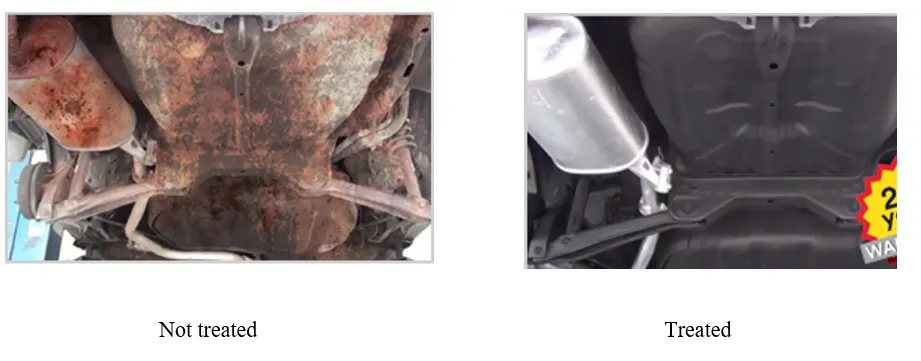
Figure: It shows difference before and after coating
Pros:
- It provides a layer of protection against corrosion.
- It will extend the life of vehicle.
- It can be applied to damaged areas.
- It can be self-applied.
- There are multiple undercoating methods that can be used.
- It helps to reduce interior noise.
Cons:
- It is less helpful if corrosion is already present.
- It works best on new cars.
- Most vehicles make it five years before corrosion begins to show.
- A third-party undercoating service might void your vehicles warranty.
- It adds weight to the vehicle.
- An undercoating is not impervious to damage.
- For every 3 to 5 years coating is applied to get best results.