To Compare the bending performance of 3 beams (Rectangular, I-section and C-section).
Aim:
To Compare the bending performance of 3 beams (Rectangular, I-section and C-section).
Objective:
- To create a model of Rectangular, I-section and C-section beams.
- Run the Simulation on all the 3 beams: -
- Fix one end of all the beams to make them a cantilever beam.
- Subjecting them to a uniformly distributed load (UDL) of 1500N. UDL is applied on 45mm, 40mm, 45mm wide face of Rectangular, I-section & C-section/C-channel beam respectively.
- Compare the results for stress, strain and displacement due to the applied load, of all the three beams and suggest the best out of the three.
Dimensions (in mm):
Length of all the beams is 400mm.
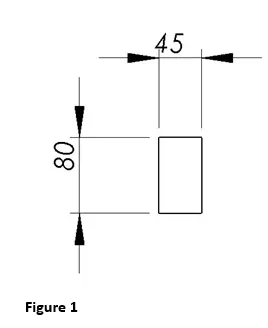
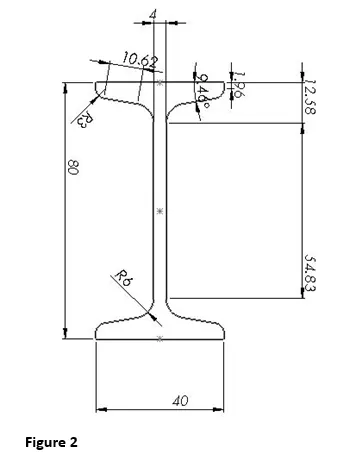
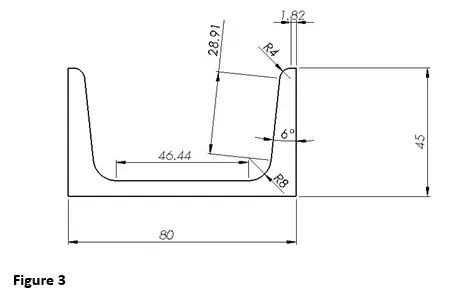
Introduction:
Beams, in general, are very long compared to their cross-sectional dimensions. They are represented in diagrams by their centroidal, longitudinal axis and carry loads predominantly transverse to this axis. The primary effect of the loads is to bend the beam as shown by the dotted line in Figure 4.
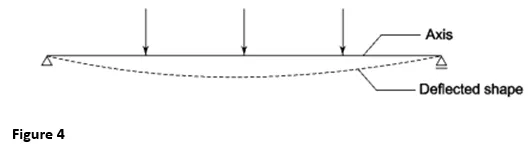
Cantilever beam
A cantilever is a beam which has a fixed support at one end and is free at the other.
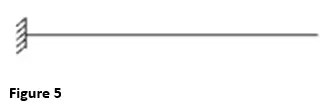
Under the action of loads, a beam gets deflected. This is known as bending or flexure. The curved shape of the beam after bending is known as the deflected shape or elastic curve.
Stress
It can be defined as the internal resistance developed by the body over unit area of its cross section when the body is subjected to an external load.
Strain
As the body is subjected to forces, the body deforms. Strain is a measure of the deformation of the body.
Displacement/Deflection
It is the movement of the object when subjected to an external load. For a beam the deflection is vertical.
Procedure:
- Creating 3D model using SolidWorks:
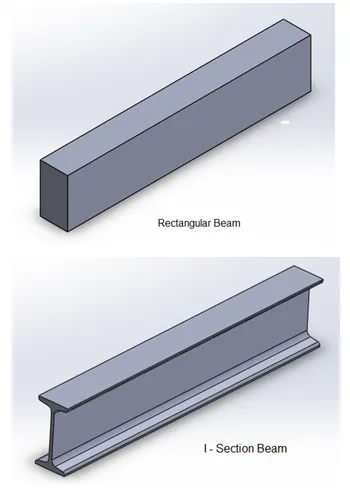
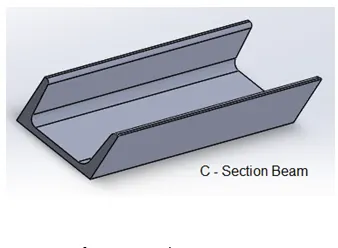
2. Performing simulation:
- We need to perform static analysis simulation.
- Material applied for the study = Alloy steel.
- To make the beam cantilever, apply ‘fixed geometry’ fixtures at the end of the beam.
- Apply external load on the beam face.
- Create mesh for the Model.
- Run the study to get results for stress, strain and Displacement of the beam.
Results:
For Rectangular beam:
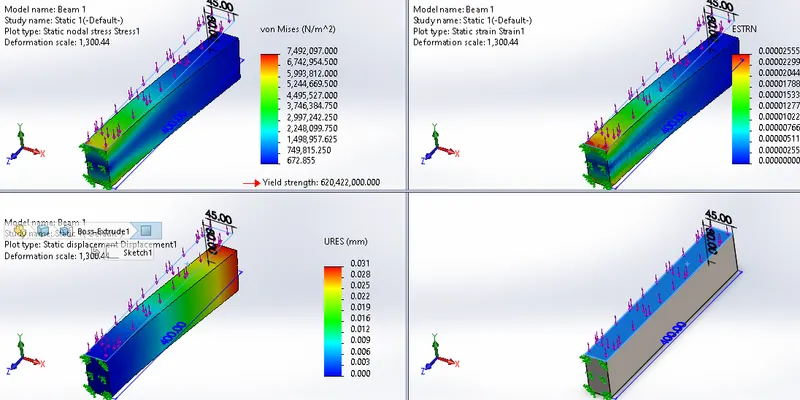
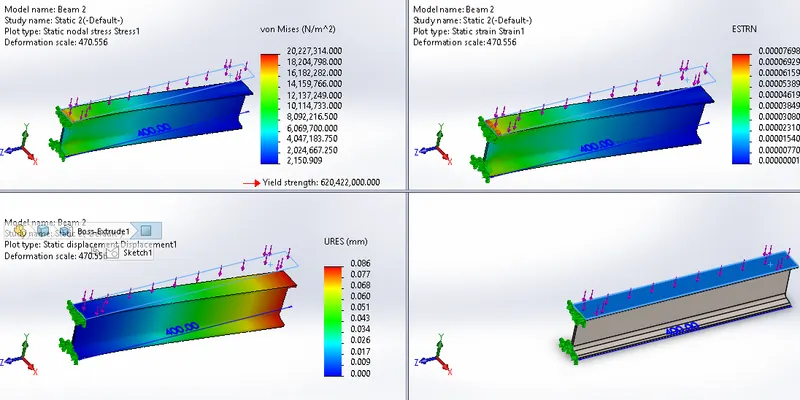
For I-Section Beam:
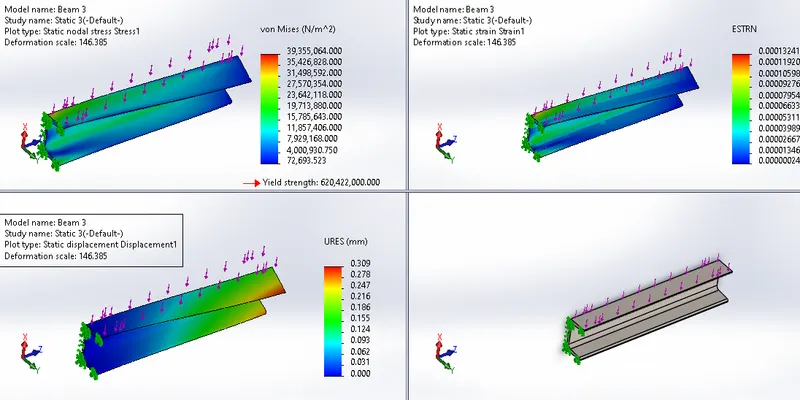
For C-Section beam:
Results Comparison:
|
Beam |
Stress (MN/m^2) |
Strain |
Deflection (mm) |
|
Rectangular |
7.49 |
2.5 * 10^(-5) |
0.031 |
|
I – Section |
20.23 |
7.7 * 10^(-5) |
0.086 |
|
C-Section |
39.39 |
13 .2* 10^(-5) |
0.309 |
Conclusion:
- As seen from the results the Rectangular beam produces minimum stress, strain and displacement under the applied load when compared with other two beams. This shows that a rectangular beam can bear large amount of load and generate small deflection as compared other two beams under similar circumstances and dimension. The only limitation of rectangular beam is, it has more Dead Weight among all 3 beams, hence require more material to manufacture. This poses an economic burden.
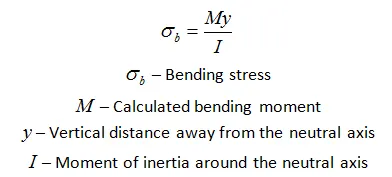
- It can also be seen from formula given below, that for same length, width and hight, the moment of Inertia (MOI) of Rectangular beam is greater than that of I-section beam and MOI of I-Section beam is greater than that of C-section beam. And as MOI is inversely proportional to bending stress, hence Rectangular beam will have least bending stress out of all 3 beams, followed by I-Section and then C-Section.
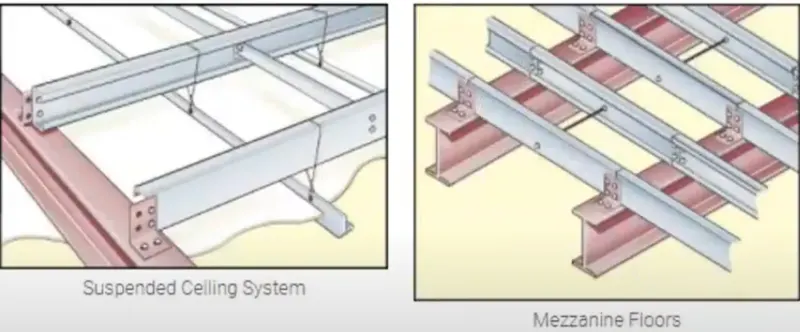
- In case of C-Section beam/ C-Channel beam, when used as cantilever, the amount of stress, strain and deflection produced is maximum of all the beam. This means the beam is not rigid enough. Hence the use of C-Section beam is limited to Mezzanine floor, suspended celling systems etc.
- In case of I-Section beam, the value of Maximum stress, strain and deflection is in between other two beams. Hence, I-Section beam is a better choice as it not only provides satisfactory structural stability with limited deflection but also helps in cost cutting as material use is less. In I-Beam, bending moment is resisted by flange, shear force is resisted by web. I-Beam is widely used in steel structures and frameworks of buildings to provide structural support and stability.