MBD Simulation on a Piston Assembly using SolidWorks.
Aim:
To Simulate a Piston assembly and perform motion analysis.
Objective:
- Model all the parts and then assemble them in SolidWorks.
- The motion analysis is going to be carried out in three different conditions,
|
Sl. No. |
Wrist Pin Offset ` |
Crank Speed (Rpm) |
|
|
1 |
"0" mm |
2000 |
|
|
2 |
10 mm Positive |
2000 |
|
|
3 |
10 mm Negative |
2000 |
Wrist Pin Offset - The position of the wrist pin is going to be varied as followed. But the center of the axis of the piston head and the crank are coincident to each other (i.e) They are on the same plane in all the three cases.
"0" mm Offset - Run a simulation.
10 mm Positive Offset - If the crank rotation is in the Clockwise direction.
10 mm Negative Offset - If the crank rotation is in the Clockwise direction.
- Obtain the Linear displacement of the Piston Head in all the three cases.
- Export the graphs into Excel.
- Superimpose all the three graphs into a single graph.
Basic Definition:
A piston is a component of reciprocating engines, reciprocating pumps, gas compressors, hydraulic cylinders and pneumatic cylinders, among other similar mechanisms. It is the moving component that is contained by a cylinder and is made gas-tight by piston rings. In an engine, its purpose is to transfer force from expanding gas in the cylinder to the crankshaft via a piston rod and/or connecting rod. In a pump, the function is reversed and force is transferred from the crankshaft to the piston for the purpose of compressing or ejecting the fluid in the cylinder. In some engines, the piston also acts as a valve by covering and uncovering ports in the cylinder. (Source: Wikipedia)
Models of all the Components:
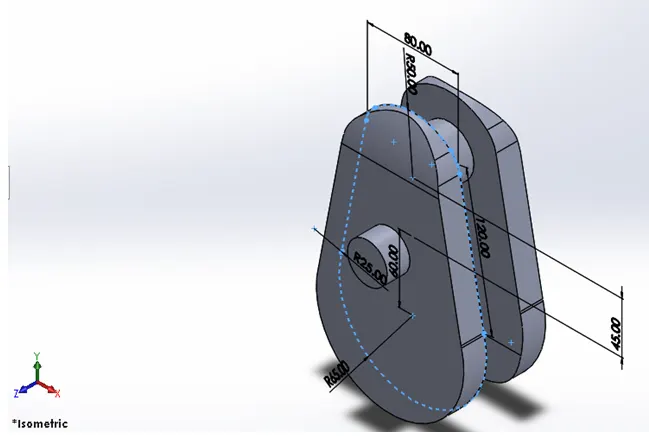
- Crank:
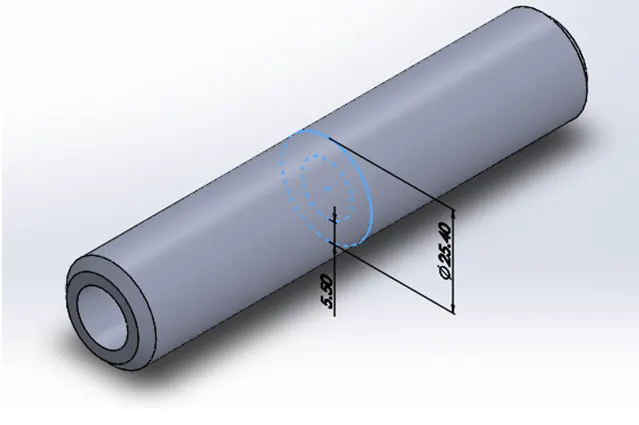
- Gudgeon Pin:
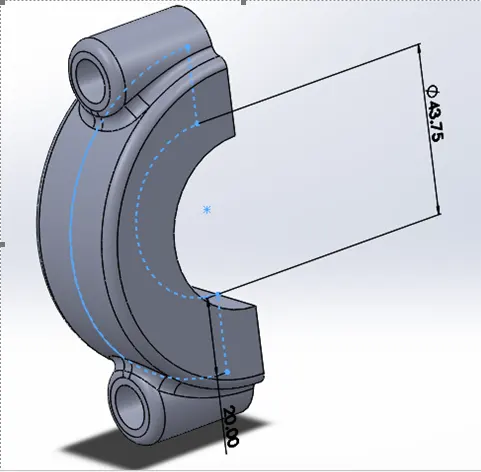
- End Cap:
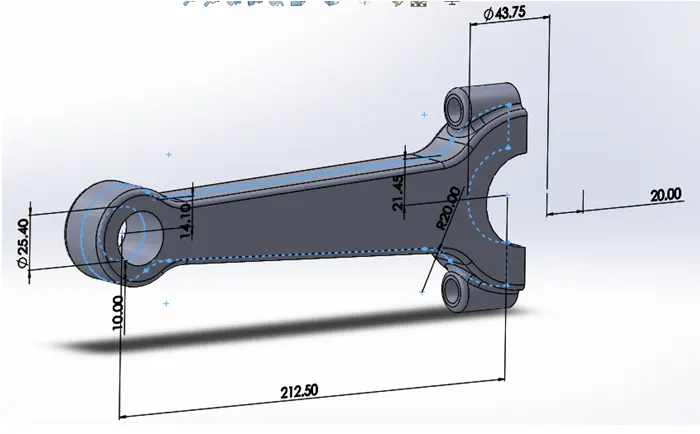
- Connecting Rod:
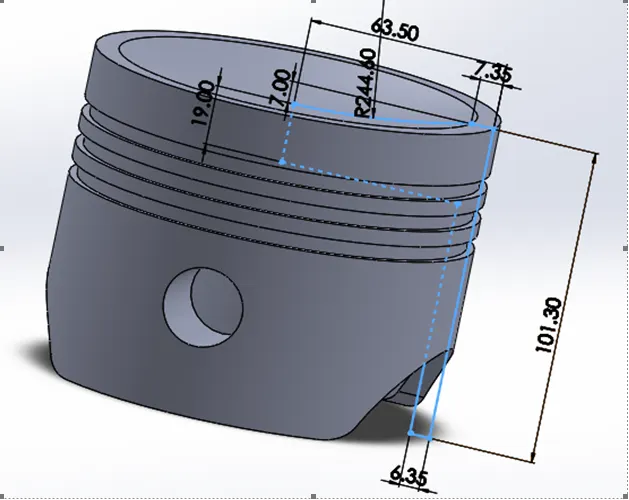
- Piston head:
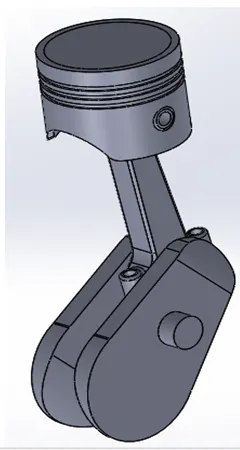
Final Assembly:
Motion Analysis:
|
Case No. |
Wrist Pin Offset ` |
Crank Speed (Rpm) |
|
1 |
"0" mm |
2000 |
|
2 |
10 mm Positive |
2000 |
|
3 |
10 mm Negative |
2000 |
Condition:
- Rotation speed is 2000RPM in Clockwise Direction.
- Frame Per second = 6000FPS with Precise contact.
Steps Followed:
- Modelling and Assembling all the components in SolidWorks.
- There are 3 Study types in Solid works motion study:
- Animation b. Basic motion c. Motion Analysis
- Here, we will make use of “Motion Analysis” feature as it helps in engineering analysis for example by utilising this, we may able to calculate rate of movement, torque and forces involved, which may not be calculated by using “Basic motion” or “Animation”.
- The analysis done using “Motion analysis” can be exported using ‘Results and Plots’.
- Material used for all components is Steel(dry).
- The study is performed for an interval of 0.5 seconds.
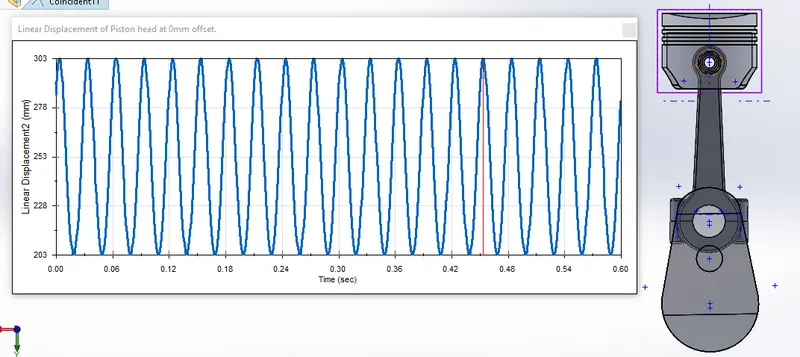
- Case No. 1:
'0 mm' offset, 2000RPM clockwise.
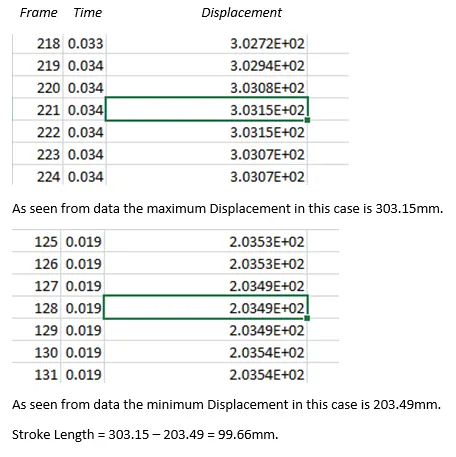
Linear displacement of piston and spread sheet data:
- Case 2:
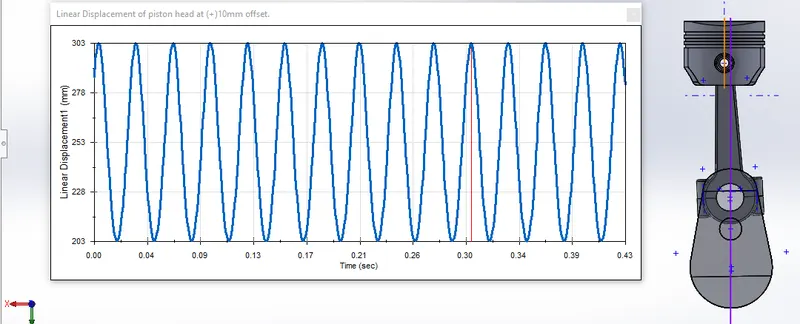
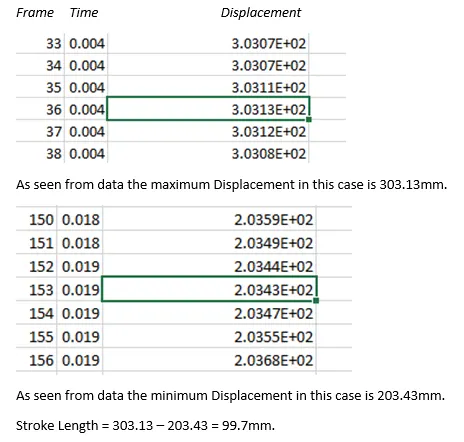
10mm Positive offset, 2000RPM clockwise.
- Case 3:
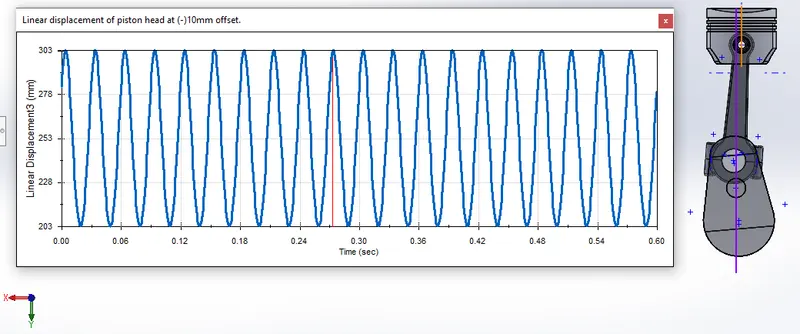
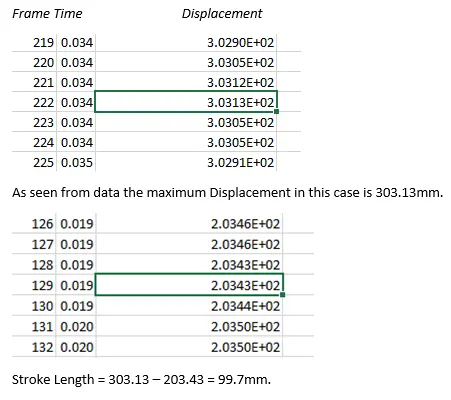
10 mm negative offset, 2000RPM clockwise.
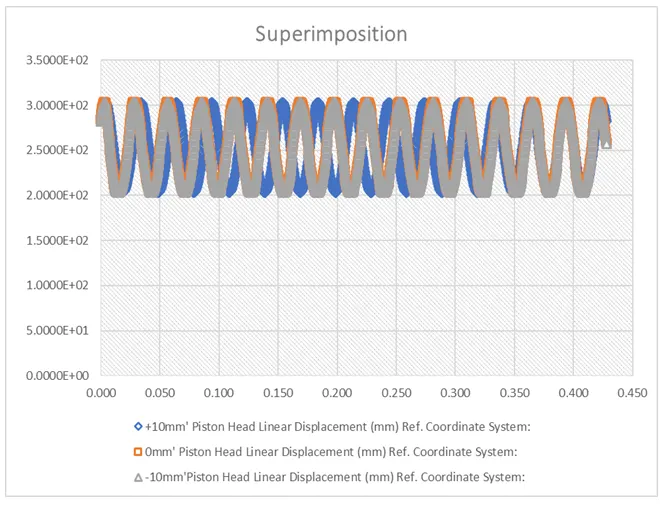
Superimposing all the three graphs into a single graph:
Conclusion:
- There is a variation in the value of the maximum and minimum displacement achieved by the piston in case1 and case 2&3. As seen from the exported data of ‘0mm offset’, in which the piston displacement is maximum in upstroke but least in down stroke, resulting in relatively smaller stroke length. Whereas in other two cases the stroke length is same and greater than the 0mm offset case.
This also means that in case 2&3, the volume swept by the piston will be maximum. Which could be used to intake more fuel and air mixture, thereby increasing volumetric efficiency. On the other hand, wrist pin offset enables the crank to rotate with less resistance hence, saving the engine power output. Imagine it like ’a lever mechanism’ the closer we get to the hinge; more effort is required to transfer same amount of force.
- Offsetting the piston pin yields two major benefits. First, it improves the noise characteristics of the engine due to piston slap at top dead centre. Second, it improves engine output by reducing internal friction. (Source: http://blog.wiseco.com)
Hence by offsetting the piston pin, the engine runs quitter and produces more horsepower due to lower friction during the combustion event.