Structural dynamics
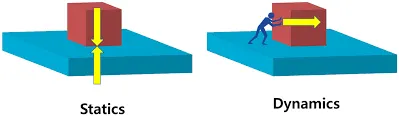
Q1. Differentiate Static analysis and Dynamic analysis by properly representing pictures
ANSWER=
STATIC ANALYSIS:
1. A Static Structural analysis calculates the effect of steady loading conditions on the structure
2. Static means stationary or fixed
3. Eg. Dead load its intensity doesn't change over the time
4. It ignores Inertia and the damping effect because time-varying loads cause them
5. Static Analysis is essential for designing of structure
6. Static analysis is performed when the structure is subjected to external displacement
DYNAMIC ANALYSIS:
1. A DynaminStructural Analysis Calculates the effect of dynamic loading conditions on the structure
2. Dynamic means Energetic and capable of changing
3. A Dynamic load is any load that changes over time
4. Eg. wind load, earthquake load their intensity changes over the time
5. These type of loads exerts a force onto the structure that is seldom greater than the static load
6. Dynamic Analysis tests and evaluates a program by executing the data in real-time. The main objective is to find the error in the program while it is running

Q2. Explain the following with a relevant force-displacement graph
- Elastic behavior
- Inelastic behavior
- Plastic behavior
- Non-linear Inelastic behavior
ANSWER=
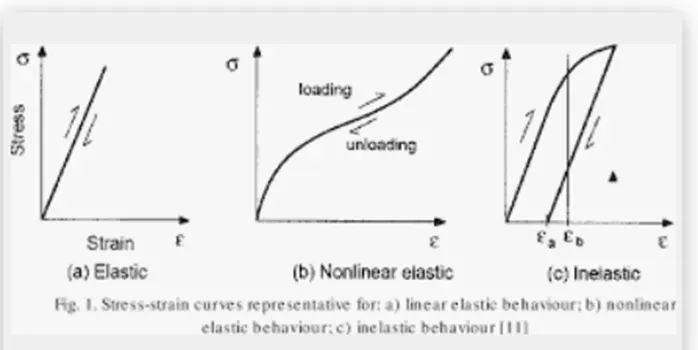
1. Elastic Behaviour: The deformed body's ability to return to its original shape and size When the force causing the deformation is removed. hence a body with this ability is said to have elastic behavior
2. Inelastic behavior: Material that does not return to its original shape after being deformed or when the external force has removed a body with that ability is said to have inelastic behavior.
3. Plastic Behavior: A material exhibits plastic behavior for stress beyond the elastic limit. this means the material deforms irreversibly and does not return to its original shape and size, even when the load is removed. When stress gradually increases beyond the elastic limit, The material undergoes plastic deformation.
4. Non-linear elastic behavior: Material having elastic behavior up to a certain load Which we call yield point. After that deformation is plastic. Rubber for instance has an elastic stress Strain curve, However, the relation is not linear in such cases nonlinear elastic models are required
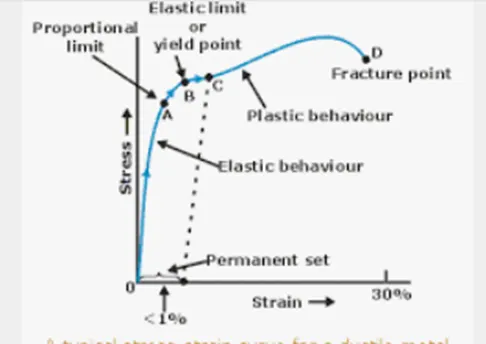
PLASTIC BEHAVIOR
Q3. Explain Mass, Stiffness & Damping components in the equation of motion
ANSWER=
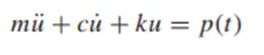
- The Single Degree of Freedom System is a combination of 3 pure independent systems such as the stiffness, the damping, and the mass component.
- The stiffness components: The frame without damping or mass. The external force fs on the stiffness component is related to displacement ‘u’ by fs=ku if the system is linear.
- The damping component: The frame with its damping property but no stiffness or mass. The external force on the damping component is related to velocity by fd=cu
- The mass component: The mass without the stiffness or damping of the frame. The external force fi on the mass component is related to the acceleration by fi=

- Hence it becomes,
Q4. Provide the relationship between Natural period (Tn) & Natural frequency (f) and provide their definitions
ANSWER=
Natural frequency (f):
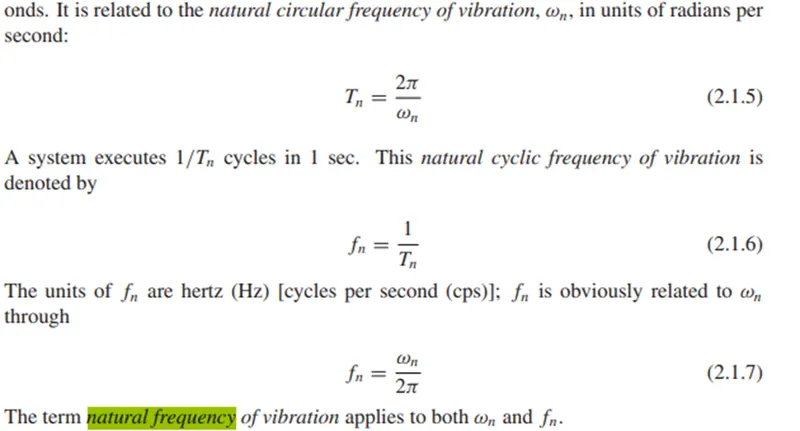
Natural frequency, also known as eigenfrequency, is the frequency at which a system tends to oscillate in the absence of any driving force. Also referred to as wn
Natural period (Tn):
The period of one complete oscillation of a body or system.
Relationship:
- Both refer to quantities which are mass and stiffness.
- Natural frequency is inversely proportional to the natural period.
- The following formulas are taken from the book, Dynamics of structure,
Q5. Explain in detail about Response spectrum & its Graph
ANSWER=
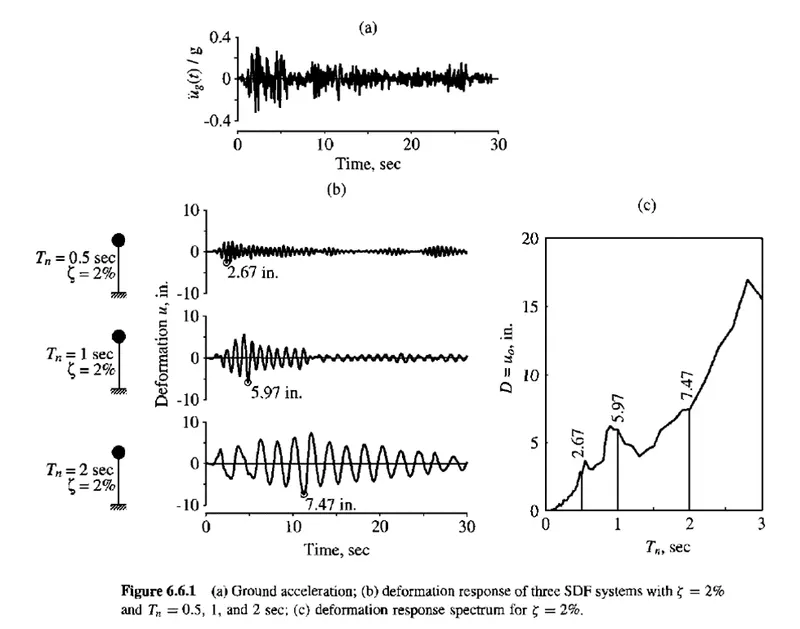
- It’s the central concept in earthquake engineering and provides a convenient means to summarize the peak response of all possible linear SDF systems to a particular component of ground motion.
- It provides a practical approach to applying the knowledge of structural dynamics to the design structures and development of lateral force requirements in building codes.
- A plot of the peak value of a response quantity as a function of the natural vibration period Tn of the system, or a related parameter such as circular frequency ωn or cyclic frequency fn, is called the response spectrum for that quantity.
- Each such plot is for Single Degree of Freedom systems having a fixed damping ratio Շ, and several such plots for different values of Շ are included to cover the range of damping values encountered in actual structures.
- A variety of response spectra can be defined depending on the response quantity plotted. Consider the following peak responses.
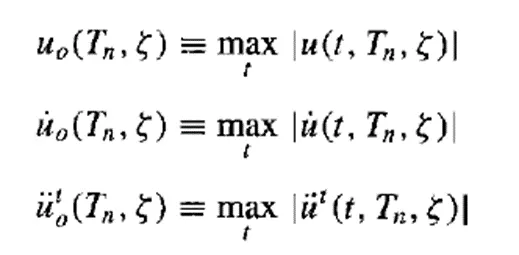
- The deformation response spectrum is a plot of up against Tn for fixed Շ (damping ratio). A similar plot for ůo is the relative velocity response spectrum, and for űto is the acceleration response spectrum.