Structural dynamics
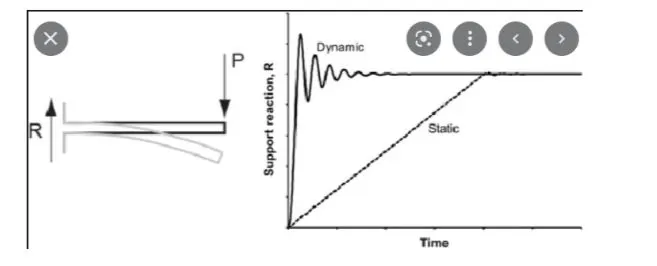
1. Differentiate Static analysis and Dynamic analysis
with proper representing pictures (30 marks)
ANSWER -
STATIC ANALYSIS -
-Static refers to force that has
constant Size , position and direction
on or with in a structure .
-There is no necessary to count
inertia and damping forces in case
of static analysis , but elastic force
should be accounted
-in static analysis not consider Inertia .
-static analysis can only performed if
system will be Simulated ,
does not depends on time .
-Take Load will be applied constant .
DYNAMIC ANALYSIS -
In dynamic refers to force on a structures
that changes size , position ,and direction .
-in dynamic two additional forces may be
accounted such as inertia and damping
force .in equillibrium equation it can
be disrearded in static analysis .
-in dynamic analysis load application
or both might change with time .
-
2
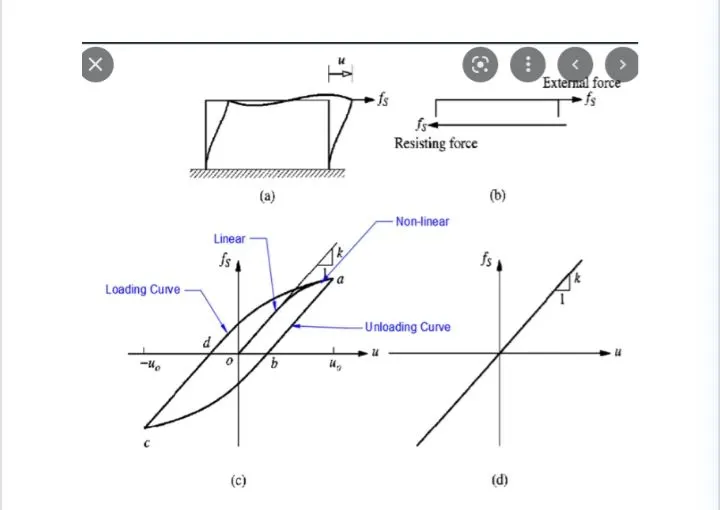
2. Explain the following with relevant
force-displacement graph (40 marks)
- Elastic behavior
- Inelastic behavior
- Plastic behavior
- Non-linear Inelastic behavior
1. ELASTIC BEHAVIOR -
-Elasticity , ability of deformed material body
to return its original shape and size when
force causing the deformation removed .
-the theory of elastcity is used to
design safe and stable man made structures
such as Skyscrappers and over bridge
to make life convinent .
2 . INELASTIC BEHAVIOUR -
THE behaviour of material in here
material not comes in original
shape after a certain ultimate limit .
and shown rupture suddenly
shown brittle material type qualities .
-because of material have no elongation
up to its ultimate strength .
ex.
WOOD , FABRICATES ETC.
3. PLASTIC BEHAVIOUR -
When stress is grudually increased
beyond elastic limit , material undergoes
platic behaviour .
-stress beyond the elastic limit
a material a material exhibits plastic behaviours .
-in plastic behaviour of material ,materials
shown continued deformation and not comes
its original shape after deformation will be start .
ex - plastic wrap
2 . NON LINEAR INELATIC BEHAVIOR -
-Material shows elastic behaviours
at certain limit after that deformation
will start and shows diffrent properties
of strenth of material as like 1st convert
to plastic behaviours and than next further
continue to start elongation and
than shown its non linear behaviour
its non linear behaviors of material .
3. Explain Mass, Stiffness & Damping components
in the equation of motion (30 marks)
STIFFNESS COMPONENTS -
-FRame without damping and mass .
-external force Fs = ku
k stiffness component related to U
deformation .
- if system is linearly elastic .
2 DAMPING COMPONENTS -
frame having damping property
without stiffness and mass .
-EXTERNAL FORCE of
damping components Fd = cv
is related to velocity .
-3MASS COMPONENT -
Roff mass without stiffness or
damping of frame .
-external force Fi =mu `[2 pi ] / [Wn]`
mass components related to
accelaration .
4. Provide relationship between Natural period (Tn)
& Natural frequency (f) and provide their definitions
answer -
NATURAL PERIO OF VIBRATION Tn
-it is time required for
undamped system to
complete one
cycle of free vibration .
-Units = seconds
Tn = `[ 2 pi ] / [W n ]`= 2π /Wn
it is related
natural circular frequency of vibration Wn
unit = radian / seconds
2. NATURAL CYCLIC FREQUENCY - F n
no. of cycles [or one complete revoluation ]
executed by system in 1 sec.
unit = hertz
Fn =1 / Tn
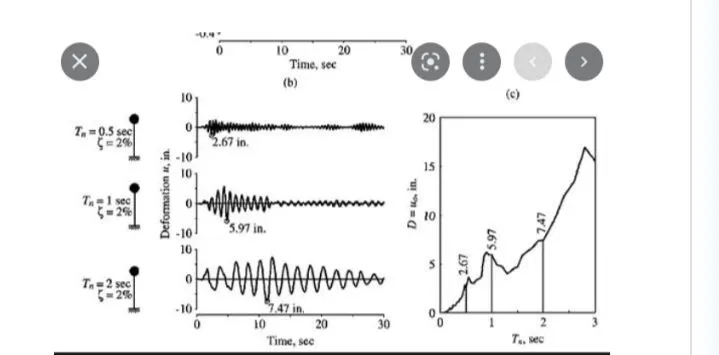
5. Explain in detail about Response spectrum & its Graph (25 marks)
Response spectrum means
of characterized ground
motion and there effect on
structure .
-it summarize peak response of all
possible linear SDF systems
- it also provided a particular
approch to apply knowledge of
structural dynamicks to design structures .
-and also helpful for find out devloped
lateral force requirement in building codes .
-plot of peak values of response quantity
[ U ,V AND a ] as a function of natural
vibration period = Tn
is called response Spectrum of that
Quaintity .
-each such plot for SDF system
having a fixed damping ration .
-response spectrum can be 3 types
Deformation response spectrum is
a plot of peak U ,
aginist Tn have fixed damping ration
-a similar plot U , is relative velocity
response spectrum .
and for peak is U^t is accelaration
response spectrum .
2