Structural dynamics
1.Differentiate Static analysis and Dynamic analysis with proper representing pictures
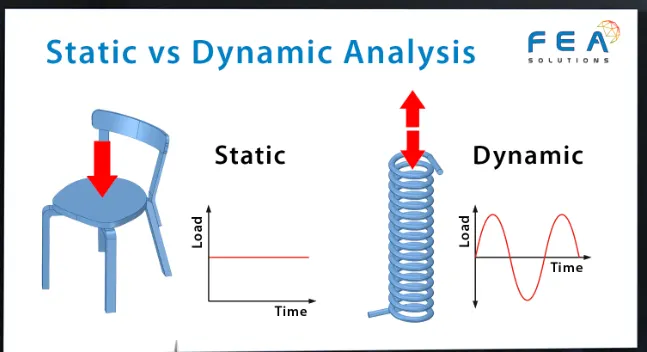
A.static analysis :
- In the static analysis the load are acting with respect to time.
- in the static analysis we are going to calculate the internal force in the structure.
- the loads are applied slowly to the structure.
dynamic analyis:
- variation of load with the time.
- two forces are accounted in the dynamic analysis
- 1.damping force.
- 2.intial force.
- motion is not be disregaradable.
- we done analysis by taking either linear (or) non linear system
- linear system-the structure is to elastic and little deformation.
- non linear system-the structure get larger deformation and cracks.
- in the dynamics the loads are applied quickly to the structure.
2.Explain the following with relevant force-displacement graph
Elastic behavior
Inelastic behavior
Plastic behavior
Non-linear Inelastic behavior
A.
- elastic behaviour:
elastic means regain its original positon.
the material exerted to load it gets deformation after relasing the load the material gets it original position.
2.Inelastic behavior:the material after deformation it doesnot gets orignal position.
3.Plastic behavior:this stage will happened after the yeidpoint.
the material doesnot get original position even after the load is removed.
4.Non-linear Inelastic behavior
In the non linear system the load is not directly proportional to deformation.
the material is inelastic behaviour in the non linear system.
- Explain Mass, Stiffness & Damping components in the equation of motion
A.The differential equation govering the equation of motion.
mu+fd+fs=p(t)
where u is the acceration of mass.
fd is the damping force.
fs is the stiffness force.
the motion of equation generate three pure independepent systems.
1.stiffness component
2.damping component.
3.mass componentt.
stiffness component related to the dissplacement .absence of mass and damping .
damping component related to the velocity .(no stiffness ,no mass).
mass component(or) interia force related to the accerlation( no damping,no stiffness)
4.Provide relationship between Natural period (Tn) & Natural frequency (f) and provide their definitions
A.Natural period of free vibration(Tn) :completion of one cyclic of the system.
Tn=2π/Wn.
where wn=2π/Tn.
where Wn is the natural circular frequency of the vibration.
natural frequency: Natural frequency of the vibration is to complete the no of cycle (one revoultion) in 1 second.
unit is hertz.
the formula is Fn =1/Tn.
the natural frequency is inversly proportional to the natural period.
Fn=Wn/2π.
- Explain in detail about Response spectrum & its Graph
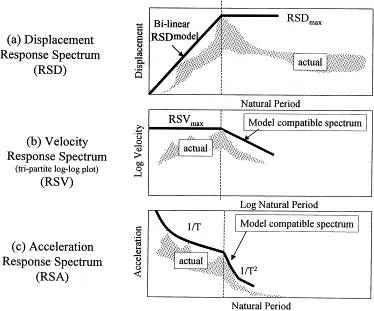
A.Response spectrum: It is the plot having peak many deformation single-degree-of-freedom systems with different natural periods is called the deformation response spectrum.
- A central concept in earthquake engineering, response spectrum is a practical means of characterizing ground motions and their effects on structures of different Tn
- It provides a convenient means to summarize the peak response of all possible linear SDF systems to a particular component of ground motion.
- It also provides a practical approach to apply the knowledge of structural dynamics to the design of structures and development of lateral force requirements in building codes.
- A plot of the peak value of a response quantity (u, v, and a) as a function of the natural vibration period Tn of the system, is called the response spectrum for that quantity.
- Each such plot is for SDF systems having a fixed damping ratio and several such plots for different values of are included to cover the range of damping values encountered in actual structures.
response are of the two types.
1.deformation response spectrum.
2. accerlation response spectrum.
3.velocity response spectrum .
most of the engineer prefers the accelation response spectrum.