Structural dynamics
1)Differentiate Static analysis and Dynamic analysis with proper representing pictures.
Static analysis
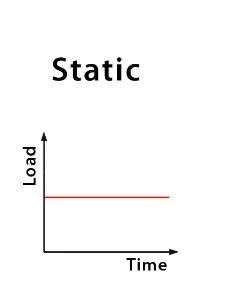
When loads or displacements are applied very slowly to a structure inertia force is negligible,Static analyses don’t consider inertia
In static analysis the system does not depend upon time
The load applied is slowly or constant(slowly, meaning that the frequencies of the loads are much smaller than the natural frequencies of the structure)
Dynamic analysis
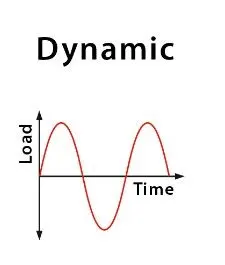
In a dynamic analysis, the system itself, the load application, or both might change with time.
In a dynamic analysis, the inertial loads developed by the system due to acceleration are taken into account.
The load applied is fast(fast, meaning that the frequencies of the loads are in the range of the natural frequencies of the structure)
Damping and inertia forces are taken in account
2)Explain the following with relevant force-displacement graph
- Elastic behavior
- Inelastic behavior
- Plastic behavior
- Non-linear Inelastic behavior
Elastic behavior
The property of material which recover the original dimensions of a deformed body when the load is removed is known as Elastic behavior
The limiting load beyond which the material no longer behaves elastically is the elastic limit
It occurs when weaker forces, lesser than the object's elastic limit, are exerted. For This reason, an object undergoes elastic deformation before plastic deformation.
Inelastic behavior
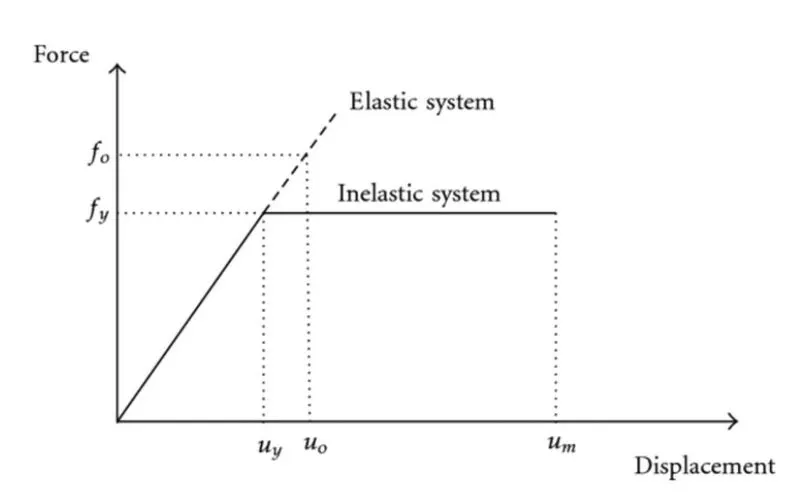
Inelastic materials behave non elastically. They do not show a fixed trend of deformation vs applied force; in fact, they might not deform at all (rigid materials) or the deformation observed is not completely recoverable; on removal of the applied force, the material doesn't return to its original shape, but to a permanent deformed shape
Plastic behavior
Plastic behavior is when that force is removed and it does not return to it original shape
If the elastic limit is exceeded, the body will experience a permanent set or deformation when the load is removed. A body which is permanently deformed is said to have undergone Plastic Deformation
Non linear Inelastic behavior
Force displacement relationship becomes non-linear and inelastic at large deformations
A nonlinear material model can be defined as nonlinear elastic where the part returns to a zero strain state when the load is removed
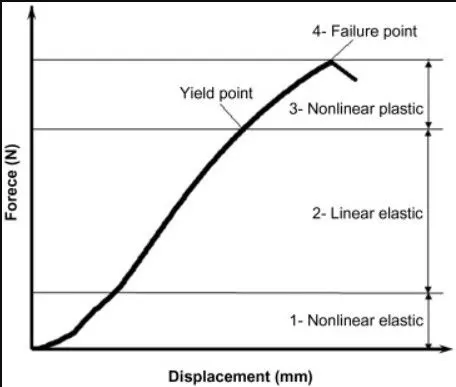
3)Explain Mass, Stiffness & Damping components in the equation of motion
Mass component
Mass component:The roof mass without the stiffness or damping of the frame.The external force fi on the mass component is related to the acceleration by fi =mu
Stiffness component
Stiffness component is the frame without damping or mass
The external force fs on the stiffness component is related to displacement u by fs=ku,if the system is linearly elastic
Damping component
Damping component is the frame with its damping property but no stiffness or mass
The external force on the damping component is related to velocity by fd=cv
4)Provide relationship between Natural period (Tn) & Natural frequency (f) and provide their definitions
Natural period of vibration(Tn)
Natural period of vibration(Tn) of the system is the time required for the undamped system to complete one cycle of free vibration
Its unit is seconds
It is an inherent property of a building controlled by its mass m and stiffness k
Natural period of vibration Tn = 2 π/wn
Natural frequency
The number of cycles(or one complete revolution ) executed by the system in one second
Its unit is hertz
The reciprocal of natural period of vibration is called the Natural Frequency
Natural frequency f=(1/Natural period of vibration)
f=(1/Tn)
5)Explain in detail about Response spectrum & its Graph
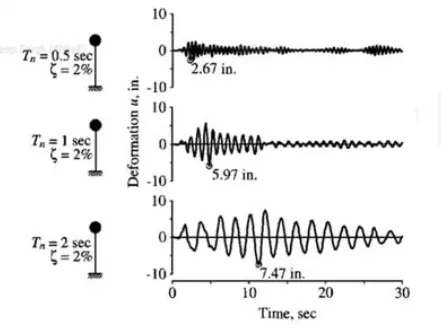
A plot of peak value of a response quantity (u,v and a) as a function of the natural vibration period Tn of the system is called the Response spectrum for that quantity
The response spectrum can be of three type
Deformation response spectrum
Relative velocity response spectrum
Acceleration response spectrum
Deformation response spectrum is a plot of peak value of u against Tn for fixed damping ratio
Relative velocity response spectrum is similar plot for peak u’
Acceleration response spectrum peak u^T