Project on Concrete Mix Design for various grades of Concrete
Calculate the Concrete Mix Design for M35 grade concrete with fly ash & M50 grade concrete without Fly ash ?
AIM
To calculate the Concrete Mix Design for M35 grade concrete with fly ash & M50 grade concrete without Fly ash
INTRODUCTION
Concrete is the most commonly used material in civil construction work all over the world.The various ingredients of concrete are cement,coarse aggregate,fine aggregate,water,admixtures etc..The process of selecting suitable ingredients of concrete and determining their relative amounts with the objective of producing a concrete of required strength, durability, and workability as economically as possible, is termed as concrete mix design
OBJECTIVE
To produce mix design for M35 grade concrete with fly ash & M50 grade concrete without Fly ash
PROCEDURE
1.Concrete Mix Design for M35 grade concrete with fly ash
STEP 1: Stipulations for Concrete design mix
Grade designation: M35
Type of cement: OPC 43 grade
Type of mineral admixture : Fly ash conforming to IS 3812 (Part 1)
Maximum nominal size of aggregate:20mm
Minimum cement content:320 Kg (From Table 5 of IS 456:2000)
Maximum water-cement ratio: 0.45 (From Table 5 of IS 456:2000)
Degree of Workability: 100mm slump
Exposure condition: Sever
Method of concrete placing:Pumping
Degree of supervision: Good
Type of aggregate: Crushed angular aggregate
Maximum cement content: 450 kg/m^3
Chemical admixture type: Superplasticizer
STEP 2:Test Data for Material
Cement used : OPC 43 Grade conforming to IS 8112
Specific gravity of cement : 3.15
Chemical admixture : Super plasticizer conforming to IS 9103
Specific gravity of fly ash : 2.2
Specific gravity of coarse aggregate : 2.74
Specific gravity of fine aggregate : 2.74
Water absorption of coarse aggregate : 0.5%
Water absorption of fine aggregate : 1.0%
Free surface moisture of coarse aggregate : Nil (The aggregate should be in dry condition and doesn't use wet condition)
Free surface moisture of fine aggregate : Nil
Sieve Analysis : Test for coarse aggregate should conforming to Table-2 of IS 383
Sieve Analysis : Test for fine aggregate should conforming to Grading of Zone-II of table-4 of IS 383
Step 3: Determination of Target Strength of concrete
Target mean strength f’ck= fck +(1.65*S)
where
f’ck= target average compressive strength at 28 days
fck = characteristics compressive strength at 28
s = standard deviation
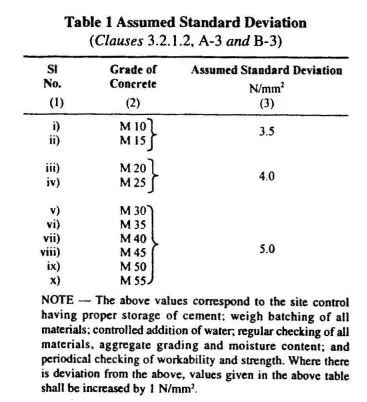
From Table 1 of IS 10262:2009 the standard deviation for M35 grade concrete is
s =, S = 5 N/mm^2
Target mean strength f’ck= 35+(1.65*5)
f’ck= 43.25 N/mm^2
Step 4: Determination of water cement ratio
From Table 5 of IS 456-2000
Exposure condition is Severe
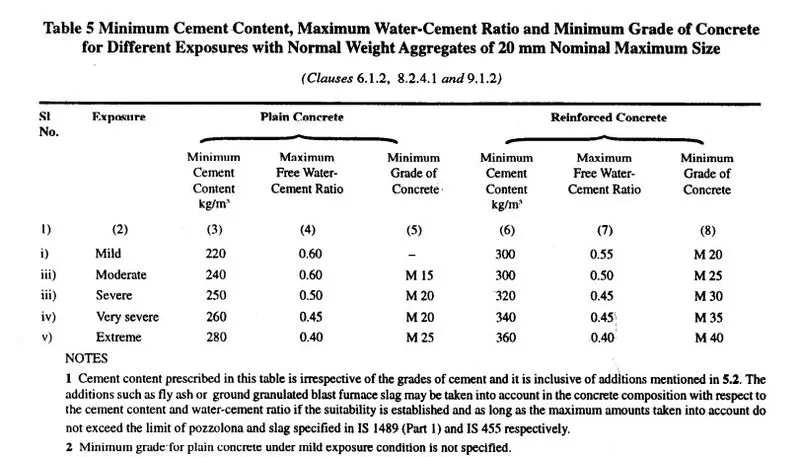
Maximum water-cement ratio : 0.45
Based on the experience, we have adopted water-cement ratio : 0.44
0.44<0.45, hence OK
STEP 5 : Selection of water content
From Table-2 of IS 10262:2009.
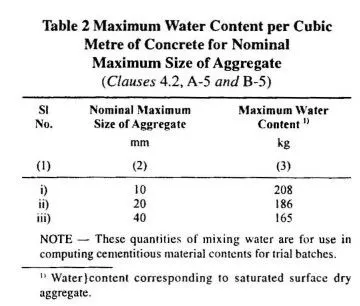
Nominal size of aggregates = 20 mm
maximum water content for 25 to 50 mm slump range =186 litre
Here slump value is 100mm
As per Clause 4.2 .3% of water content must increase for every extra 25 mm slump from 50 mm slump.
Estimated water content for 100 mm slump =186+6/100 x 186
=197 liters
As superplasticizer is used water content is reduced up to 30%
As trail it can be 25%
water content = 197*0.75
= 147 liters
STEP 6 : Calculation of cementitious content (cement + fly ash)
Water cement ratio = 0.44
Water content = 147 liter
Cementitious content (cement + fly ash)= 147/0.44
=334 kg/m^3
From Table 5 of IS 456, Minimum cement content for ‘Severe’ exposure conditions is 320 kg/m^3
334 kg/m^3>320 kg/m^3
Hence ok
cementitious content is increased by 10%
New cementitious content =334*1.10 =367.4kg/m^3
Water content = 147 liter
New water cement ratio =147/367.4
=0.40
Fly ash content is taken as 30% of the total cementitious content=367.4*.3
=110.22
Cement required = 367.4 - 110.22 = 257.18 kg/m^3
Cement quantity saved using fly ash addition = 367.4 - 257.18= 110.22 kg/m^3
Step 7:Calculation of volume of coarse aggregate and fine aggregate
From Table 3 of I.S : 10262-2009 volume of coarse aggregate corresponding tor 20mm size aggregate and for fine aggregate (zone 2) water cement ratio 0.50 = 0.62
In the present case the water-cement ratio we have calculated is 0.40
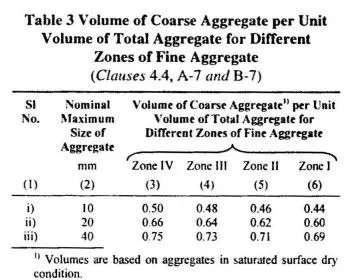
So, the proportion of volume of coarse aggregate is increased by 0.02 (at the rate of ± 0.01 for every ± 0.05 change in water-cement ratio)
So the value is 0.64
For pumpable concrete the value is reduced by 10%
Volume of coarse aggregate=0.64*.9
=0.576
Volume of fine aggregate= 1- 0.576
= 0.424
Step 8:Mix calculation
- a) Volume of concrete = 1 m^3
- b) Volume of cement = Mass of cement/Specific gravity of cement *(1/1000)
= 257.18/3.15*(1/1000)
=0.0815m^3
c)Volume of fly ash =Mass of fly ash/Specific gravity of fly ash *(1/1000)
=110.22/2.20*(1/1000)
=0.0501m^3
- d) Volume of water = Mass of water/Specific gravity of water *(1/1000)
=147/1*(1/1000)
=0.147m^3
- e) Volume of chemical admixtures = Mass of chemical admixture/Specific gravity of water *(1/1000)
=7.348/1.145*(1/1000)
=0.0062m^3
f)volume of aggregate(FA+CA) =a-(b+c+d+e)
=1-(0.0815+.05010+.140+0.0064)
=0.7222 m^3
- g) Mass of coarse aggregates = e × Volume of coarse aggregate × Specific gravity of coarse aggregate × 100
=0.7222 x 0.576 × 2.74 × 1000 =1139.80 kg/m^3
- h) Mass of fine aggregates = e × Volume of fine aggregate × Specific gravity of fine aggregate × 1000
=0.7222 x 0.424 × 2.74 × 1000 =839.02 kg/m^3
STEP 9 : RESULTS
Mix proportion
Cement =257.18kg/m^3
Fly ash =110.22kg/m^3
Water =147kg/m^3
Fine aggregate =839.02 kg/m^3
Coarse aggregates =1139.80 kg/m^3
Chemical admixtures =7.348 kg/m^3
Water cement ratio =0.40
Trail mix ratio =1:2.28:3.10
2.Concrete Mix Design for M50 grade concrete without fly ash
STEP 1: Stipulations for Concrete design mix
Grade designation: M50
Type of cement: OPC 43 grade
Maximum nominal size of aggregate:20mm
Minimum cement content:320 Kg (From Table 5 of IS 456:2000)
Maximum water-cement ratio: 0.45 (From Table 5 of IS 456:2000)
Degree of Workability: 100mm slump
Exposure condition: Sever
Method of concrete placing:Pumping
Degree of supervision: Good
Type of aggregate: Crushed angular aggregate
Maximum cement content: 450 kg/m^3
Chemical admixture type: Superplasticizer
STEP 2:Test Data for Material
Cement used : OPC 43 Grade conforming to IS 8112
Specific gravity of cement : 3.15
Chemical admixture : Super plasticizer conforming to IS 9103
Specific gravity of fly ash : 2.2
Specific gravity of coarse aggregate : 2.74
Specific gravity of fine aggregate : 2.74
Water absorption of coarse aggregate : 0.5%
Water absorption of fine aggregate : 1.0%
Free surface moisture of coarse aggregate : Nil (The aggregate should be in dry condition and doesn't use wet condition)
Free surface moisture of fine aggregate : Nil
Sieve Analysis : Test for coarse aggregate should conforming to Table-2 of IS 383
Sieve Analysis : Test for fine aggregate should conforming to Grading of Zone-II of table-4 of IS 383
Step 3: Determination of Target Strength of concrete
Target mean strength f’ck= fck +(1.65*S)
where
f’ck= target average compressive strength at 28 days
fck = characteristics compressive strength at 28
s = standard deviation
From Table 1 of IS 10262:2009 the standard deviation for M35 grade concrete is
s =, S = 5 N/mm^2
Target mean strength f’ck= 50+(1.65*5)
f’ck= 58.25 N/mm^2
Step 4: Determination of water cement ratio
From Table 5 of IS 456-2000
Exposure condition is Severe
Maximum water-cement ratio : 0.45
Based on the experience, we have adopted water-cement ratio : 0.44
0.44<0.45, hence OK
STEP 5 : Selection of water content
From Table-2 of IS 10262:2009.
Nominal size of aggregates = 20 mm
maximum water content for 25 to 50 mm slump range =186 litre
Here slump value is 100mm
As per Clause 4.2 .3% of water content must increase for every extra 25 mm slump from 50 mm slump.
Estimated water content for 100 mm slump =186+6/100 x 186
=197 liters
As superplasticizer is used water content is reduced up to 20%
As trail it can be 20%
water content = 197*0.80
= 158 liters
STEP 6 : Calculation of cement content
Water cement ratio = 0.44
Water content = 158 liter
Cement content = 158/0.44
=359 kg/m^3
From Table 5 of IS 456, Minimum cement content for ‘Severe’ exposure conditions is 320 kg/m^3
359 kg/m^3>320 kg/m^3
Hence ok
Step 7:Calculation of volume of coarse aggregate and fine aggregate
From Table 3 of I.S : 10262-2009 volume of coarse aggregate corresponding tor 20mm size aggregate and for fine aggregate (zone 2) water cement ratio 0.50 = 0.62
In the present case the water-cement ratio we have calculated is 0.44
So, the proportion of volume of coarse aggregate is increased by 0.02 (at the rate of ± 0.01 for every ± 0.05 change in water-cement ratio)
So the value is 0.632
For pumpable concrete the value is reduced by 10%
Volume of coarse aggregate=0.632*.9
=0.568
Volume of fine aggregate= 1- 0.568
= 0.432
Step 8:Mix calculation
- a) Volume of concrete = 1 m^3
- b) Volume of cement = Mass of cement/Specific gravity of cement *(1/1000)
= 359/3.15*(1/1000)
=0.114m^3
- c) Volume of water = Mass of water/Specific gravity of water *(1/1000)
=158/1*(1/1000)
=0.158m^3
- g) Volume of chemical admixtures = Mass of chemical admixture/Specific gravity of water *(1/1000)
=7.18/1.145*(1/1000)
=0.0062m^3
e)volume of aggregate(FA+CA) =a-(b+c+d)
=1-(0.114+.158+0.0062)
=0.7218m^3
- f) Mass of coarse aggregates = e × Volume of coarse aggregate × Specific gravity of coarse aggregate × 100
=0.7218 x 0.568 × 2.74 × 1000 =1123.35 kg/m^3
- g) Mass of fine aggregates = e × Volume of fine aggregate × Specific gravity of fine aggregate × 1000
=0.7218x 0.432× 2.74 × 1000 =854.38 kg/m^3
STEP 9 : RESULTS
Mix proportion
Cement =359kg/m^3
Water =158kg/m^3
Fine aggregate =854.38 kg/m^3
Coarse aggregates =1123.35 kg/m^3
Chemical admixtures =7.18 kg/m^3
Water cement ratio =0.40
Trail mix ratio =1:2.37:3.129
RESULTS
Mix proportion for M35 grade of concrete with fly ash
Cement =257.18kg/m^3
Fly ash =110.22kg/m^3
Water =147kg/m^3
Fine aggregate =839.02 kg/m^3
Coarse aggregates =1139.80 kg/m^3
Chemical admixtures =7.348 kg/m^3
Water cement ratio =0.40
Trail mix ratio =1:2.28:3.10
Mix proportion for M50 grade of concrete without fly ash
Cement =359kg/m^3
Water =158kg/m^3
Fine aggregate =854.38 kg/m^3
Coarse aggregates =1123.35 kg/m^3
Chemical admixtures =7.18 kg/m^3
Water cement ratio =0.40
Trail mix ratio =1:2.37:3.129
CONCLUSIONS
The Mix ratio for M35 grade of concrete using fly ash is obtained as 1:2.28:3.10(Cement : Fine Aggregate : Coarse Aggregate)
The Mix ratio for M50 grade of concrete 1:2.37:3.129(Cement : Fine Aggregate : Coarse Aggregate)
Using fly ash we can reduce the amount of cement used in the concrete