Stoichiometric Combustion Calculator
Stoichiometric or Theoretical Combustion is the ideal combustion process where fuel is burned completely.
A complete combustion is a process burning all the carbon (C) to (CO2), all the hydrogen (H) to (H2O)
With unburned components in the exhaust gas such as C, H2, CO, the combustion process is uncompleted and not stoichiometric
The combustion process can be expressed:
[C + H (fuel)] + [O2 + N2 (Air)] -> (Combustion Process) -> [CO2 + H2O + N2 (Heat)]
where
C = Carbon
H = Hydrogen
O = Oxygen
N = Nitrogen
To determine the excess air or excess fuel for a combustion system we starts with the stoichiometric air-fuel ratio. The stoichiometric ratio is the perfect ideal fuel ratio where the chemical mixing proportion is correct. When burned all fuel and air is consumed without any excess left over.
Process heating equipment are rarely run that way. "On-ratio" combustion used in boilers and high temperature process furnaces usually incorporates a modest amount of excess air - about 10 to 20% more than what is needed to burn the fuel completely.
If an insufficient amount of air is supplied to the burner, unburned fuel, soot, smoke, and carbon monoxide exhausts from the boiler - resulting in heat transfer surface fouling, pollution, lower combustion efficiency, flame instability and a potential for explosion.
To avoid inefficient and unsafe conditions boilers normally operate at an excess air level. This excess air level also provides protection from insufficient oxygen conditions caused by variations in fuel composition and "operating slops" in the fuel-air control system.
- if air content is higher than the stoichiometric ratio - the mixture is said to be fuel-lean
- if air content is less than the stoichiometric ratio - the mixture is fuel-rich
Creating function file to calculate the stoichiometric co-efficient (ar) for each fuel
1. Function File for Alkane
`C_nH_(2n+2)+ar(O_2+3.76N_2)=aCO_2+bH_2O+cN_2`
Balancing the equation
For C : n=a
For H : 2n+2=2b or n+1=b
For O : ar*2=a*2+b
so, `ar*2=n*2+(n+1)`
therefore, `ar=(3n+1)/2`
For `N_2`
ar*3.76=c
(3n+1)*3.76/2=c
% A function to calculate the stoichiometric co-efficient (ar) for alkane fuel
function ar = alkane_fuel(n)


%(C*n+H*2*n+2)+ar*(O*2+3.76*N*2)==a*(C+O*2)+b*(H*2+O)+c*N*2,ar)

% n = Number of moles of C
% ar = Stoichiometric co-efficient
% a = Number of moles of Carbon-di-oxide
% b = Number of moles of water
% c = Number of moles of nitrogen

% By balancing these equations we get
% For C :
a=n;
% For H : 2n+2=2b
b=n+1;
% For O : ar*2=a*2+b
% so, `ar*2=n*2+(n+1)`
% therefore,
ar=(3*n+1)/2;
% For `N_2`
% ar*3.76=c
c=(3*n+1)*3.76/2;

end
2. Function File for Alkene
`C_nH_(2n)+ar(O_2+3.76N_2)=aCO_2+bH_2O+cN_2`
Balancing the equation
For C : n=a
For H : 2n=2b or n=b
For O : ar*2=a*2+b
so, `ar*2=n*2+(n)`
therefore, `ar=(3n)/2`
For `N_2`
ar*3.76=c
(3n)*3.76/2=c
% A function to calculate the stoichiometric co-efficient (ar) for alkene fuel
function ar = alkene_fuel(n)


%(C*n+H*2*n)+ar*(O*2+3.76*N*2)==a*(C+O*2)+b*(H*2+O)+c*N*2,ar)

% n = Number of moles of C
% ar = Stoichiometric co-efficient
% a = Number of moles of Carbon-di-oxide
% b = Number of moles of water
% c = Number of moles of nitrogen

% By balancing these equations we get
% For C :
a=n;
% For H : 2n=2b
b=n;
% For O : ar*2=a*2+b
% so, `ar*2=n*2+(n)`
% therefore,
ar=(3*n)/2;
% For `N_2`
% ar*3.76=c
c=(3*n)*3.76/2;

end
3. Function File for Alkyne
`C_nH_(2n-2)+ar(O_2+3.76N_2)=aCO_2+bH_2O+cN_2`
Balancing the equation
For C : n=a
For H : 2n-2=2b or n-1=b
For O : ar*2=a*2+b
so, `ar*2=n*2+(n-1)`
therefore, `ar=(3n-1)/2`
For `N_2`
ar*3.76=c
(3n-1)*3.76/2=c
% A function to calculate the stoichiometric co-efficient (ar) for alkyne fuel
function ar = alkyne_fuel(n)


%(C*n+H*2*n-2)+ar*(O*2+3.76*N*2)==a*(C+O*2)+b*(H*2+O)+c*N*2,ar)

% n = Number of moles of C
% ar = Stoichiometric co-efficient
% a = Number of moles of Carbon-di-oxide
% b = Number of moles of water
% c = Number of moles of nitrogen

% By balancing these equations we get
% For C :
a=n;
% For H : 2n-2=2b
b=n-1;
% For O : ar*2=a*2+b
% so, `ar*2=n*2+(n-1)`
% therefore,
ar=(3*n-1)/2;
% For `N_2`
% ar*3.76=c
c=(3*n-1)*3.76/2;

end
MATLAB PROGRAM FOR STIOCHIOMETRIC COMBUSTION CALCULATOR
Here, we are going to use all the functions of fuels to generate plots for different values of n
% A program that calculates stoichiometric co-efficient for different
% values of carbon atoms for alkanes, alkenes, and alkynes

clc % clears the command window
clear %clears the workspace
close all % closes the window


for n=1:10

    alkane_ar(n)=alkane_fuel(n);
    alkene_ar(n)=alkene_fuel(n);
    alkyne_ar(n)=alkyne_fuel(n);
    m(n)=n;
end
hold on
plot(m,alkane_ar,'red')
plot(m,alkene_ar,'green')
plot(m,alkyne_ar,'blue')
legend('alkane','alkene','alkyne');
ylabel('Stoichiometric Co-efficient');
xlabel('No. of Carbon atoms');
OUTPUT :
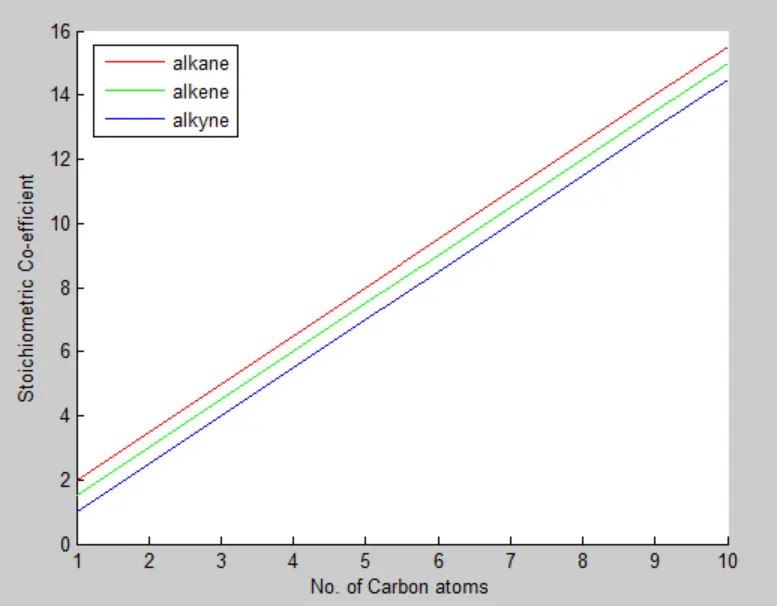
As we can see that there is linear relationship between the variables that is ar & n and it was also clear from the equation of the relation.