Stoichiometric Coefficient for combustion Estimation, with respect to No. of Moles of Carbon & Alkanes, Alkenes,& Alkynes (ITCFDUML&OF/Challenge/Week3.1)
AIM -
1. Write a function to calculate the stoichiometric co-efficient (ar) for each fuel
2. Show a plot that compares the effect of number of atoms of carbon on the stoichiometric co-efficient "ar". Compare how this trend changes with the fuel type (alkane, alkene and alkyne)
THEORY -
Stoichiometric combustion is a theoretical position in which the optimal amount of oxygen and fuel mix generates the most heat possible, and maximum combustion efficiency is achieved. There are no unburnt combustibles and no excess air. A stoichiometric ratio is neither too rich nor too lean. lt contains just enough oxygen to burn all the fuel.
Stoichiometric combustion offers an easy way to understand combustion concepts. When fuel and air mix they produce products as `CO_2`, CO, OH, `H_2O`, NO, `N_2 O` and many more. In stoichiometric combustion we make a simple assumption that the by products are only `CO_2`, `H_2 O` and `N_2`.
For a generic alkane fuel the combustion process will following the below equation,
`C_n H_(2n+2) + ar(o_2 + 3.76N_2) = aCo_2 + bH_2O + CN_2`
Here
n = Number of moles of C
ar = Stoichiometric co-efficient
a = Number of moles of Carbon-di-oxide
b = Number of moles of water
c = Number of moles of nitrogen
Stoichiometric Coefficients
In a balanced reaction, both sides of the equation have the same number of elements. The stoichiometric coefficient is the number written in front of atoms, ion and molecules in a chemical reaction to balance the number of each element on both the reactant and product sides of the equation. Though the stoichiometric coefficients can be fractions, whole numbers are frequently used and often preferred.
Alkanes, Alkenes & Alkynes
Alkanes are Hydrocarbons / i.e. organic compounds that consist of single-bonded carbon and hydrogen atoms. Alkanes are family of hydrocarbons that represent by the Molecular formula - `C_n H_(2n+2)`
Alkenes are organic compounds that consist of Double-bonded carbon and Single-bonded hydrogen atoms. Alkanes are family of hydrocarbons that represent by the Molecular formula - `C_n H_(2n)`
Alkynes are Hydrocarbons / i.e. organic compounds that consist of Triple-bonded carbon and Single bond with hydrogen atoms. Alkanes are family of hydrocarbons that represent by the Molecular formula - `C_n H_(2n-2)`
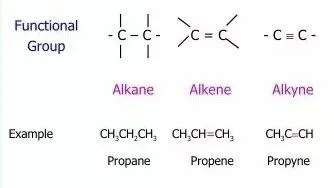
Now, analyzing the Stoichiometric Combustion for Alkanes, Alkenes and Alkynes and getting the Stoichiometric Coefficients -
For Alkanes -
`C_n H_(2n+2) + ar(o_2 + 3.76N_2) = aCo_2 + bH_2O + CN_2`
Reaction Balancing of moles of each element -
i) Carbon, n = a
ii) Hydrogen, 2n+2 = 2b
iii) Oxygen, 2ar = 2a+b
iv) Nitrogren, ar*3.76*2 = 2c
From the relations, subsitituting (i) & (ii), in (iii),
We get the Stoichiometric Coefficient for Alkanes, `ar = (3n+1)/2`
For Alkenes -
`C_n H_(2n) + ar(o_2 + 3.76N_2) = aCo_2 + bH_2O + CN_2`
Reaction Balancing of moles of each element -
i) Carbon, n = a
ii) Hydrogen, 2n = 2b
iii) Oxygen, 2ar = 2a+b
iv) Nitrogren, ar*3.76*2 = 2c
From the relations, subsitituting (i) & (ii), in (iii),
We get the Stoichiometric Coefficient for Alkenes, `ar = (3n)/2`
For Alkynes -
`C_n H_(2n-2) + ar(o_2 + 3.76N_2) = aCo_2 + bH_2O + CN_2`
Reaction Balancing of moles of each element -
i) Carbon, n = a
ii) Hydrogen, 2n-2 = 2b
iii) Oxygen, 2ar = 2a+b
iv) Nitrogren, ar*3.76*2 = 2c
From the relations, subsitituting (i) & (ii), in (iii),
We get the Stoichiometric Coefficient for Alkynes, `ar = (3n-1)/2`
PROGRAM -
Code logic -
- For showing change with respect no. of moles of carbon, we gonna consider a array of no.s [1-20] of the no. of the moles of the carbon(n). and plot it against the Stoichiometric Coefficient(ar).
- Also, we have to see the differences in 'Stoichiometric Coefficient vs No. of moles of carbon' characteristic for the alkanes,alkenes and alkynes, And plot them. For these we are gonna use the above equations we obtained for the Stoichiometric Coefficients of them -
for Alkanes, `ar = (3n+1)/2`
for Alkenes, `ar = (3n)/2`
for Alkynes, `ar = (3n-1)/2`
From using the For Loop we can evaluate the equations and generate Resultant Stoichiometric Coefficient array for each of them (ar_alka[ ], ar_alke[ ], ar_alky[ ]) by the input of the no. of the carbon mole array(n[]).
The following is the Main Function -
close all;
clear all;
clc

n = 1:20;       % No. of Moles of Carbon

for i = 1:length(n)

    ar_alka(i) = ((3*n(i))+1)/2 ;       % Stoichiometric Coefficients for Alkanes
    ar_alke(i) = (3*n(i))/2  ;          % Stoichiometric Coefficients for Alkenes
    ar_alky(i) = (3*n(i)-1)/2  ;        % Stoichiometric Coefficients for Alkynes

end


% plotting the Stoichiometric Coefficient vs No. of moles of carbon

plot(n,ar_alka,'color','r','lineWidth',2);
hold on;
grid on;
plot(n,ar_alke,'color','g','lineWidth',2);
plot(n,ar_alky,'color','b','lineWidth',2);
xlabel(' No. of Moles of Carbon ');
ylabel(' Stoichiometric Coefficient (ar)');
legend('Stoichiometric Coefficients for Alkanes','Stoichiometric Coefficients for Alkenes','Stoichiometric Coefficients for Alkynes');
OUTPUT :
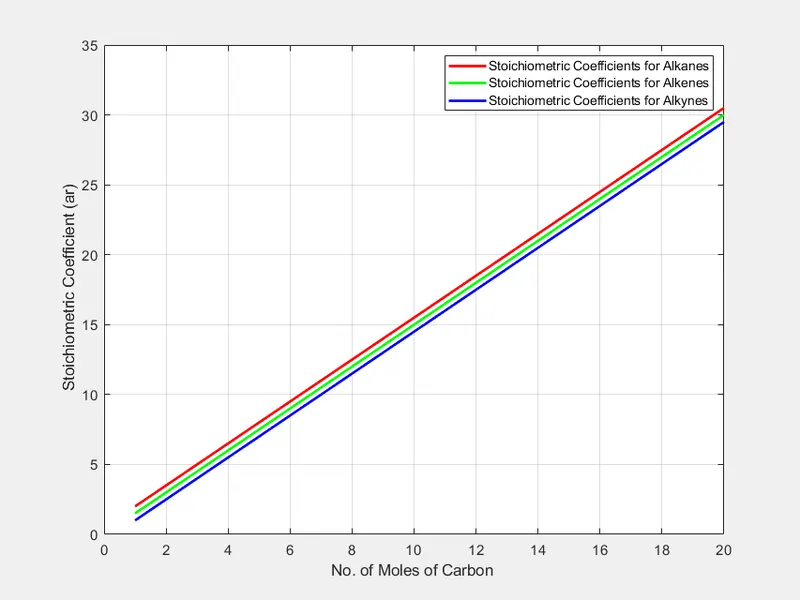
Result and Conclusion -
- From the output plot we can see the linear characteristic, the Stoichiometric Coefficient increases linearly with the increase of no. of moles of carbon. And this characteristics is same for the alkanes, alkenes and alkynes.
- We can observe the values of stoichiometric Coeff.s of Alkanes > Alkenes > Alkynes, throughout the range of no. of moles.
- Since the Stoichiometric Coefficient relates to the sufficient required amount of moles of oxygen for the combustion, we can see that the Alkynes stoichiometric Coeff.s were below the both of Alkanes & Alkenes. Therefore, for the combustion of alkynes the no. of moles oxygen are required less compared to both alkanes and alkenes.