Stability Analysis in Unsteady(Transient) State problem
Stability Analysis in the unsteady(Transient) problem:
To study: Effect of time step dt on stability of the solution of 2D heat conduction equation for both implict and explicit schemes
In solving a unsteady state,the problem is that the solution changes with time that means the temp values change with time i.e `frac{delT}{delt}` and become stable after some particular time`
Transient 2D heat conduction equation
`frac{delT}{delt}=alpha[frac{del^2T}{delx^2}+frac{del^2T}{dely^2}]`
CFL (courant-Friedrichs-lewy) is an essential condition in solving the partial differential equation. CFL number is controlled by altering the space interval and time interval.
CFL for Transient problem CFL<=0.5 solution is stable.
CFL>0.5 solution is unstable only for explicit scheme
so in explicit scheme
`k1=alphafrac{Deltat}{Deltax^2} ;k2=alphafrac{Deltat}{Deltay^2}`
Transient problem:
we have two schemes to solve and check for stability for time steps:
- Implicit scheme- in this the values are not knowns so we use iterative techniques to find out the values.
Jacobi method
Gauss siedel method
Successive over-relaxation method
- Explicit scheme- In this we do not use any of the above methods as we know the values.
stable solution:
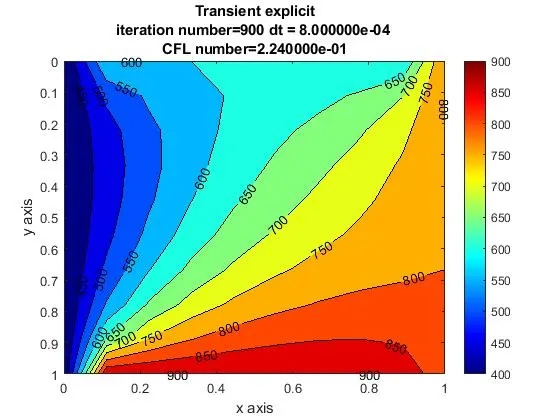
for dt=0.0008 and `alpha=1.4`the CFL number is 0.224 ;since its less tha 0.5 the solutuion is stable for 900 iterations.
code for explicit transient problem
clear all
close all
clc
%inputs
n=10;
x=linspace(0,1,n);
y=linspace(0,1,n);
dx = 0.1;
dy = 0.1;
dt=0.0008;
alpha=1.4;
k1=(alpha*dt)/dx^2;
k2=(alpha*dt)/dy^2;
CFL=k1+k2;
T = ones(n);
nt=900;

%boundary conditions
T(1,1:n) = 600;%top bc
T(n,1:n) = 900; %bottom bc
T(1:n,1) = 400;%left bc
T(1:n,n) = 800;%right bc
Told=T;
iterative_solver = 1;
tol=1e-4;

tic;

 for v=1:nt
     for i = 2:n-1
        for j = 2:n-1

     term1=Told(i,j);
     term2=k1*(Told(i-1,j) - 2*Told(i,j)+ Told(i+1,j));
     term3=k2*(Told(i,j-1) - 2*Told(i,j)+ Told(i,j+1));
     T(i,j)=(term1+term2+term3);
    end
  end
   Told=T;
    end

 c= toc;

figure(1)
[P,Q]=contourf(x,y,T);
clabel(P,Q)
colormap('jet');
colorbar;
axis ij;
xlabel('x axis')
ylabel('y axis')
title_text1=sprintf('Transient explicit');
title_text2=sprintf('iteration number=%d dt = %s ',nt,dt);
title_text3=sprintf('CFL number=%s',CFL);
title({title_text1,title_text2,title_text3});
Output plot
Unstable solution :
The solution becomes unstable for the explicit transient problem after certain time steps:
parameters: for `dt=0.002`,`alpha=1.4` the CFL comes out to be `CFL=0.56` the solution becomes unstable.
code :
clear all
close all
clc
%inputs
n=10;
x=linspace(0,1,n);
y=linspace(0,1,n);
dx = 0.1;
dy = 0.1;
dt=0.002;
alpha=1.4;
k1=(alpha*dt)/dx^2;
k2=(alpha*dt)/dy^2;
CFL=k1+k2;
T = ones(n);
nt=900;

%boundary conditions
T(1,1:n) = 600;%top bc
T(n,1:n) = 900; %bottom bc
T(1:n,1) = 400;%left bc
T(1:n,n) = 800;%right bc
Told=T;
iterative_solver = 1;
tol=1e-4;

tic;

 for v=1:nt
     for i = 2:n-1
        for j = 2:n-1

     term1=Told(i,j);
     term2=k1*(Told(i-1,j) - 2*Told(i,j)+ Told(i+1,j));
     term3=k2*(Told(i,j-1) - 2*Told(i,j)+ Told(i,j+1));
     T(i,j)=(term1+term2+term3);
    end
  end
   Told=T;
    end

 c= toc;

figure(1)
[P,Q]=contourf(x,y,T);
clabel(P,Q)
colormap('jet');
colorbar;
axis ij;
xlabel('x axis')
ylabel('y axis')
title_text1=sprintf('Transient explicit');
title_text2=sprintf('iteration number=%d dt = %s ',nt,dt);
title_text3=sprintf('CFL number=%s',CFL);
title({title_text1,title_text2,title_text3});
Plot for Unstable solution:
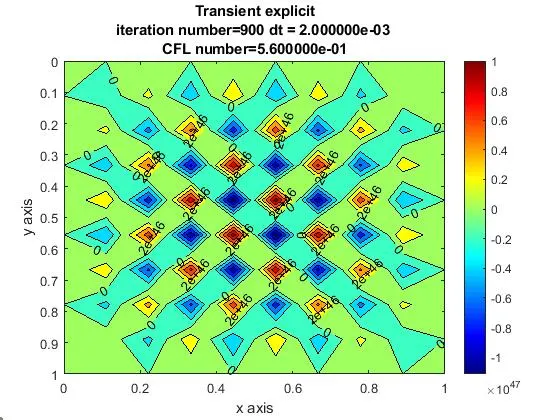
The plot shows that for time step of 0.002 , alpha=1.4 and CFL of 0.56 the solution becomes unstable
Implicit method:
these methods are exceptionally stable than that of explicit . even for step size of 0.3 and alpha of 1.4 these have a stable solution
Stability in Jacobi:
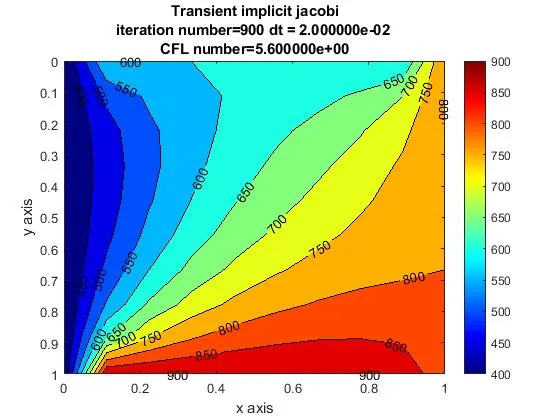
step size dt=0.02,alpha=1.4 the CFL comes out to be CFL=0.56 for nt=900 iteration.
code:
clear all
close all
clc
%inputs
n=10;
x=linspace(0,1,n);
y=linspace(0,1,n);
dx = 0.1;
dy = 0.1;
dt=0.02;
alpha=1.4;
k1=(alpha*dt)/dx^2;
k2=(alpha*dt)/dy^2;
term1=(1/(2*k1+2*k2));
term2=k1*term1;
term3=k2*term1;
CFL=k1+k2;
T = ones(n);
nt=900;

%boundary conditions
T(1,1:n) = 600;%top bc
T(n,1:n) = 900; %bottom bc
T(1:n,1) = 400;%left bc
T(1:n,n) = 800;%right bc
Told=T;
T_prev=Told;
tol=1e-4;

tic;

 for v=1:nt
     for i = 2:n-1
        for j = 2:n-1

     H=(Told(i-1,j)+Told(i+1,j));
     V=(Told(i,j-1)+Told(i,j+1));
     T(i,j)=(term1*T_prev(i,j)) + (term2*H) + (term3*V);
    end
  end
   Told=T;
    end

 c= toc;

figure(1)
[P,Q]=contourf(x,y,T);
clabel(P,Q)
colormap('jet');
colorbar;
axis ij;
xlabel('x axis')
ylabel('y axis')
title_text1=sprintf('Transient implicit jacobi');
title_text2=sprintf('iteration number=%d dt = %s ',nt,dt);
title_text3=sprintf('CFL number=%s',CFL);
title({title_text1,title_text2,title_text3});
pause(0.3)
Stability in Gauss siedel:
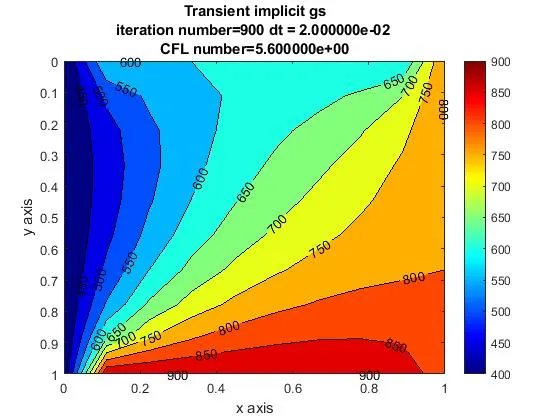
step size dt=0.02,alpha=1.4 the CFL comes out to be CFL=0.56 for nt=900 iteration.
code:
clear all
close all
clc
%inputs
n=10;
x=linspace(0,1,n);
y=linspace(0,1,n);
dx = 0.1;
dy = 0.1;
dt=0.02;
alpha=1.4;
k1=(alpha*dt)/dx^2;
k2=(alpha*dt)/dy^2;
term1=(1/(2*k1+2*k2));
term2=k1*term1;
term3=k2*term1;
CFL=k1+k2;
T = ones(n);
nt=900;

%boundary conditions
T(1,1:n) = 600;%top bc
T(n,1:n) = 900; %bottom bc
T(1:n,1) = 400;%left bc
T(1:n,n) = 800;%right bc
Told=T;
T_prev=Told;
tol=1e-4;

tic;

 for v=1:nt
     for i = 2:n-1
        for j = 2:n-1

     H=(T(i-1,j)+Told(i+1,j));
     V=(T(i,j-1)+Told(i,j+1));
     T(i,j)=(term1*T_prev(i,j)) + (term2*H) + (term3*V);
    end
  end
   Told=T;
    end

 c= toc;

figure(1)
[P,Q]=contourf(x,y,T);
clabel(P,Q)
colormap('jet');
colorbar;
axis ij;
xlabel('x axis')
ylabel('y axis')
title_text1=sprintf('Transient implicit gs');
title_text2=sprintf('iteration number=%d dt = %s ',nt,dt);
title_text3=sprintf('CFL number=%s',CFL);
title({title_text1,title_text2,title_text3});
pause(0.3)
Stability in SOR:
step size dt=0.02,alpha=1.4 the CFL comes out to be CFL=0.56 for nt=900 iteration.
code:
clear all
close all
clc
%inputs
n=10;
w=1.3;
x=linspace(0,1,n);
y=linspace(0,1,n);
dx = 0.1;
dy = 0.1;
dt=0.3;
alpha=1.4;
k1=(alpha*dt)/dx^2;
k2=(alpha*dt)/dy^2;
term1=(1/(2*k1+2*k2));
term2=k1*term1;
term3=k2*term1;
CFL=k1+k2;
T = ones(n);
nt=900;

%boundary conditions
T(1,1:n) = 600;%top bc
T(n,1:n) = 900; %bottom bc
T(1:n,1) = 400;%left bc
T(1:n,n) = 800;%right bc
Told=T;
T_prev=Told;
tol=1e-4;

tic;

 for v=1:nt
     for i = 2:n-1
        for j = 2:n-1

     H=(T(i-1,j)+Told(i+1,j));
         V=(T(i,j-1)+Told(i,j+1));
         T(i,j)=(1-w)*Told(i,j) + w*((term1*T_prev(i,j)) + (term2*H) + (term3*V));
       end
  end
   Told=T;
    end

 c= toc;

figure(1)
[P,Q]=contourf(x,y,T);
clabel(P,Q)
colormap('jet');
colorbar;
axis ij;
xlabel('x axis')
ylabel('y axis')
title_text1=sprintf('Transient implicit SOR');
title_text2=sprintf('iteration number=%d dt = %s ',nt,dt);
title_text3=sprintf('CFL number=%s',CFL);
title({title_text1,title_text2,title_text3});
pause(0.3)
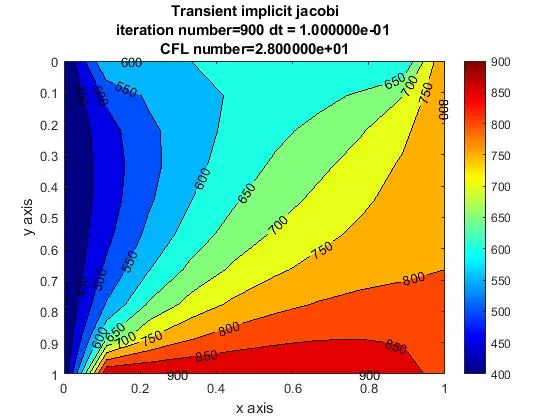
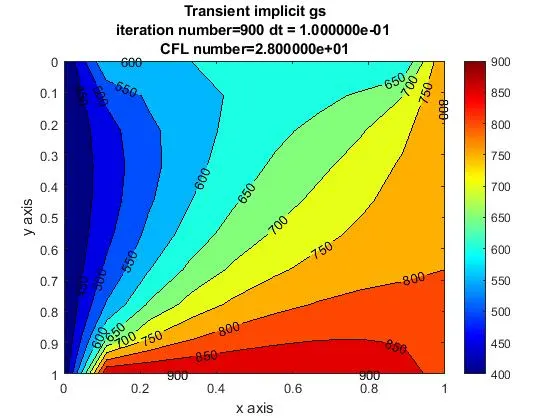
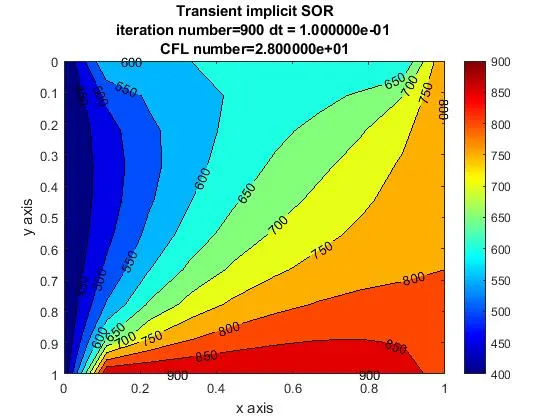
output plot for jaccobi,Gauss siedel and SOR for nt=900,alpha=1.4:
code for different implicit scheme for nt=900,dt=0.1; the CFL=28
jacobi code:
clear all
close all
clc
%inputs
n=10;
x=linspace(0,1,n);
y=linspace(0,1,n);
dx = 0.1;
dy = 0.1;
dt=0.1;
alpha=1.4;
k1=(alpha*dt)/dx^2;
k2=(alpha*dt)/dy^2;
term1=(1/(2*k1+2*k2));
term2=k1*term1;
term3=k2*term1;
CFL=k1+k2;
T = ones(n);
nt=900;
%boundary conditions
T(1,1:n) = 600;%top bc
T(n,1:n) = 900; %bottom bc
T(1:n,1) = 400;%left bc
T(1:n,n) = 800;%right bc
Told=T;
T_prev=Told;
tol=1e-4;
tic;

 for v=1:nt
     for i = 2:n-1
        for j = 2:n-1

     H=(Told(i-1,j)+Told(i+1,j));
     V=(Told(i,j-1)+Told(i,j+1));
     T(i,j)=(term1*T_prev(i,j)) + (term2*H) + (term3*V);
    end
  end
   Told=T;
    end
c= toc;
 figure(1)
[P,Q]=contourf(x,y,T);
clabel(P,Q)
colormap('jet');
colorbar;
axis ij;
xlabel('x axis')
ylabel('y axis')
title_text1=sprintf('Transient implicit jacobi');
title_text2=sprintf('iteration number=%d dt = %s ',nt,dt);
title_text3=sprintf('CFL number=%s',CFL);
title({title_text1,title_text2,title_text3});
code for Gauss sidel:
clear all
close all
clc
%inputs
n=10;
x=linspace(0,1,n);
y=linspace(0,1,n);
dx = 0.1;
dy = 0.1;
dt=0.1;
alpha=1.4;
k1=(alpha*dt)/dx^2;
k2=(alpha*dt)/dy^2;
term1=(1/(2*k1+2*k2));
term2=k1*term1;
term3=k2*term1;
CFL=k1+k2;
T = ones(n);
nt=900;

%boundary conditions
T(1,1:n) = 600;%top bc
T(n,1:n) = 900; %bottom bc
T(1:n,1) = 400;%left bc
T(1:n,n) = 800;%right bc
Told=T;
T_prev=Told;
tol=1e-4;

tic;

 for v=1:nt
     for i = 2:n-1
        for j = 2:n-1

     H=(T(i-1,j)+Told(i+1,j));
     V=(T(i,j-1)+Told(i,j+1));
     T(i,j)=(term1*T_prev(i,j)) + (term2*H) + (term3*V);
    end
  end
   Told=T;
    end

 c= toc;

figure(1)
[P,Q]=contourf(x,y,T);
clabel(P,Q)
colormap('jet');
colorbar;
axis ij;
xlabel('x axis')
ylabel('y axis')
title_text1=sprintf('Transient implicit gs');
title_text2=sprintf('iteration number=%d dt = %s ',nt,dt);
title_text3=sprintf('CFL number=%s',CFL);
title({title_text1,title_text2,title_text3});
code for SOR:
clear all
close all
clc
%inputs
n=10;
w=1.3;
x=linspace(0,1,n);
y=linspace(0,1,n);
dx = 0.1;
dy = 0.1;
dt=0.1;
alpha=1.4;
k1=(alpha*dt)/dx^2;
k2=(alpha*dt)/dy^2;
term1=(1/(2*k1+2*k2));
term2=k1*term1;
term3=k2*term1;
CFL=k1+k2;
T = ones(n);
nt=900;

%boundary conditions
T(1,1:n) = 600;%top bc
T(n,1:n) = 900; %bottom bc
T(1:n,1) = 400;%left bc
T(1:n,n) = 800;%right bc
Told=T;
T_prev=Told;
tol=1e-4;

tic;

 for v=1:nt
     for i = 2:n-1
        for j = 2:n-1

     H=(T(i-1,j)+Told(i+1,j));
         V=(T(i,j-1)+Told(i,j+1));
         T(i,j)=(1-w)*Told(i,j) + w*((term1*T_prev(i,j)) + (term2*H) + (term3*V));
       end
  end
   Told=T;
    end

 c= toc;

figure(1)
[P,Q]=contourf(x,y,T);
clabel(P,Q)
colormap('jet');
colorbar;
axis ij;
xlabel('x axis')
ylabel('y axis')
title_text1=sprintf('Transient implicit SOR');
title_text2=sprintf('iteration number=%d dt = %s ',nt,dt);
title_text3=sprintf('CFL number=%s',CFL);
title({title_text1,title_text2,title_text3});
output plot for nt=900,dt=0.1; the CFL=28:
Explanation for code:
- declare nodes n,x axis and yaxis,dx,dy,alpha,omega in case of SOR.
- write the equation for k1,k2 and CFL
- declare the boundary conditions
- set Told=T and Tprev =Told.
- initiate a for loop for nt ,another two for i,j
- write the descritized eqaution for individual methods.
- close the for loop and increment the counter.
- set again Told=T
- plot the coutour for each indivual schemes and methods.
Explanation for results/plots:
The solution become unstable for explicit at dt=0.002 ,alpha=1.4 as CFL is 0.56.
As the CFL>0.5 the solution becomes unstable for transient explicit scheme.
Implicit schemes are exceptionally stable for larger time steps.
for dt=0.02,alpha=1.4, CFL=0.56 the solution is stable for implicit scheme in transient state.
Even for a larger time step dt=0.1, alpha =1.4 ,CFL=28 the solution is exceptionally stable for implicit scheme in transient state.
conclusion:
So CFL number plays a vital role in determining the stability of solution depending on the methods and schemes used.