Section modulus
section modulus is ageometric property for a given cross secton used in the design of beam or members, its also at the polar modulus or the torsional section modulus .in other case geometric are used to the design included area for the tension and shear ,radius of gyration foe compression and moment of inertia and polar moment of interia stiffness. there are two types of the modulus are given and that are elatic and plastic modulus.
s=I/Y
Here
s=section modulus
I=MOMENT OF INERTIA (UNIT mm4)
Y=distance from the neutral axis to the extreme end(unit mm)
the unit of "section modulus" is(mm 3)
section modulus is two types
1.elastic modulus
2.plastic modulus
1.elastic modulus
the elastic design modulus is used, applying up to the yeild point for most metal and other common material.
The elastic section modulus is defined as the ratio of the second moment of area (or moment of inertia) and the distance from the neutral axis to any given (or extreme) fiber. It can also be defined in terms of the first moment of area.
Elastic section modulus is calculated when we are to use the material behavior till the yield point.
For general design purposes, we use elastic section modulus.
Generally, elastic section modulus is denoted by Zₑ.
So,
Zₑ = I/ymax
Where,
I = Moment of inertia
ymax = Distance from NA to extreme layer
Elastic Section Modulus of Different Section
There are following different elastic section modulus:
Rectangular Section
As we know the moment of inertia of the rectangular section,
I = bd³/12
And the distance from the neutral axis,
ymax = d/2
So,
Zₑ = I/ymax
Zₑ = (bd³/12)/(d/2)
After calculating them,
Section modulus of rectangular section,
Zₑ = bd²/6
Hollow Rectangular Section
As we know the moment of inertia of the hollow rectangular section,
I = (BD³/12) - (bd³/12)
ymax = D/2
After putting these values,
Zₑ = I/ymax
(BD³/12) - (bd³/12)/(D/2)
Zₑ = (BD³ - bd³)/6D
Solid Circular
For solid Circular moment of inertia,
I = (π/64) × d⁴
ymax = d/2
Then,
Zₑ = {(π/64) × d⁴}/(d/2)
After calculating then find values of section modulus of solid circular
Zₑ = (π/32) × d³
Hollow Circular
The moment of inertia of hollow Circular,
I = (π/64) × (D⁴ - d⁴)
And,
ymax = D/2
After putting these values,
Zₑ = (π/64) × (D⁴ - d⁴)/(D/2)
Zₑ = π/32 × {(D⁴ - d⁴)/D}
Symmetric I & C Section
Moment of inertia for the I & C section,
I = (BD³/12) - {(B - b)d³}/12
ymax = D/2
So,
Zₑ = [(BD³/12) - {(B - b)d³}/12]/(D/2)
Zₑ = {BD³ - (B - b)d³}/6D
Diamond
Elastic section modulus for diamond is,
Zₑ = bd²/24
plastic section modulus
THE plastic section modulus is used to the where the elastic yielding is acceptable and plastic behavior is assummed to be an acceptable limit. the plastic section modulus is depends on the plastic neutral axis . The PNA is the axix spilts the cross section such that compression force from the area in compression equal the tension froce from the area in tension .
FRIST DESIGN STUDY
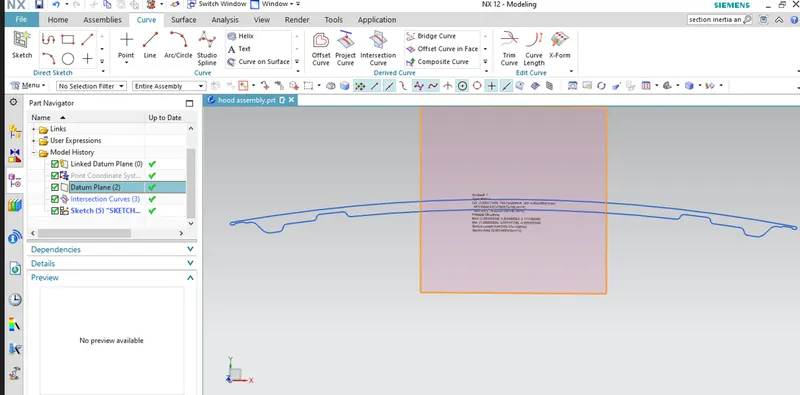
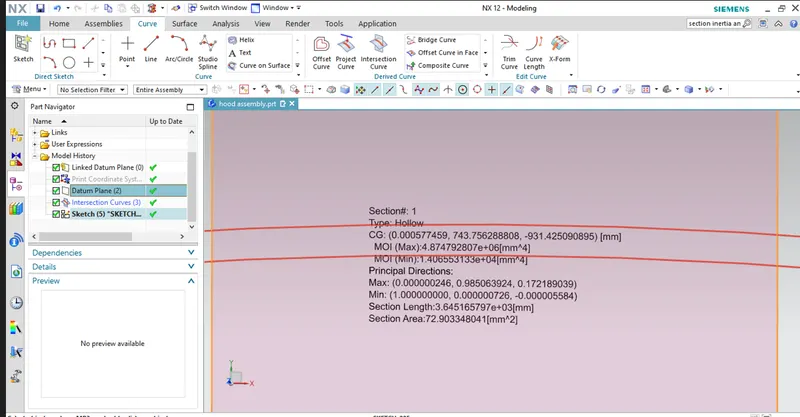
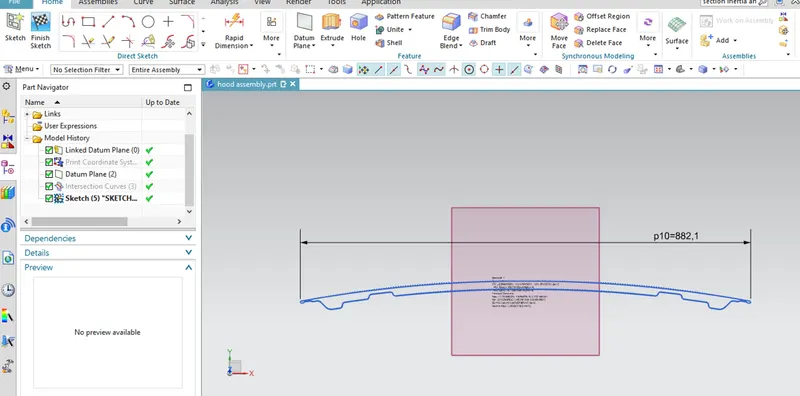
The intersection of the design was taken and section inertia Analysis was done
moment of inertia (max)= 4.8747*10^6*mm^4
moment of inertia(min)=1.40655*10^4*mm^4
Y=882.1/2=441.05mm
S=I/Y
S=1.40655*10^4/441.05=31.89mm^4
HOOD DESIGN OPTIMIZATION
By increasing the depth of the inner panel by 0.5 mm
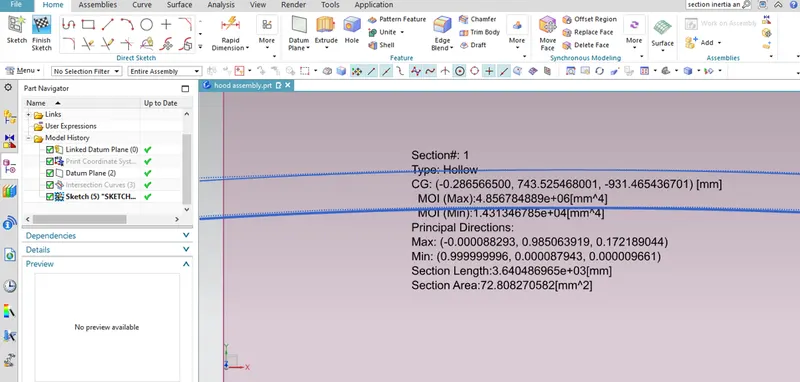
Here
moment of inertia (max)= 4.8747*10^6*mm^4
moment of inertia(min) = 1.4313*10^4*mm^4
Y=882.1/2=441.05mm
S=I/Y
S=1.4313*10^4/441.05=32.45mm
conclusion
So ,here the difference can be seen in the moment of inertia and change in the section modulus can be seen by the change in the design (depth).