Section Modulus calculation and optimization
OBJECTIVE
To find section modulus of the designed hood using NX CAD and tabulating the resultant inertia using formula.
To create a new design that would improve the section modulus of the designed hood thus obtaining optimized result.
INTRODUCTION
Section modulus is a geometric property for a given cross-section that is used in the design of beams and flexural members. A beam or flexural member will be stronger and capable of supporting greater load if it has a higher section modulus than the other. It is defined as the ratio of the moment of inertia of a section about its centroidal axis and to the distance of the extreme end from the neutral axis. The unit of section modulus is mm³.
`S=I/y_max`
Where,
- S = section modulus (mm3)
- I = moment of inertia (mm⁴)
- y = distance from neutral axis to extreme end (mm)
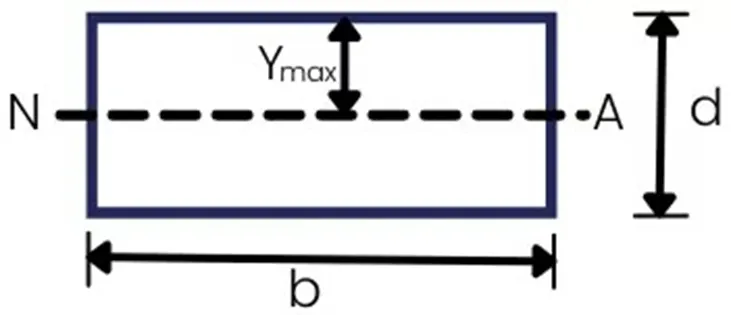
From bending stress equation, it is used to determine the yield moment (M):
`M/I=σ_max/y_max`
`M=σ_max×(I/y_max)`
`M=σ_max×S`
There are two types of section modulus:
- Elastic Section Modulus
- Plastic Section Modulus
Elastic Section Modulus
The elastic section modulus is a single parameter that measures a cross section’s strength in bending. The elastic section modulus is used for general design applications.
Plastic Section Modulus
The plastic section modulus is used for materials where the elastic yield is acceptable, and the plastic behaviour is considered to be in an acceptable range. It depends on the location of the plastic neutral axis.
CALCULATION AND OPTIMIZATION OF SECTION MODULUS OF DESIGNED HOOD
For the calculation of section modulus from the designed hood, we need to take the cross-sectional sketch of hood outer panel and inner panel. Using NX CAD we can obtain the intersection curve and taken the y distance of the hood. From the hood intersection curve, we can find the inertia using the Section Inertia Analysis tool in NX CAD.
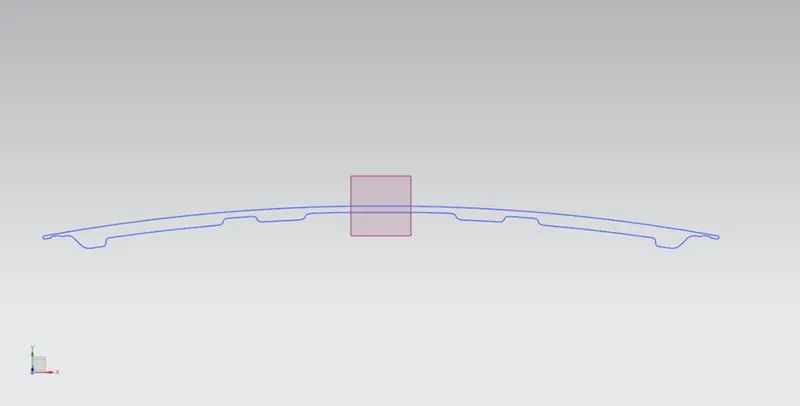
Tabulation
The section modulus is calculated using the given formula
`S=I/y_max`
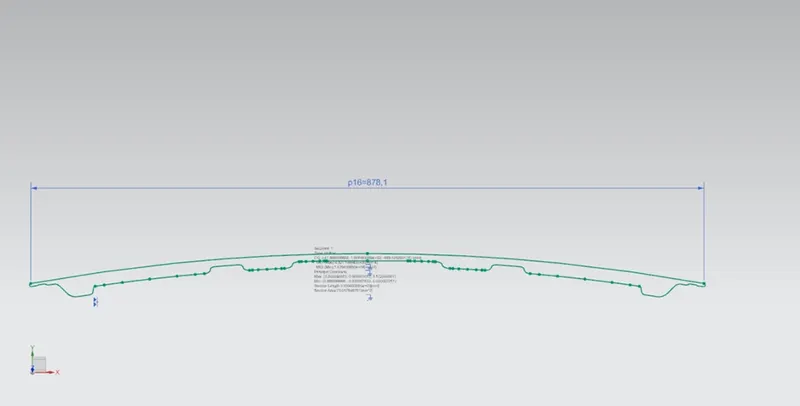
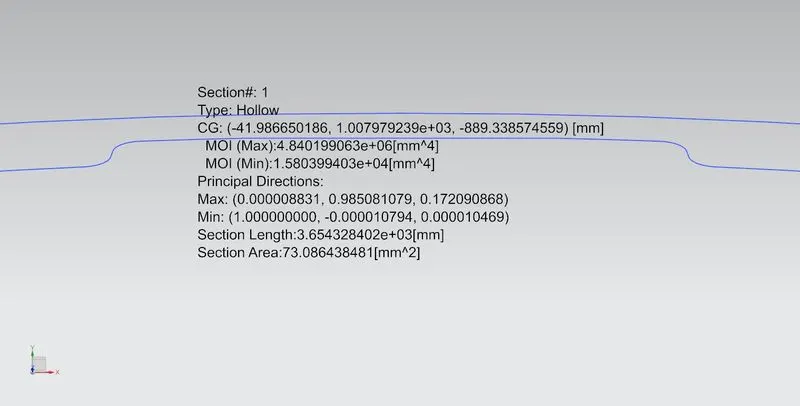
Here,
- Imax =4.840199063×106 mm4
- Imin = 1.580399403×104 mm4
- `y=L/2=878.1/2=439.05 mm`
`S_max=(4.840199063×10^6)/439.05=11.024×10^3 〖mm〗^3`
`S_min=(1.580399403×10^4)/439.05=35.99 〖mm〗^3`
Optimization of Hood Design
By offsetting the inner panel section of hood with 0.5 mm and analysing the moment of inertia we get the results as follows,
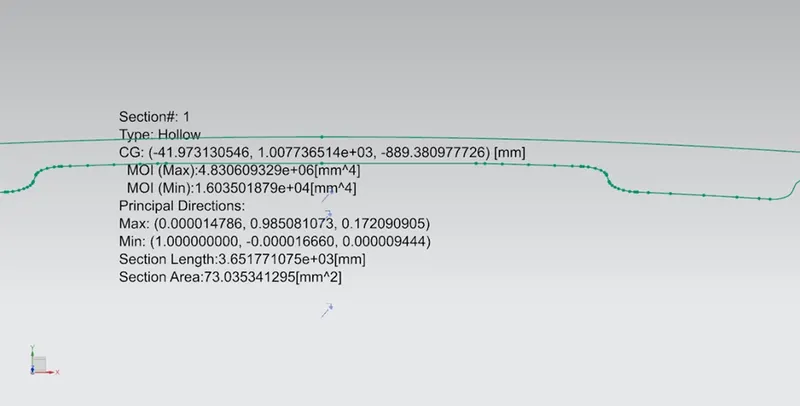
- Imax =4.830609329×106 mm4
- Imin = 1.603501879×104 mm4
- `y=L/2=878.1/2=439.05 mm`
`S_max=(4.830609329×10^6)/439.05=11.002×10^3 〖mm〗^3`
`S_min=(1.603501879×10^4)/439.05=36.52 〖mm〗^3`
Thus, the section modulus of hood has been increased and optimized, Smin 35.99 mm3 is and the optimized Smin is 36.52 mm3, considering the minimum Moment of Inertia.
CONCLUSION
In order to find the better result, the section modulus of designed hood of a car was calculated and compared with an optimised model of same. Based on the findings, we can infer that offsetting the inner panel's cross-section downward by 0.5 mm would result in a higher section modulus, which would increase the hood strength and.