Section Modulus calculation and optimization of Hood
Problem Statement:
1. Determine the Section Modulus of the designed Hood
2. Create a new design with an improved section modulus.
Section Modulus
Section modulus is a geometric property for a given cross-section used in the design of beams or flexural members.
There are two types of section moduli, the elastic section modulus, and the plastic section modulus.
Elastic Section Modulus
The elastic section modulus is used, applying up to the yield point for most metals and other common materials.
Plastic Section Modulus
The plastic section modulus is used for materials where elastic yielding is acceptable and plastic behavior is assumed to be an acceptable limit. Designs generally strive to ultimately remain below the plastic limit to avoid permanent deformations, often comparing the plastic capacity against amplified forces or stresses.
Significance of Section Modulus:
1. Higher the section Modulus lesser will be the bending stress produced. Greater will be its load-bearing capacity.
Section modulus is denoted by Z
`Z = I/(y_(max))`
where I is the moment of inertia
and `y_max` is the maximum distance between the extreme ends.
From Bending Equation, we have
`sigma / y = M/I = E/R`
`sigma` is bending stress produced in a beam at a distance y from the neutral axis.
M is the bending moment
I is the moment of inertia
E is the modulus of Elasticity
R is the radius of Curvature.
From section modulus we have,
`sigma = M/ (I/y_max) = M/Z`
From the above equation, we can infer that the higher the section modulus lesser will be the bending stress produced in the beam greater will be its load-bearing capacity.
Hence if max bending stress produced in the beam is less then the beam will not fail as the difference between max bending stress produced in the beam is and the permissible stress is more.
Section Modulus for designed Hood.
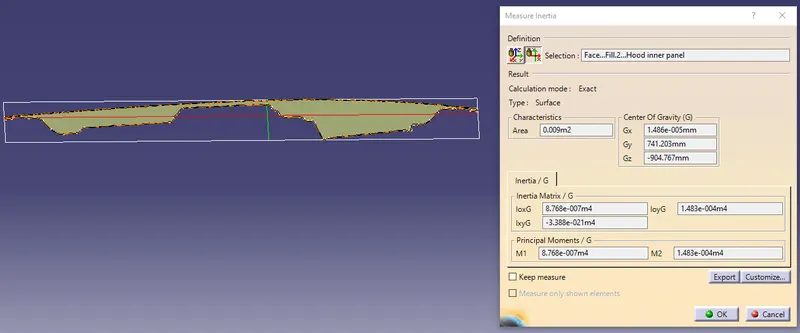
`I_min = 8.768 * 10^5 mm^4`
`I_max = 1.483 * 10^8 mm^4`
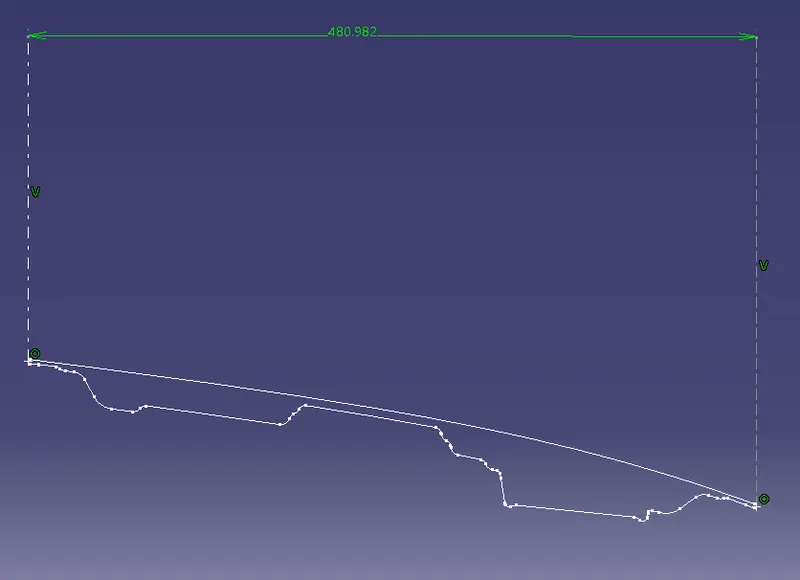
Max distance between the extreme ends
`y_max = 480.982 mm`
Section Modulus
`Z_min = (8.768*10^5)/480.982 =1822.93 mm^3`
`Z_max = (1.483*10^8)/480.982 = 3,08,327.54mm^3`
Improved Design
As the section modulus depends on the area of the section, the sectional area of the profile is increased by offsetting the bottom curve by 0.8mm.
Section Modulus
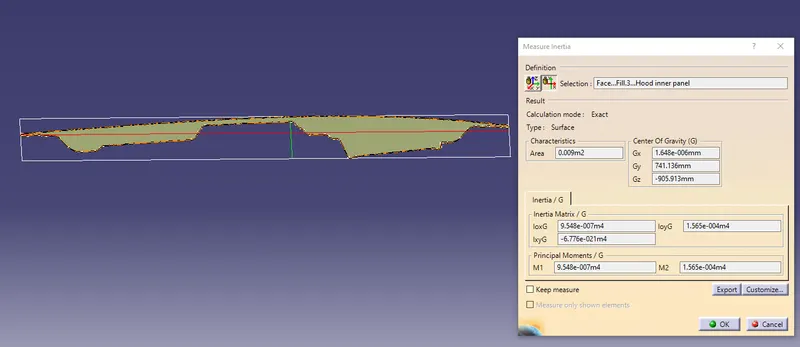
`I_min = 9.548*10^5 mm^4`
`I_max = 1.565*10^8 mm^4`
`y_max = 480.982 mm`
`Z_min = (9.548*10^5)/480.982 = 1,985.105mm^3`
`Z_max = (1.565*10^8)/480.982 = 3,25,376.001mm^3`
| Design | `Z_min` | `Z_max` |
| Initial Design | `1822.93 mm^3` | `3,08,327.54mm^3` |
| Improved Design | `1,985.105mm^3` | `3,25,376.001mm^3` |
Conclusion:
From the above table, we can conclude that with the increase in the sectional area the sectional modulus increases hence the range of bending permissible bending stress increases which results in a stronger hood design.