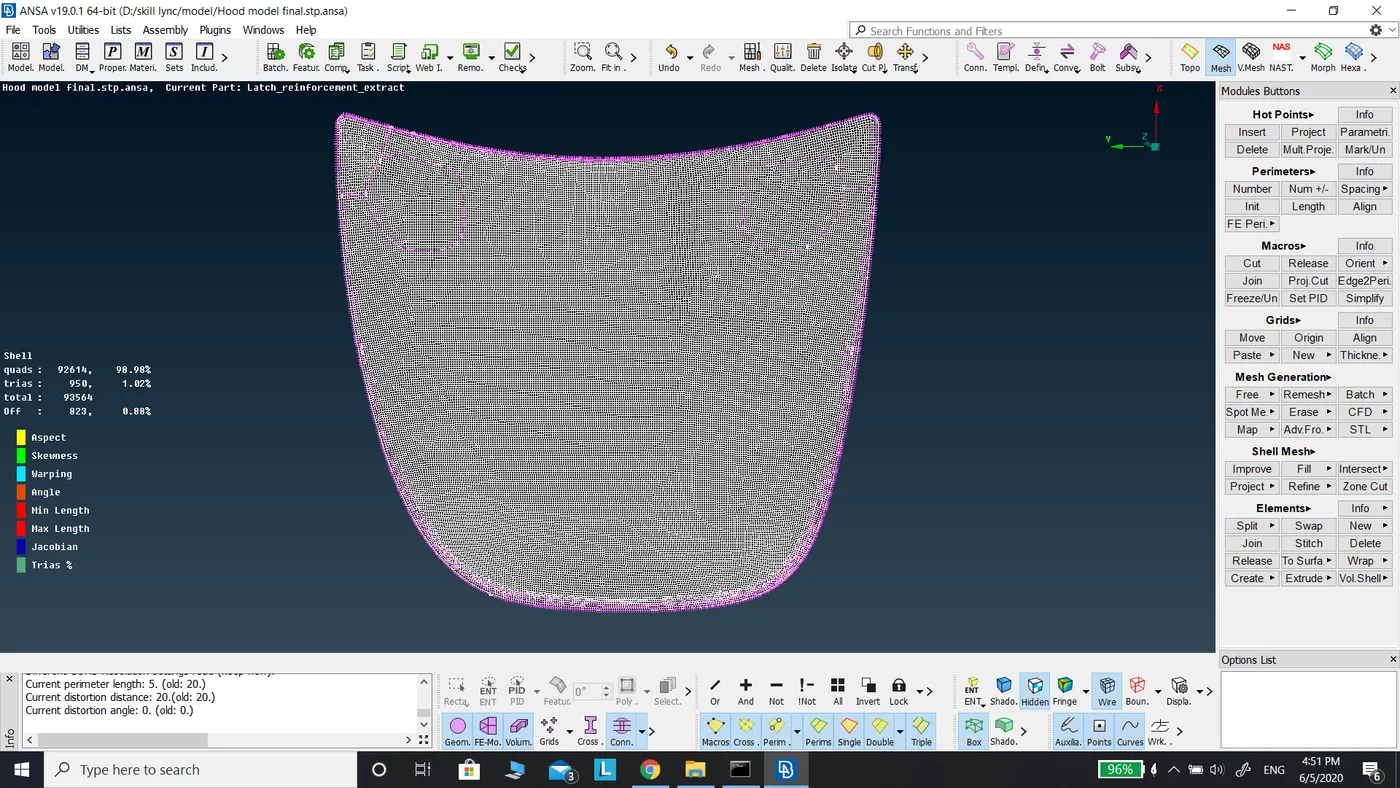
Meshing of Car Hood Model
REPORT ON THE MESHING OF HOOD MODEL
Aim:
To check for geometrical errors and mesh with the given Quality criteria.
Mesh quality Criteria are as follows:
|
S.No |
Quality Criteria |
Value |
|
1 |
Target/Average length |
5 |
|
2 |
Minimum Length |
3 |
|
3 |
Maximum Length |
7 |
|
4 |
Aspect |
3 |
|
5 |
Warpage |
15 |
|
6 |
Skewness |
45 |
|
7 |
Jacobian |
0.7 |
|
8 |
Minimum Quad Angle |
45 |
|
9 |
Maximum Quad Angle |
135 |
|
10 |
Minimum Tria Angle |
30 |
|
11 |
Maximum Tria Angle |
120 |
|
10 |
Tria Percentage |
15 |
Procedure:
- Once the challenge model is downloaded mid surface is extracted for each component in the hood.
- The mid surface is extracted using faces offset command with feature area in features selection for easy selection of faces of the component as the geometry contains various-shaped features and fillets.
- After the extraction of the mid surface of the component, the geometry check is performed to check for any geometry errors and geometry clean-up is done until there are zero errors.
- After the geometry cleanup, PID is assigned with thickness to the mid surface extracted for each component in the hood model.
- When the mid surface is extracted target length i.e., 5 is assigned for the model using length command in perimeters.
- The model is reviewed area by area to check the perimeters matching the requirements.
- Holes are reoriented such that the edge of the hole is parallel to its closet perimeter. Holes are also checked for the number of edges and assigned an even number of edges.
- Defeaturing is done to those areas who have a length less than the target length. It is done using the cut command in macros in topo mode. Unwanted cons, curved cons, and cons on straight faces are hidden for good mesh flow.
- After defeaturing the component is geometry check is performed once again for geometrical errors.
- The model is opened in mesh mode and mesh quality criteria are entered in the quality criteria and mesh parameters are also entered.
- Meshing is done using a Best mesh with a mixed element type for the good mesh flow.
- Once the mesh is generated, it is reconstructed using reconstruction command in shell mesh to eliminate any mesh quality errors.
- The component is reviewed area by area for proper mesh flow and to check for rotating quads and opposite triangular elements.
- Rotating quads and opposite triangular elements are solved using a combination of commands such as split, paste, join, swap, and smooth.
- While solving rotating quads and tria elements the component is checked for off elements using hidden drawing style.
- Those off elements are also solved using a combination of commands mentioned above.
- The orientation of the model is checked again.
Learning outcomes:
- Preprocessor: In preprocessing the model is checked, validated, and processed according to the industry standards. The steps in preprocessing are
- CAD geometry
- Model Clean up
- Meshing
- Boundary Conditions set up.
- Meshing and mesh quality Criteria:- Meshing is dividing the geometry into small discrete elements. This is an approximation technique to obtain the solution for complex problems.
Mesh quality criteria are defined to get an accurate solution in the least possible time.
Some of mesh quality criteria are:
- Warp angle- is the angle between two planes.
- Skewness –is the measure of the deviation of the shape of the mesh element from the ideal shape. Generally, it is greater than or equal to 450
- Jacobian – It is used to measure the distortion in the element. Typically it should be greater than 0.6.
- Different Type of Elements such as
- Triangular Elements – this type of elements is preferred in nonlinear and casting simulations
- Quadrilateral Elements – this type of element is used in structural and fatigue analysis.
- Tetrahedron and Hexagonal mesh elements are used in 3d simulation.
- Triangular and quadrilateral elements are used in 2d simulation
- The type of mesh elements is chosen based on the accuracy and time available for simulation.
- Introduction to ANSA GUI for the preprocessing of the hood model. I was able to perform geometry clean up and generate mid surface and performed meshing.
Conclusion.
In this challenge, I was introduced to preprocessing and the importance of preprocessing. The steps followed in preprocessing such as geometry clean up and meshing. The importance of meshing and the types of elements in meshing and its uses in different types of simulations. I also learned how to mesh quality criteria that influence the mesh flow and accuracy of the solution. I performed geometry clean up and generated mesh with the given mesh quality criteria.
For the given model total generated mesh elements are 93,609.
Tria elements percentage 1.01%
Quad element percentage 98.99 %
Off elements – 0.88%
Mid surface of the lower hood
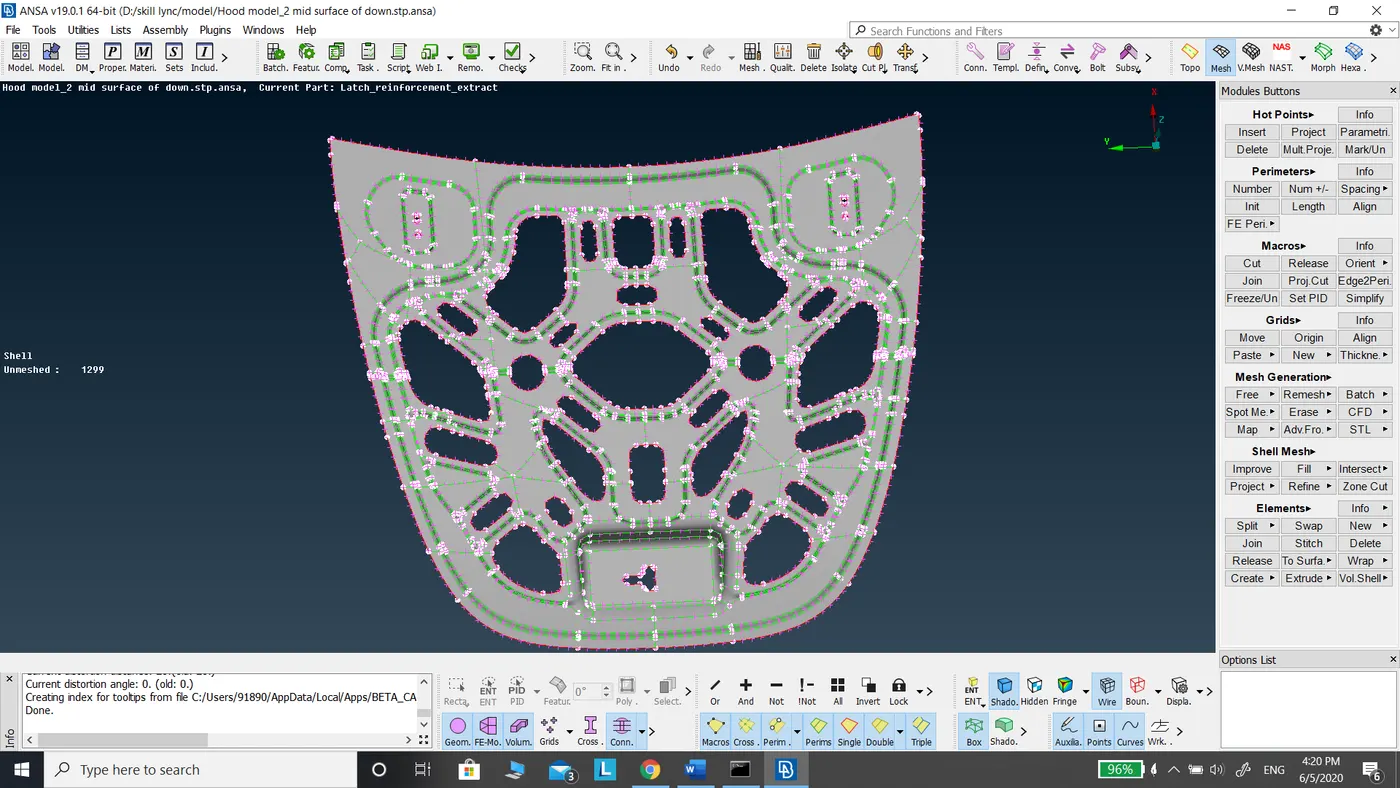
Mid surface of the lower hood after defeaturing
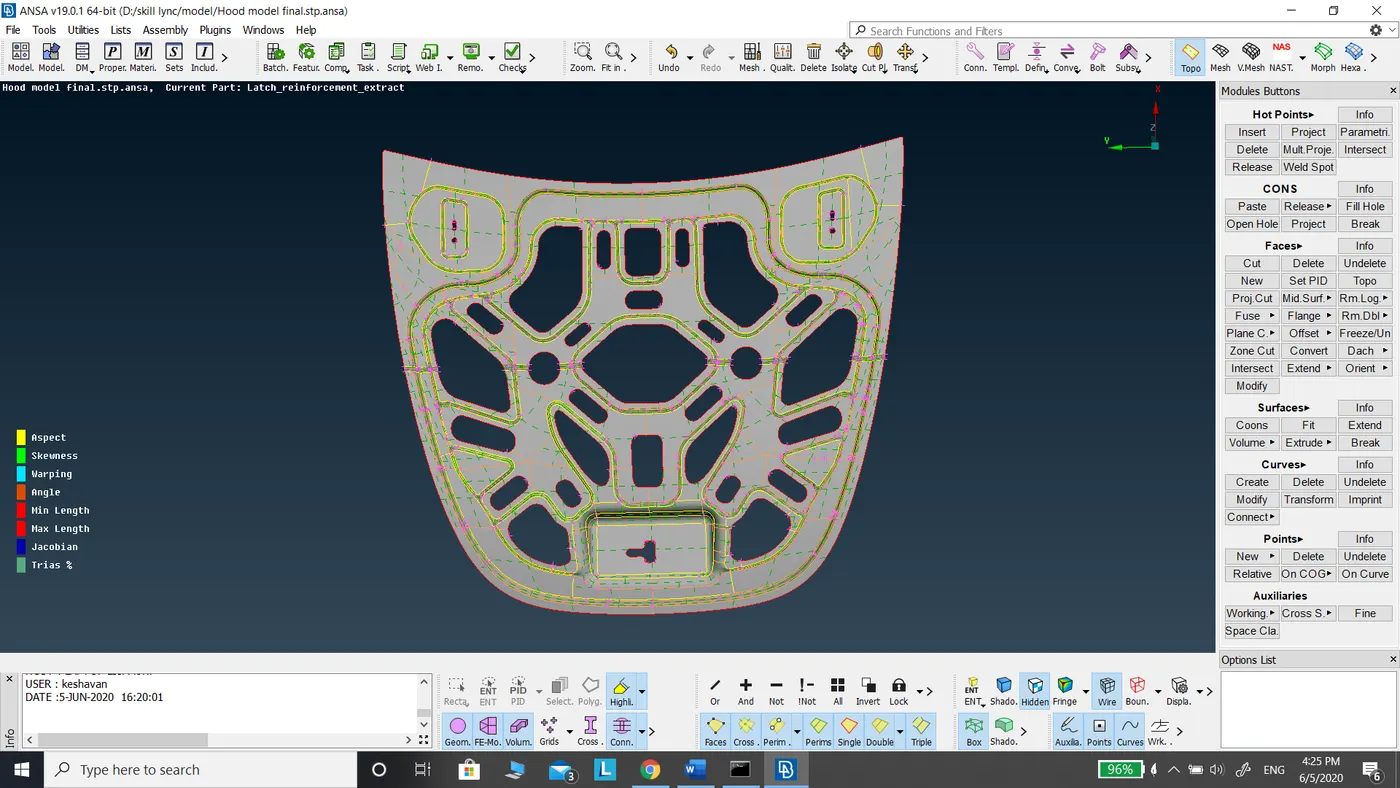
Mid surface of Upper hood
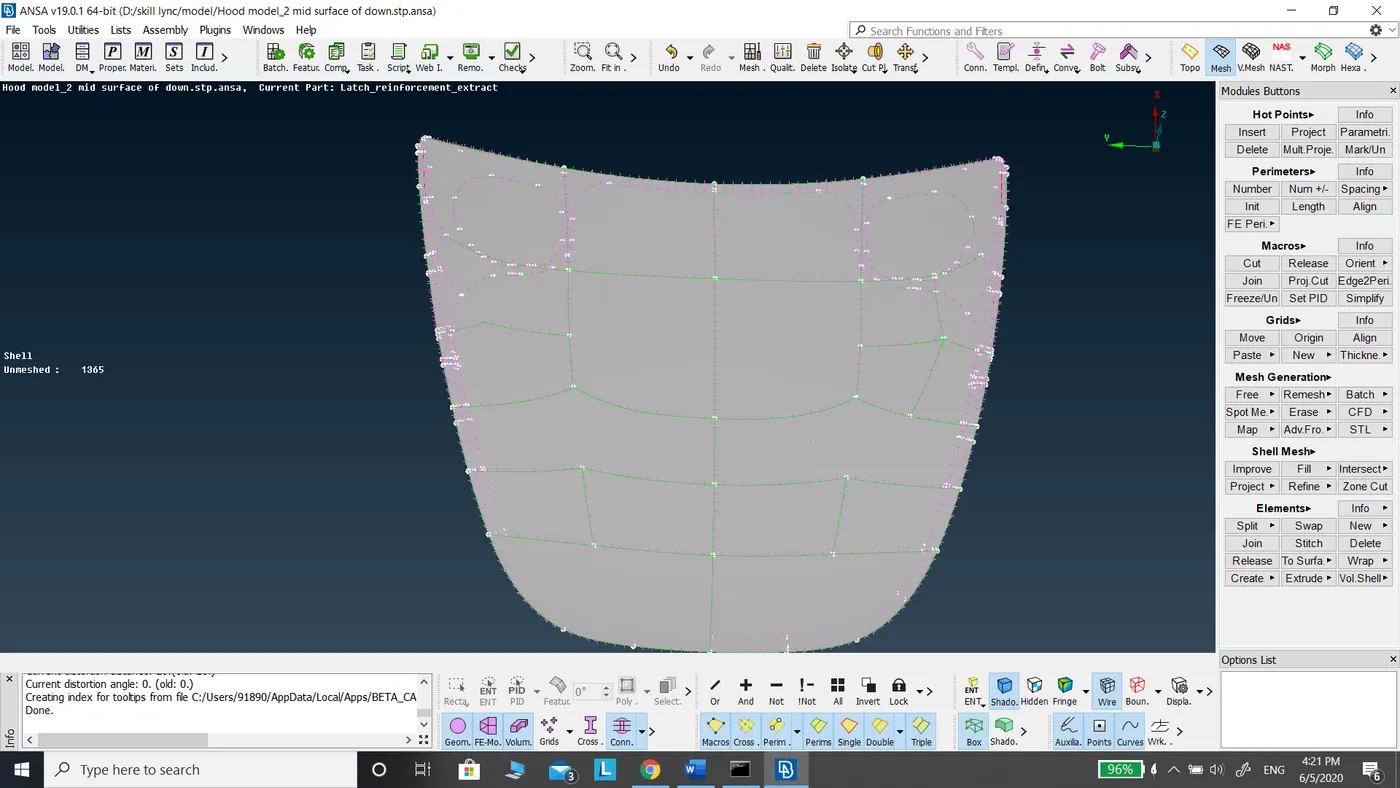
Mid surface of Upper hood after defeaturing
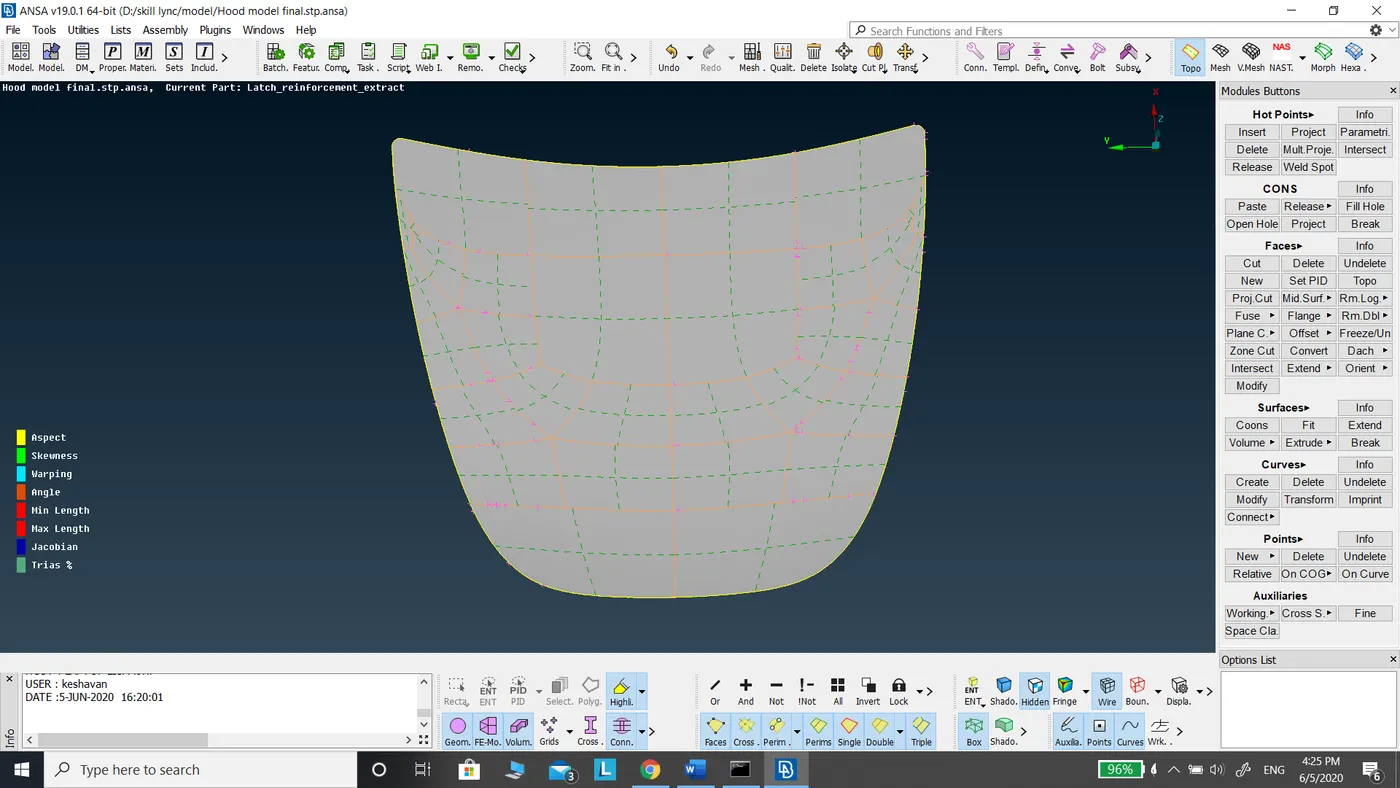
Mid surface of latch component
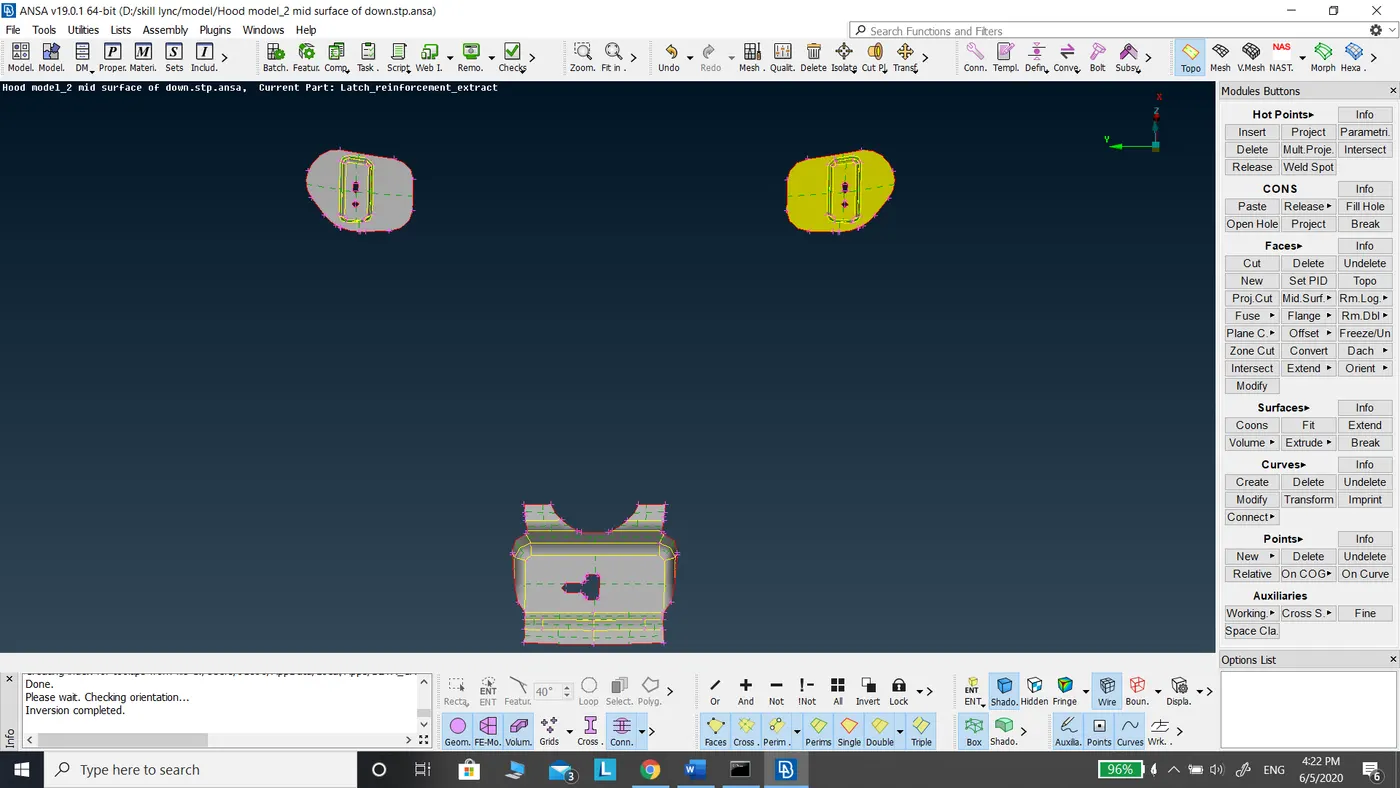
Mid Surface of latch after defeaturing
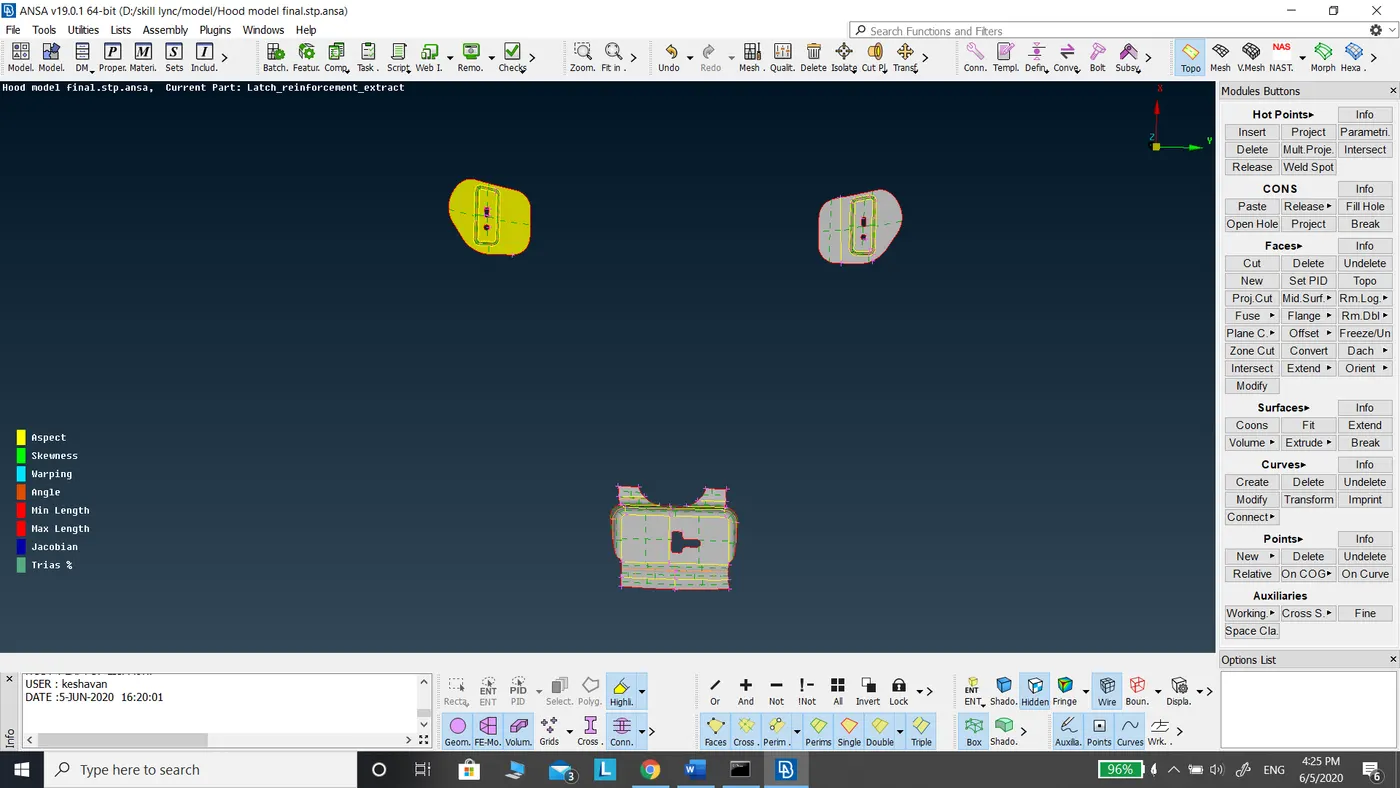
Meshing of Upper Hood
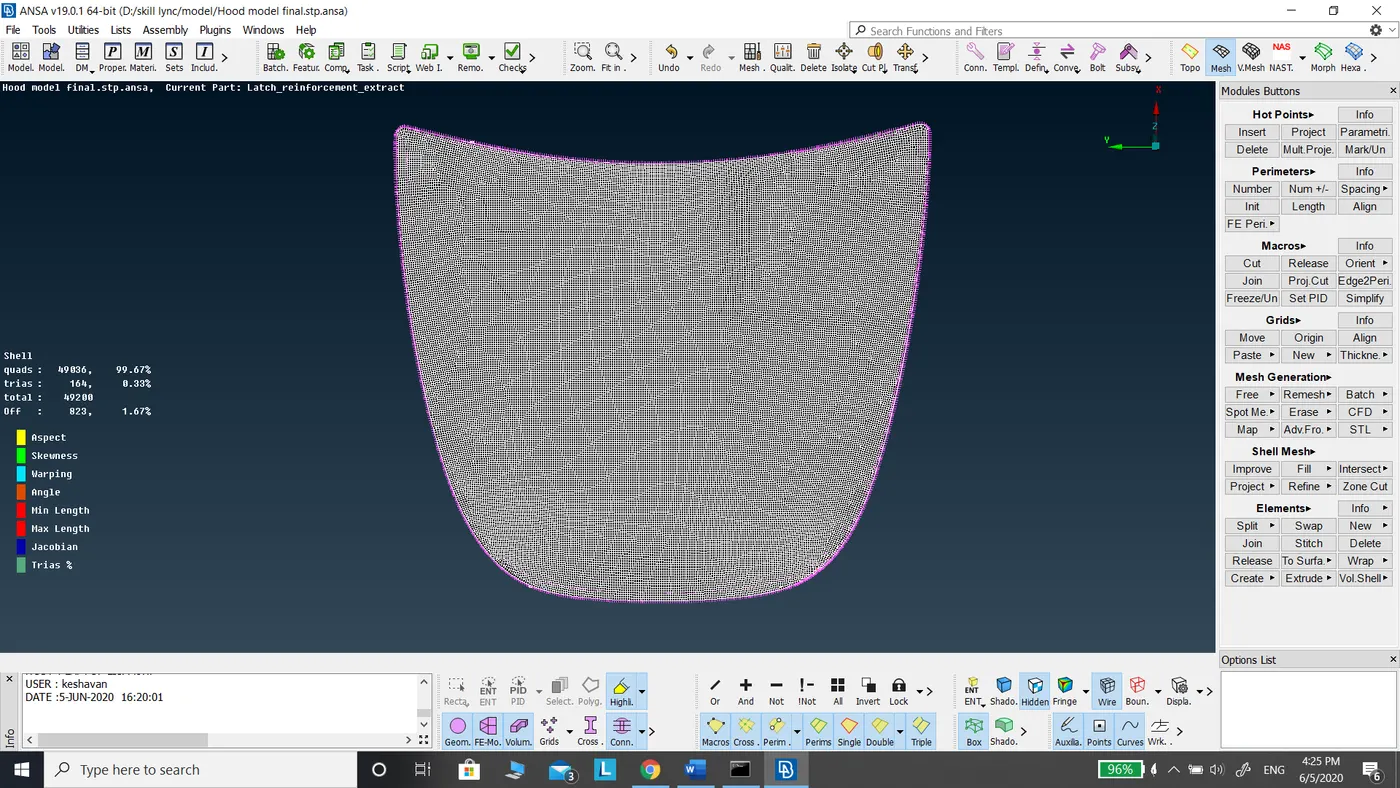
Meshing of the lower hood
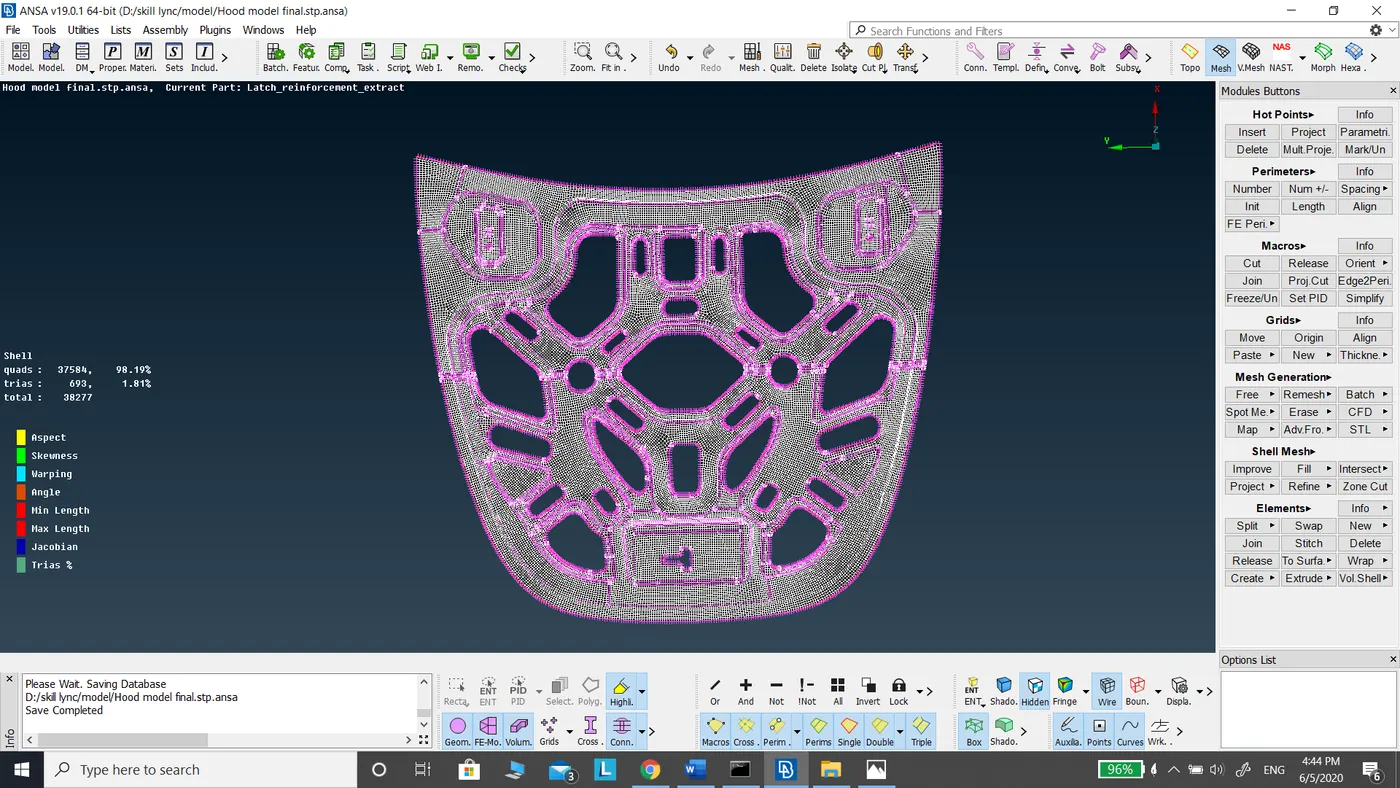
Meshing of latch components
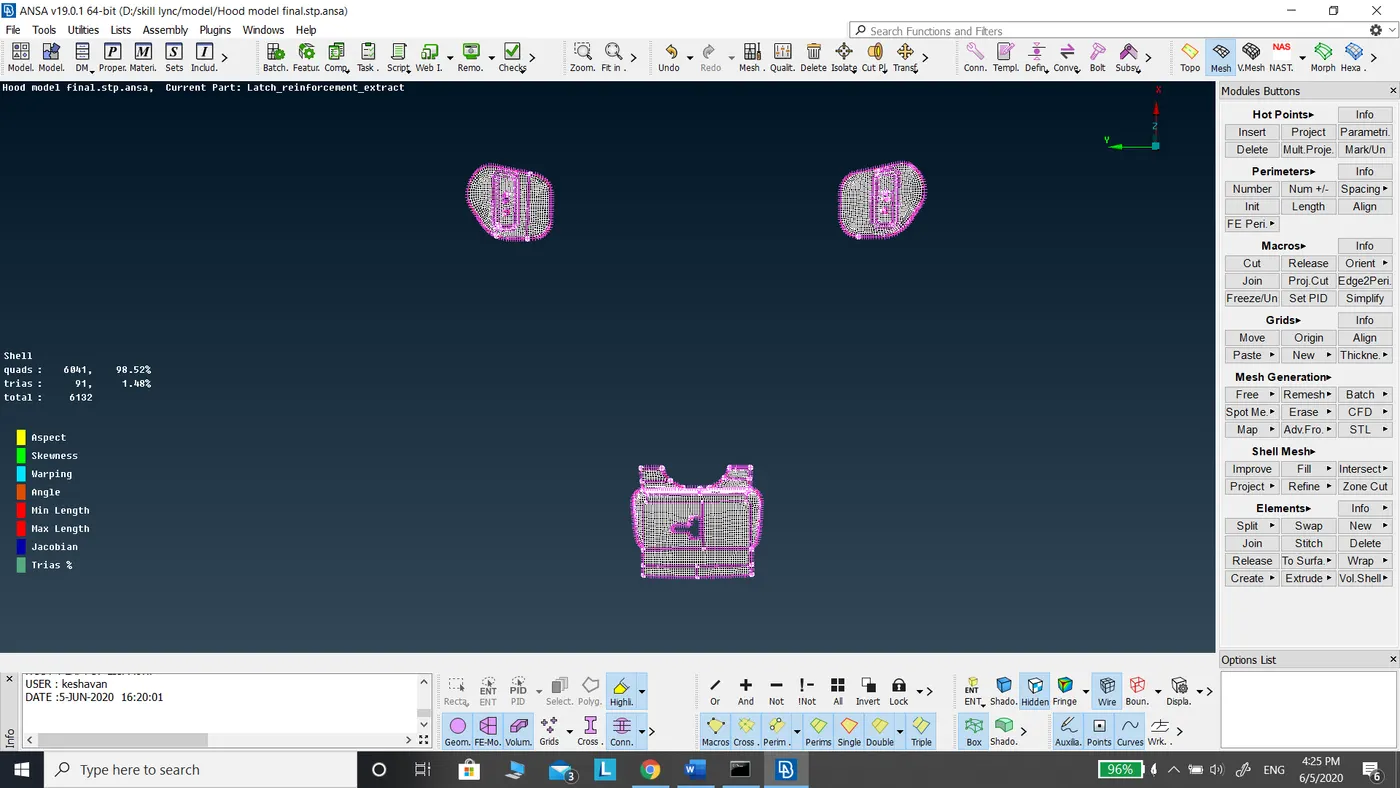
Complete Model after meshing