Section Modulus calculation and optimization
AIM
To calculate the Section Modulus from the Hood design by using the formula.
THEORY
Moment Of Inertia
Moment of inertia also known as the angular mass or rotational inertia can be defined with respect to rotation axis, as a quantity that decides the amount of torque required for a desired angular acceleration or a property of a body due to which it resists angular acceleration. The formula for the moment of inertia is the sum of the product of mass of each particle with the square of its distance from the axis of the rotation. The formula of Moment of Inertia is expressed as
`I = sum underset(i)(m) underset(i)(r)^2`
where I = moment of inertia
m = mass of each particle
r = distance from the axis of the rotation
The moment of inertia of an object is a determined measurement for a rigid body rotating around a fixed axis. The axis might be internal or external, and it can be fixed or not. However, the moment of inertia (I) is always described in relation to that axis.
The moment of Inertia depends on the distribution of the mass around its axis of rotation. Moment Of Inertia varies depending upon the position of the axis that is chosen. That is, depending on the location and direction of the axis of rotation, the same item might have various moment of inertia values. Angular mass or rotational inertia are other names for the moment of inertia.
Section Modulus
Section modulus is a geometric property of the cross section used for designing beams and flexural members. Mathematically, It is defined as the ratio of the moment of inertia of a section about its centroidal axis and to the distance of the extreme layer from the neutral axis.
The unit of section modulus is mm³.
The section modulus is classified into two types:-
Plastic section modulus:- The plastic section modulus is generally used for material in which plastic behavior is observed.
Elastic section modulus:- The elastic section modulus is applicable up to the yield point of material.
It is used in most of engineering applications.
Elastic section modulus is the ratio of moment of inertia about a neutral axis and the maximum distance between the neutral axis and outermost fiber of beam.
`S = I/y`
where S = section modulus (`mm^3`)
I = moment of inertia (`mm^4`)
y = distance between the neutral axis and the extreme end of the object (`mm`)
Significance
- Section modulus is the important factor for design of beam and flexural member
- Higher the value of section modulus, higher will be the resistance of member to bending
- It is used to calculate strength of the steel structure
- More the section modulus, it can withstand more load and it is also considered to be more tough.
DESIGN & CALCULATION
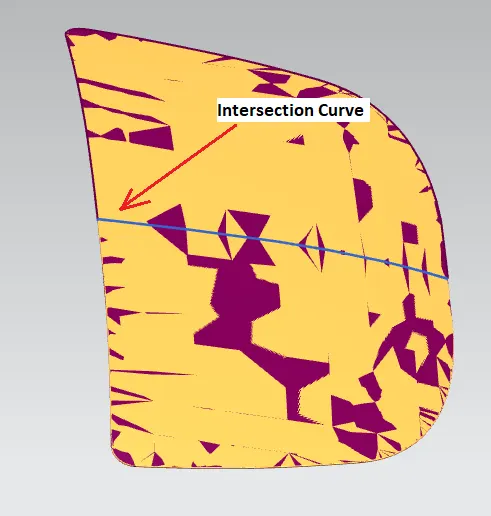
Intersection Curve
Cross Section
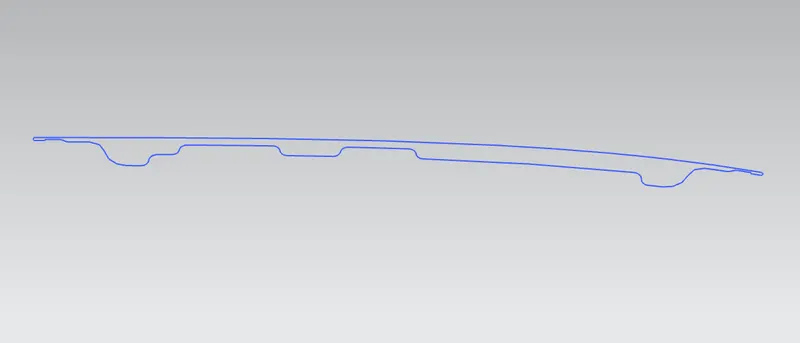
Case 1:
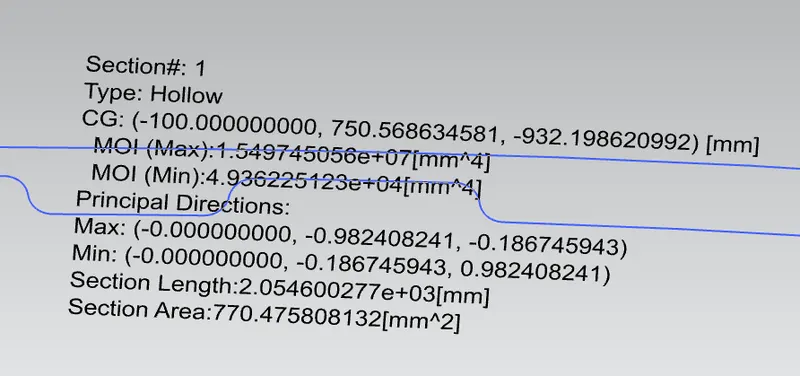
Moment of Inertia (I)
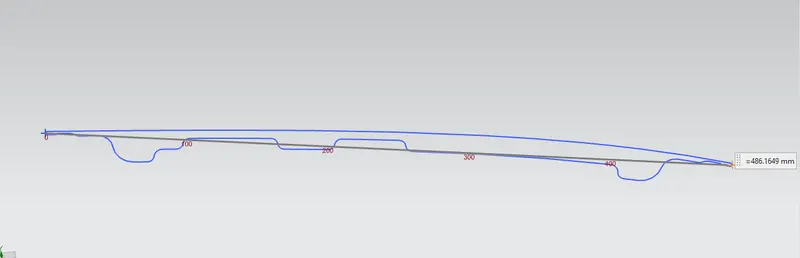
Total Distance
We know that `S = I/y`
where S = section modulus
I = moment of inertia = `4.93625123 xx10^4 mm^4`
y = distance between the neutral axis and the extreme end of the object = `486.1649/2 = 243.08245 mm`
`:. S = (4.93625123 xx10^4 )/243.08245`
`S = 203.0679 mm^3`
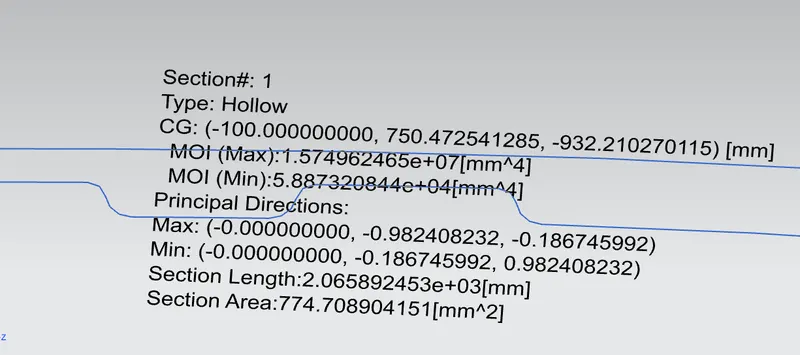
Case 2: When distance between outer panel and inner panel is increased by 0.90mm
Moment of Inertia (I)
Total Distance
We know that `S = I/y`
where S = section modulus
I = moment of inertia = `5.887320844 xx10^4 mm^4`
y = distance between the neutral axis and the extreme end of the object = `486.1649/2 = 243.08245 mm`
`:. S = (5.887320844 xx10^4 )/243.08245`
`S = 242.1944 mm^3`
RESULTS
In the first case we got section modulus as `S = 203.0679 mm^3`
In the second case i.e when distance between outer panel and inner panel is increased by 0.90mm, section modulus `S = 242.1944 mm^3`
From the above two cases it is clear that higher the value of section modulus, higher will be the resistance of member to bending, i.e load bearing capacity increases with increase in value of section moulus. Hence it can can withstand more load and it is also considered to be more tough.
CONCLUSION
Section Modulus from the Hood design by using the formula has been calculated.
REFERENCE