Section Modulus calculation and optimization
SECTION MODULUS CALCULATION AND OPTIMIZATION
Objective:
The primary aim of this project is to evaluate the strength of a vehicle hood by calculating the section modulus of its cross-section. This is done by considering various parameters influencing the moment of inertia, which helps assess the hood's resistance to bending under load.
Bending Equation:
The bending equation is given by:
σ/y =M/I =E/R
Where:
M = Bending Moment
I = Moment of Inertia about the bending axis
σ = Bending Stress at a distance ‘y’ from the neutral axis
E = Young’s Modulus of the material
R = Radius of curvature
y = Distance from the neutral axis to the outermost fiber
Another form of the equation:
σ max = M .ymax / I = M/S
Where S is the Section Modulus and is defined as:
S=I/y
Section Modulus:
Section Modulus is a geometric property of a cross-section that indicates its ability to resist bending. It is calculated as the ratio of the moment of inertia to the distance from the neutral axis to the outermost fiber:
S=I/y
- A higher section modulus implies greater resistance to bending.
- It plays a crucial role in determining the structural performance and durability of components like hoods, beams, and shafts.
In summary, by calculating the section modulus, we can predict how well the hood structure will withstand bending forces, thereby helping improve its design strength.
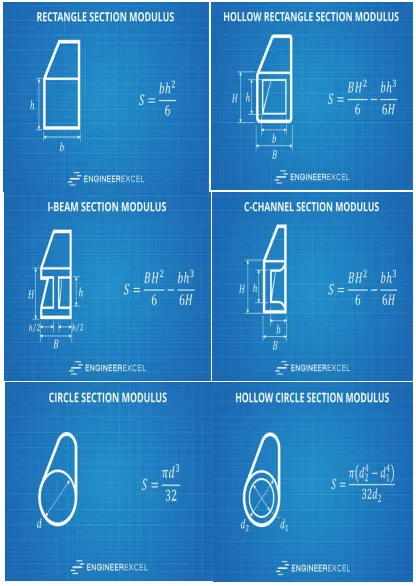
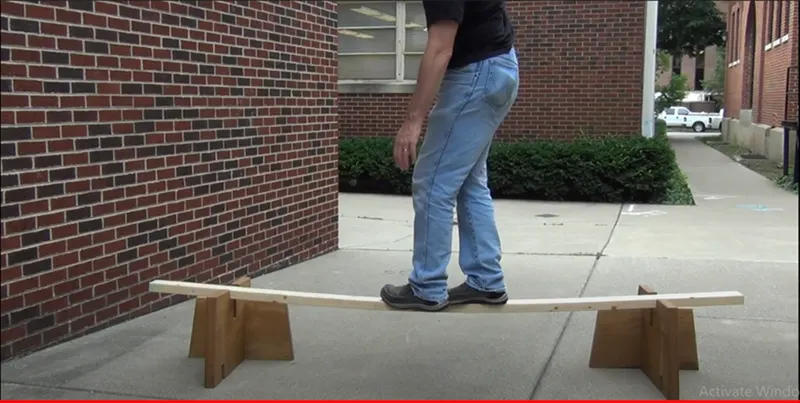
Changing the position affects how much the part bends because the distance from the center (centroid) to the outer edge (extreme fiber) changes.
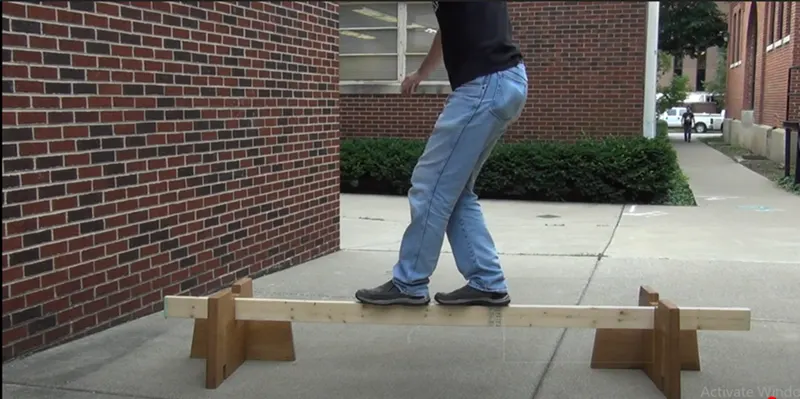
In simple terms, when more material is present in a particular direction from the center, it offers more resistance to bending. This results in less deflection and better strength.
Moment of Inertia
In this context, we are considering the area moment of inertia, also known as the second moment of inertia. It is a key parameter in structural and mechanical applications, typically related to a cross-section of a structural element. The moment of inertia depends on the shape of the section and the orientation of the axis about which it is calculated.
When the area of the section increases, the moment of inertia also increases, which leads to a higher section modulus.
Therefore, the section modulus is directly proportional to the moment of inertia.
Neutral Axis :
When a beam is subjected to pure bending, the fibers experience different types of stresses across the section:
l The topmost fibers are in maximum compression.
l The bottom most fibers are in maximum tension.
l The neutral axis is the line within the cross-section where the material experiences no stress during bending.
Material Data :
l Material: Stainless Steel AISI 302 – Cold Rolled
l Yield Strength: 520 MPa = 520 N/mm²
Section modulus calculation of the hood design:
The imported hood model undergoes section inertia analysis. It is crucial to verify that the resulting curve forms a single, closed contour.
Calculation of Y:
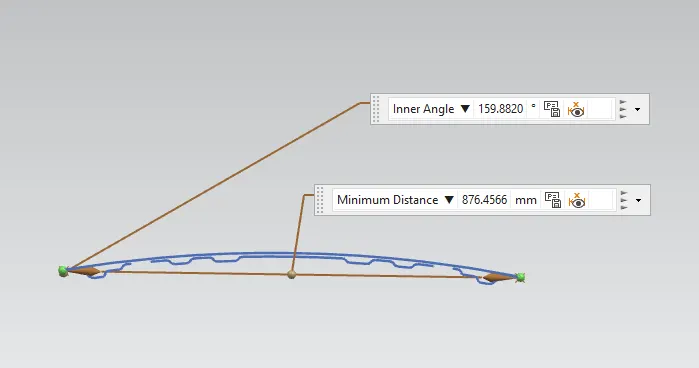
Y = Total Length / 2
= 876.4566 / 2
Y = 438.2283 mm.
SECTION : 1 (Before optimization)
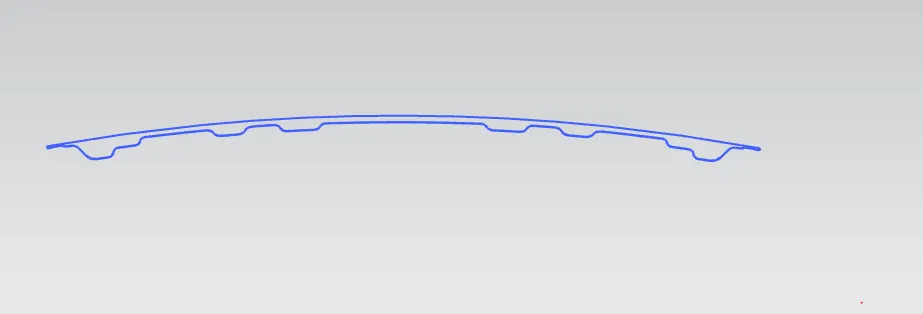
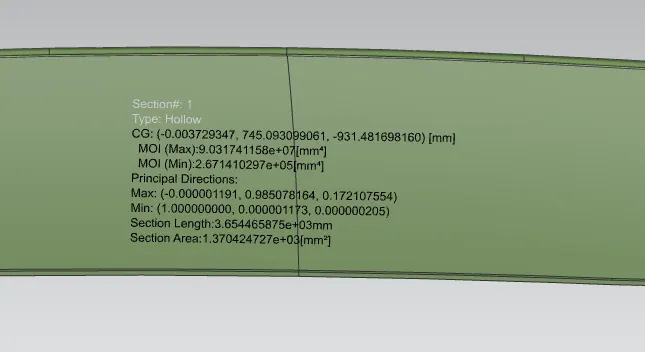
Moment of inertia
I max = 9.031741158 × 107mm4
I min = 2.671410297 × 105mm4
Y = 438.2283 mm
Section modulus of max and min
Smax = I/Y
= 9.031741158 × 107mm4 / 438.2283mm
= 206096.7116 mm3
Smin = 2.671410297 × 105mm4 / 438.2283mm
= 609.5932 mm3
Smax = 206096.7116 mm3
Smin = 609.5932 mm3
So for this hood design section modulus range from 206096.7116 mm3 to 609.5932 mm3
SECTION : 2 (After optimization)
The hood inner panel’s curve is offset by 0.5mm outwards and section inertia analysis is done same as case 1 for a closed curve.
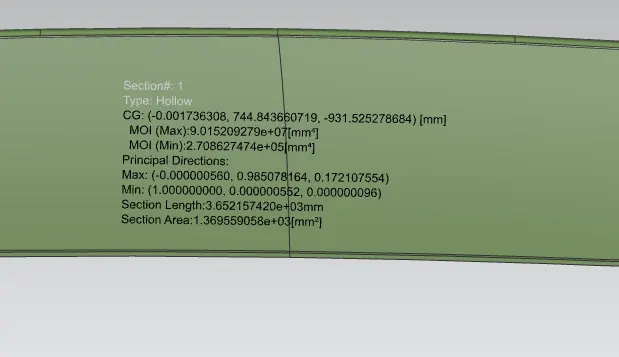
Moment of inertia
I max = 9.015209279 × 107mm4
I min = 2.708627474 × 105mm4
Y = 438.2283 mm
Section modulus of max and min
Smax = I/Y
= 9.015209279 × 107mm4 / 438.2283mm
= 205719.4681mm3
Smin = 2.708627474 × 105mm4 / 438.2283mm
= 618.0859mm3
Smax = 205719.4681mm3
Smin = 618.0859mm3
So for this hood design section modulus range from 205719.4681mm3 to 618.0859mm3
Take min MOI,
Section 1
Smin = 609.5932 mm3
Section 2
Smin = 618.0859mm3
The optimized design shows the 1.39% improvement in its section modulus value which is further improved by increasing the cross-section between hood inner and outer panel if needed. But for now, this improvement is enough when compared to the initial design. And my hood design can with stand the required resistance to bending.

Conclusion
Comparing Section 1 and 2, increasing the cross-sectional area by 0.5 mm improved the section modulus from 609.5932 mm3 to 618.0859mm3 , indicating better strength.This shows that moment of inertia and strength increase with cross-sectional area, but also add weight. Therefore, a balance between strength and weight is crucial in hood design.