Section Modulus calculation and optimization
Objective: The objective of this study is to calculate the section modulus of the hood design and analyze its strength. The study also aims to optimize the design to enhance the bending resistance of the hood by modifying its section properties. An increase in section modulus leads to improved structural integrity and resistance to deformation.
Introduction: Section modulus is a key geometric property used in the design of structural and flexural members. It determines a section's ability to resist bending stress. A higher section modulus results in better bending resistance and increased strength. The section modulus (S) is calculated using the formula:
S = I/y,
where:
S = Section Modulus (mm3)
I = Moment of Inertia (mm4)
y = Distance from the neutral axis to the extreme fiber (mm)
This study considers two sections of the hood: the initial design and an optimized design, where changes have been made to improve structural performance.
Section 1:
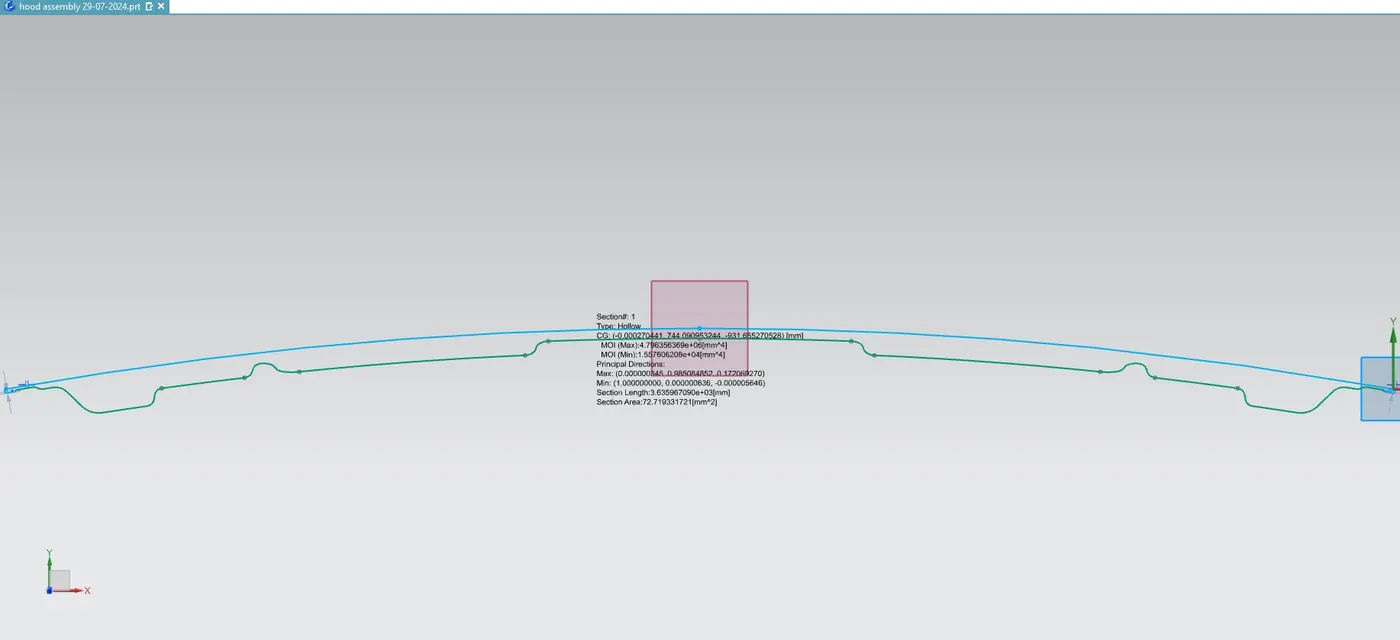
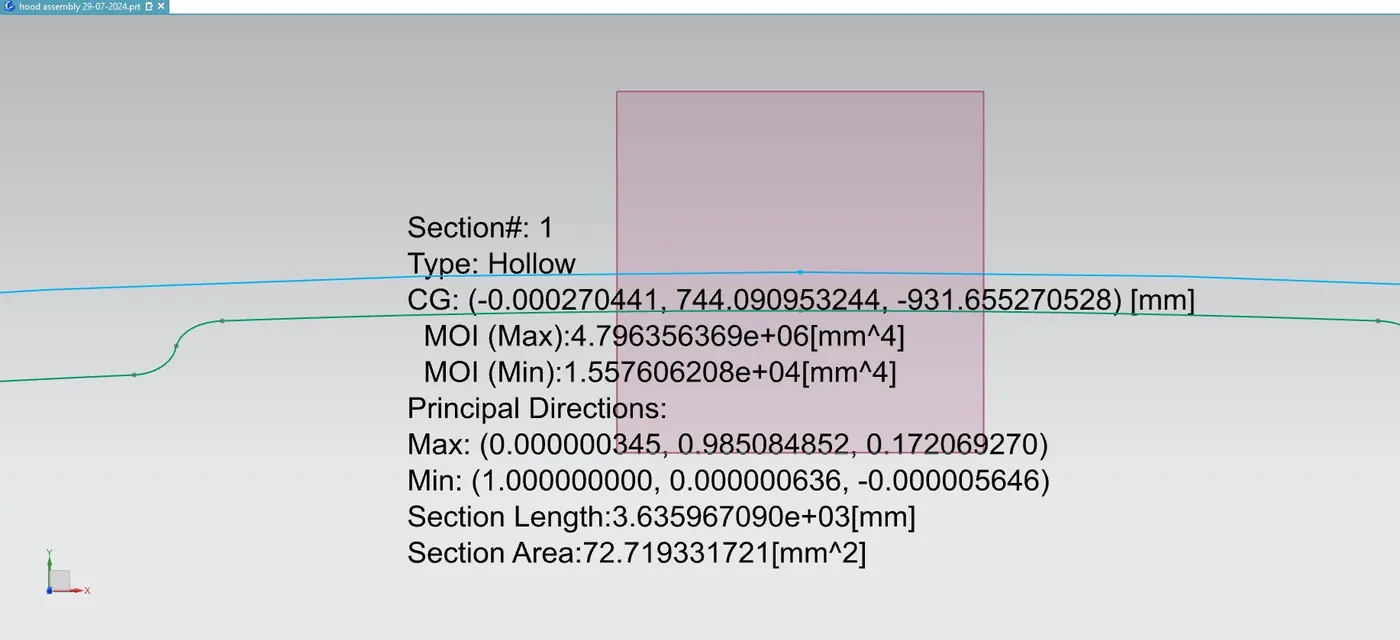
Zooming into the stats, we have:
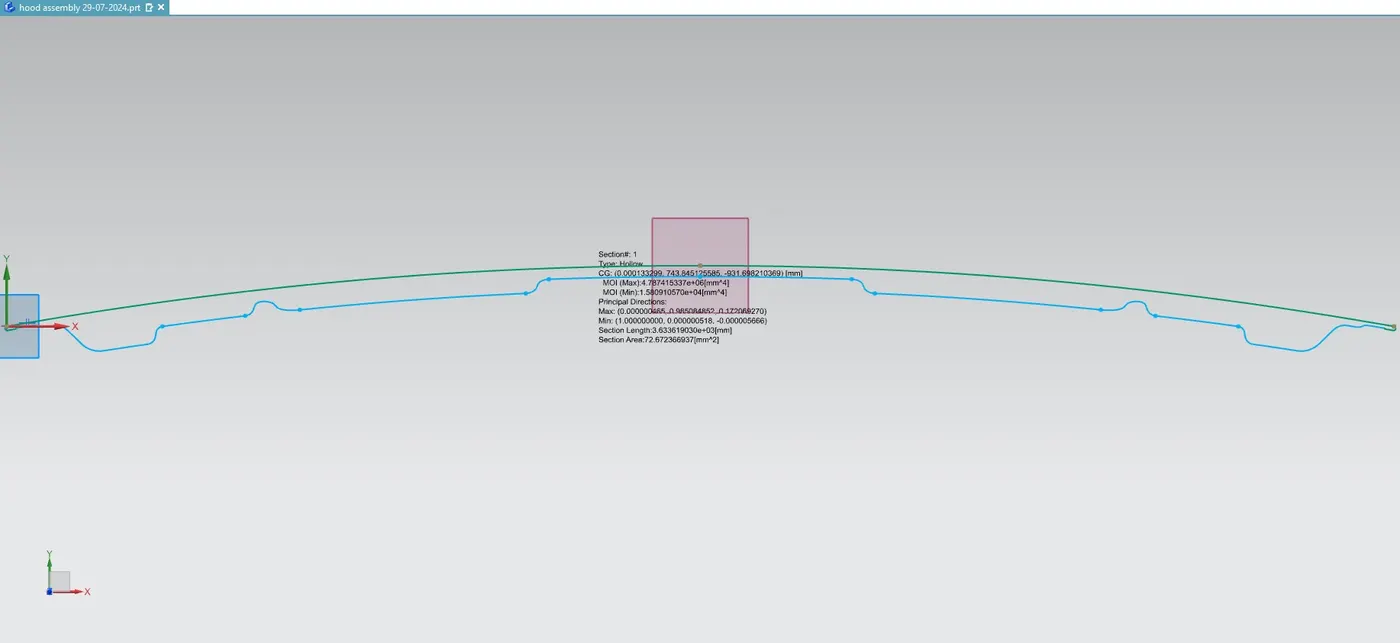
Section 2:
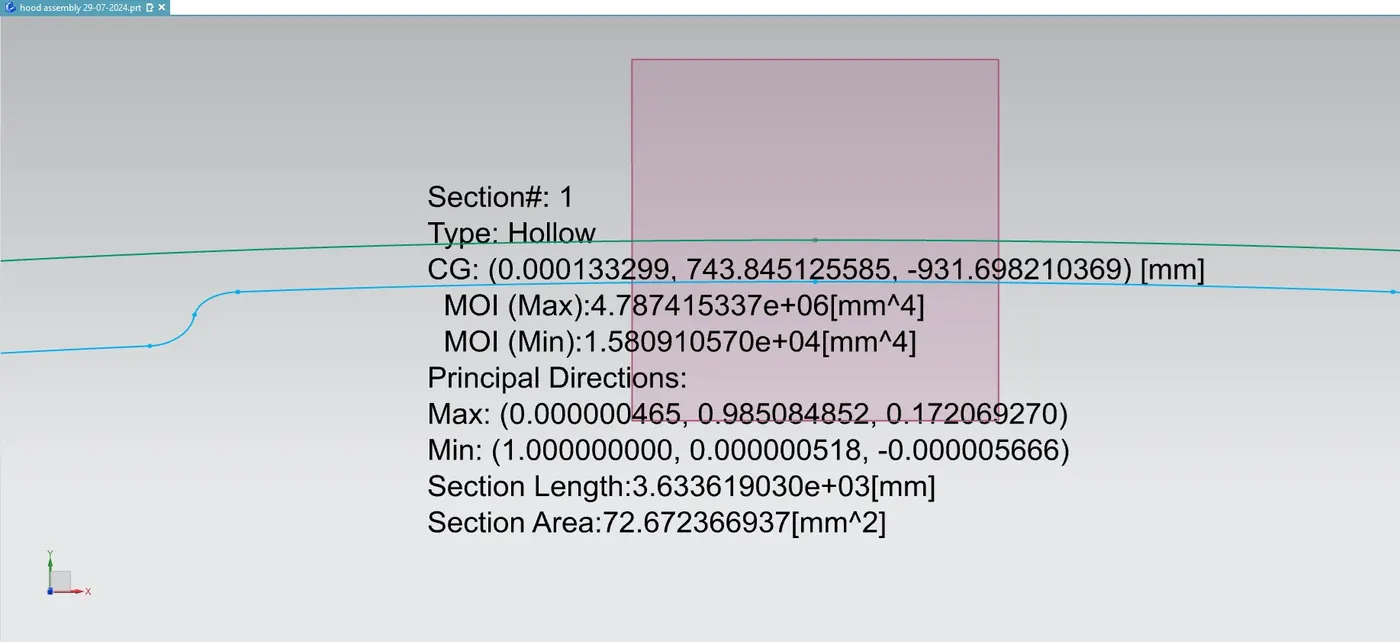
Zooming into the stats, we have:
Section Modulus Calculation for Initial Hood Design (Section 1):
Type: Hollow
Centroid (CG): (-0.000270441, 744.090953244, -931.655270528) mm
Moment of Inertia (MOI) (Max): 4.796356369 × 10 mm4
Moment of Inertia (MOI) (Min): 1.557606208 × 10 mm4
Principal Directions (Max): (0.000000345, 0.985084852, 0.172069270)
Principal Directions (Min): (1.000000000, 0.000000636, -0.000005646)
Section Length: 3.635967090 × 10 mm
Section Area: 72.719331721 mm2
Extreme Fiber Distance (y): 744.090953244 / 2 = 372.0455 mm
Section Modulus (S):
Section Modulus Calculation for Optimized Hood Design (Section 2):
Type: Hollow
Centroid (CG): (0.000133299, 743.845125585, -931.698210369) mm
Moment of Inertia (MOI) (Max): 4.787415337 × 10 mm4
Moment of Inertia (MOI) (Min): 1.580910570 × 10 mm4
Principal Directions (Max): (0.000000465, 0.985084852, 0.172069270)
Principal Directions (Min): (1.000000000, 0.000000518, -0.000005666)
Section Length: 3.633619030 × 10 mm
Section Area: 72.672366937 mm2
Extreme Fiber Distance (y): 743.845125585 / 2 = 371.9226 mm
Section Modulus (S):
Observations and Analysis:
The section modulus increased from 41.86 mm³ in the initial design to 42.50 mm³ in the optimized design.
The increase in section modulus indicates a stronger, more resistant structure to bending.
The optimization involved modifying the section geometry, improving its moment of inertia, which resulted in better load-bearing capacity.
The slight increase in section area also contributed to enhancing the stiffness and resistance to deformation.
Conclusion: The study demonstrates that optimizing the hood design by modifying the section properties results in an increase in section modulus, thereby improving structural integrity. The optimized hood design has a higher resistance to bending compared to the initial design. This confirms that structural modifications, such as increasing the depth or redistributing material, can significantly enhance the strength and durability of the hood.
Recommendation: Future design improvements can focus on further increasing the moment of inertia through additional reinforcements, adjusting thickness, or employing advanced materials to further enhance strength while maintaining weight efficiency.