Section Modulus calculation and optimization
SECTION MODULUS CALCULATION AND OPTIMIZATION
OBJECTIVES:-
- Use the Section from your Hood design and calculate the Section Modulus using the formula.
- Come up with a new section that has an improved Section Modulus compared to the previous one and mention what changes you made which resulted in the increased strength.
INTRODUCTION
Section modulus is the property of the cross-section that is used while the design of beams. The section modulus is classified into two types:-
1] Elastic section modulus: - The elastic section modulus is applicable up to the yield point of material. It is used in most engineering applications.
2] Plastic section modulus:- The plastic section modulus is generally used for material in which plastic behaviour is observed.
Importance of section modulus
- Section modulus is an important factor for designing beams and flexural members.
- Higher the section modulus, higher will be the resistance to bending.
- Easier to calculate strength and stresses in beams.
- If two beams are made of the same material and the section modulus of two beams are being compared and vice versa, the beam with larger section modulus will be tougher and more capable to withstand larger loads.
The section modulus can be calculated as
S = I/y
Where,
S = Section Modulus
I = Moment of Inertia
y = distance between the neutral axis and the extreme end of the object
Section modulus of initial Hood Design
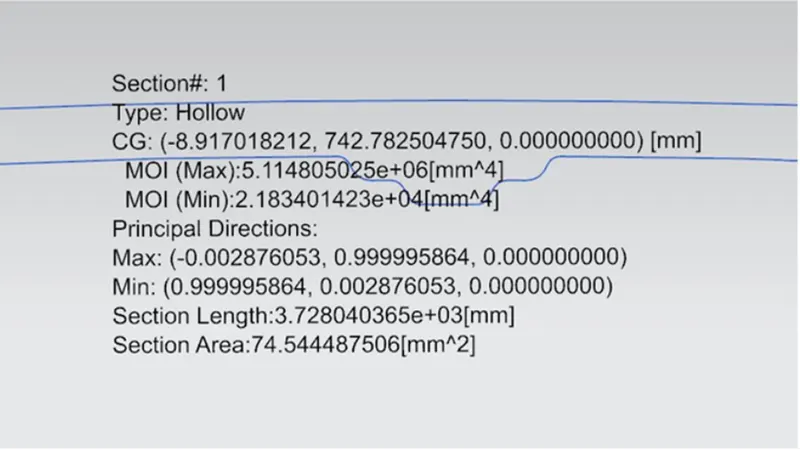
From the above analysis, following minimum and maximum moment of inertia are obtained
I max=5114805.02 mm^4
I min=2183401.4 mm^4
y = 440 mm
S max= I max / y = 11624.55 mm^3
S min = I min / y = 49.62 mm^3
Section Modulus of improved Hood Design
Steps Followed for the improved section modulus.
- As the section modulus is directly proportional to the sectional area there is a change in MOI as the increase in sectional area of the body. The section area is increased by reducing the embossing depth and offsetting the outer panel by 3 mm. This increases the value of section modulus.
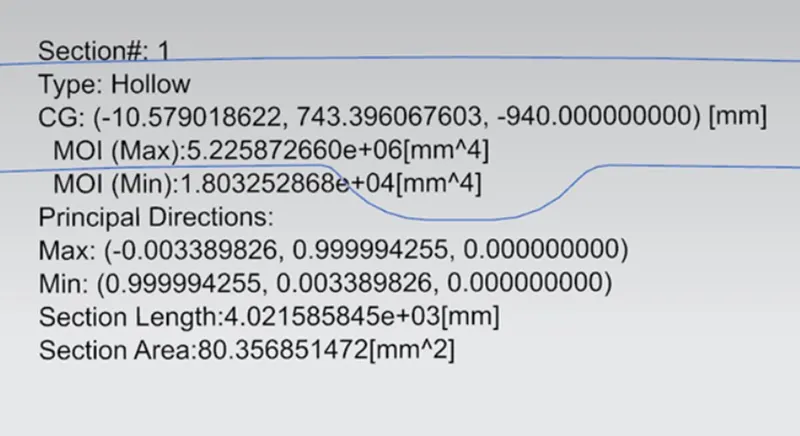
From the above analysis, following minimum and maximum moment of inertia are obtained
I max=5225872 mm^4
I min=1803252 mm^4
y = 440 mm
S max= I max / y = 11876.98 mm^3
S min = I min / y = 40.8 mm^3
Conclusion
It is observed that increasing the gap between the inner and outer panels has resulted in decreasing bending moments. No significant change in section modulus is observed just by increasing the gap between the panels. So f we tend to add more geometric features to the master section resulted in a drastic increase in section modulus. Hence it is best to add more geometric features to the master section to improve the stiffness of a section.