Section Modulus calculation and optimization
#6 SKILL LYNC
COURSE: Automotive Sheet Metal Design using Siemens NX CAD / CATIA V5
NAME: SRI RAGUL PREMKUMAR CHALLENGE: Section Modulus calculation and optimization
Bending Stresses in Beam:
It is that in which bending moment (Torsion) is constant along the length, i.e. shear force is zero.
- Material is Homogenous, Elastic which Hooke’s law is valid.
- Distance Y is directly proportional to the Neutral axis.
Neutral Axis:
- In beam, the layer does not undergo any change in length even after bending, which is called the neutral axis.
- The line of intersection of the neutral layer with the plane of the cross-section of the beam is called the neutral axis.
- In pure bending, the Neutral axis of the beam always passes through the centroid of the cross-section area and is homogenous.
Pure Bending Equation:
Where, σ – bending stress M- Bending Moment I- Moment of Inertia of area
y - Distance between the neutral axis and the extreme end of the object
E- Young modulus of elasticity R- curvature
From, Hood design and calculates the Section Modulus using the formula:
|
S = I/y |
Where S = Section Modulus I = Moment of Inertia of area
y = distance between the neutral axis and the extreme end of the object
|
Section Modulus is directly proportional to the Moment of Inertia in the area |
“Section modulus represents the strength so the section modulus depends on the area of the section “
CASE 1: INNER PANEL CREATED WITH EMBOSS
Hood design, in the inner panel, created a emboss to increase section area and strength in the Case1
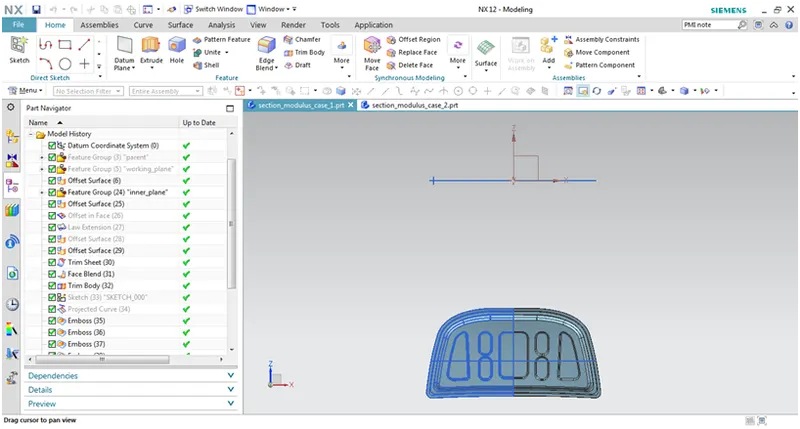
I created an intersection curve in the hood for finding section inertia analysis.
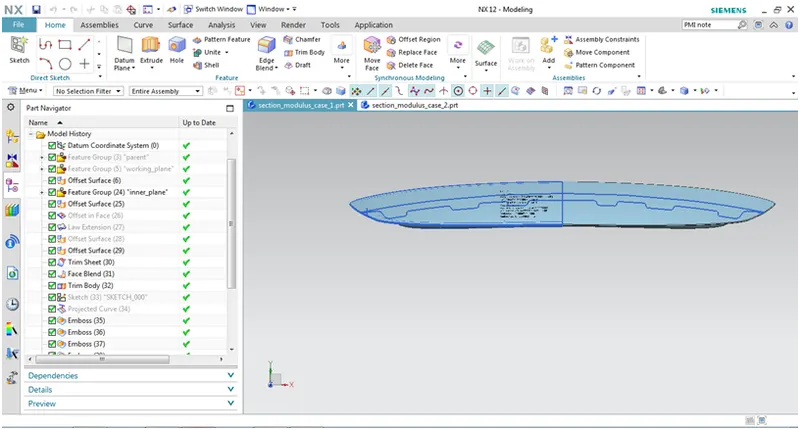
And then intersection curve is projected using the project curve command.
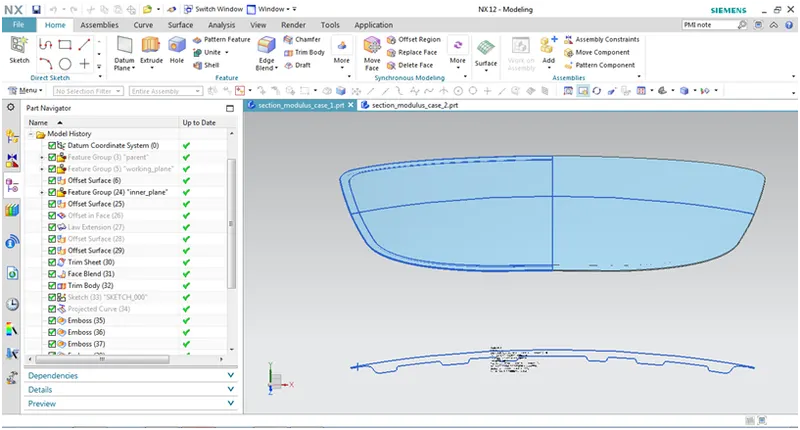
Value of case 1:
Section#: 1
Type: Hollow
CG: (-75.207869097, 749.081678205, 0.000000000) [mm]
MOI (Max):7.043333994e+06[mm^4]
MOI (Min):2.488253451e+04[mm^4]
Principal Directions:
Max: (-0.007783744, 0.999969706, 0.000000000)
Min: (0.999969706, 0.007783744, 0.000000000)
Section Length:5.660357640e+03[mm]
Section Area:113.098535882[mm^2]
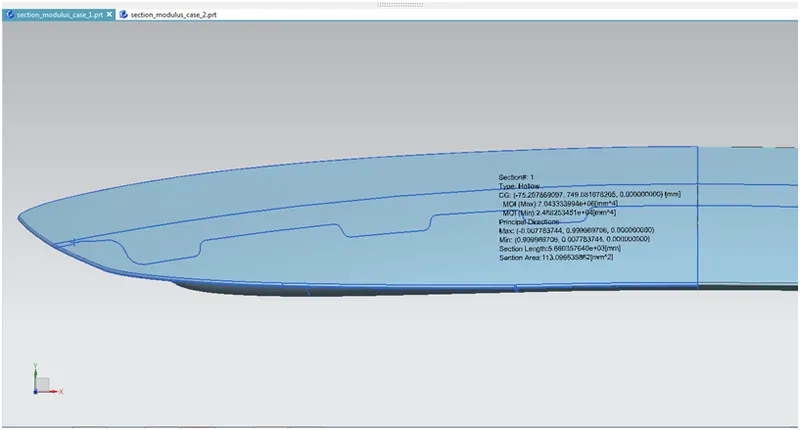
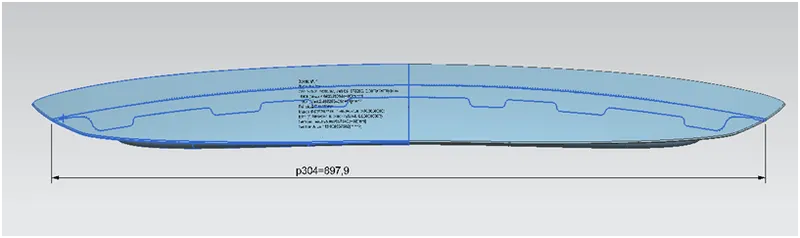
Imax = MOI (Max):7.043333994e+06[mm^4]
Imin = MOI (Min):2.488253451e+04[mm^4]
Total length of 'Y' value: 897.9mm
So, at neutral axis we need 'Y' value: Y/2=897.9/2
=448.95mm
Section modulus(s) = Imax /Y
= 7.043333994e+06[mm^4]/448.95mm
= 15.688×103 mm3 (Max strength)
Section modulus(s) = Imin/Y
= 2.488253451e+04[mm^4]/ 448.95mm
= 5.542×103mm3 (Min strength)
As a result, the strength of a hood can vary between 15.688×103 mm3 (Max strength) and 5.542×103mm3 (Min strength)
CASE 2: AN INNER PANEL CREATED WITHOUT EMBOSSING
Hood design, in the inner panel, created a without emboss for increase section area and strength
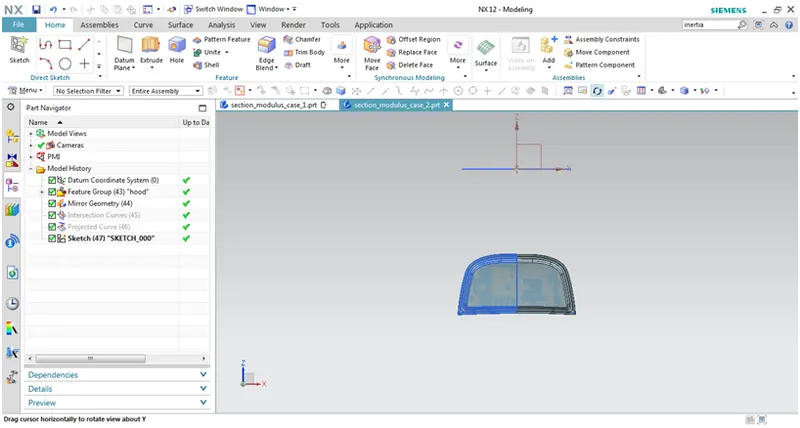
I created an intersection curve in the hood for finding section inertia analysis.
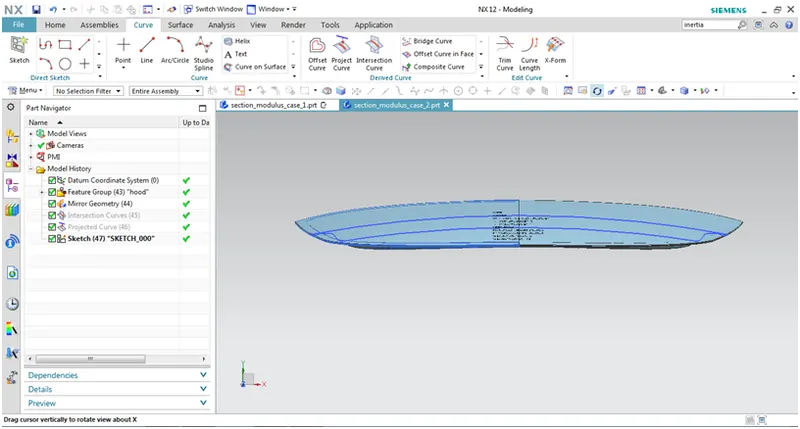
And then intersection curve is projected using the project curve command.
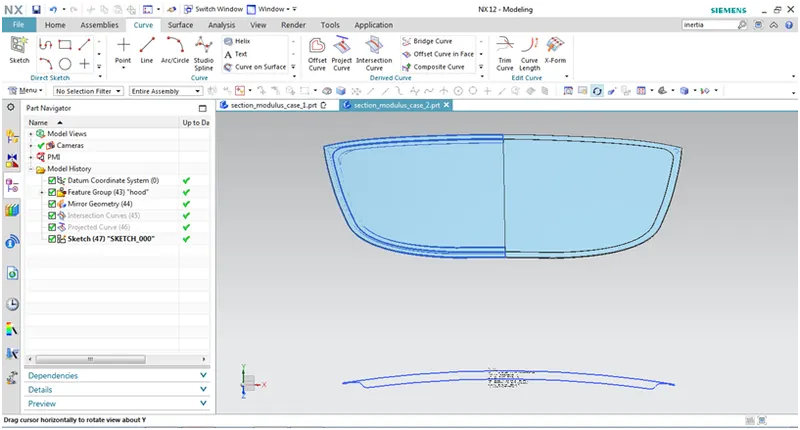
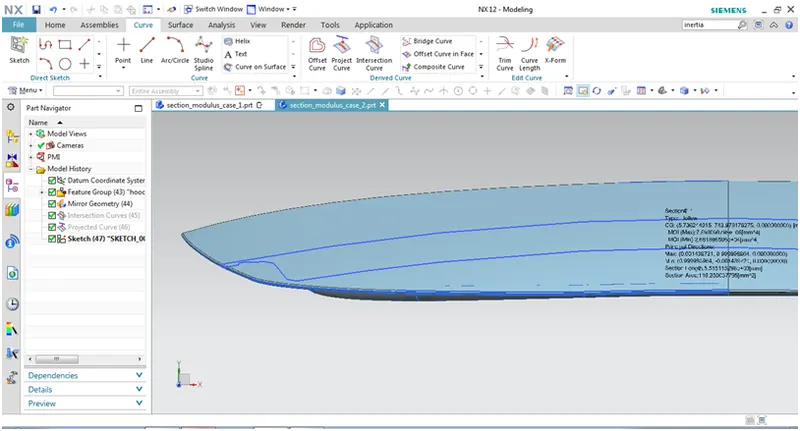
Value of case 2:
Section#: 1
Type: Hollow
CG: (5.736244015, 743.979176275, 0.000000000) [mm]
MOI (Max):7.593090795e+06[mm^4]
MOI (Min):2.681896506e+04[mm^4]
Principal Directions:
Max: (0.001439721, 0.999998964, 0.000000000)
Min: (0.999998964, -0.001439721, 0.000000000)
Section Length:5.515115298e+03[mm]
Section Area:110.259037795[mm^2]
Imax = MOI (Max):7.593090795e+06[mm^4]
Imin = MOI (Min):2.681896506e+04[mm^4]
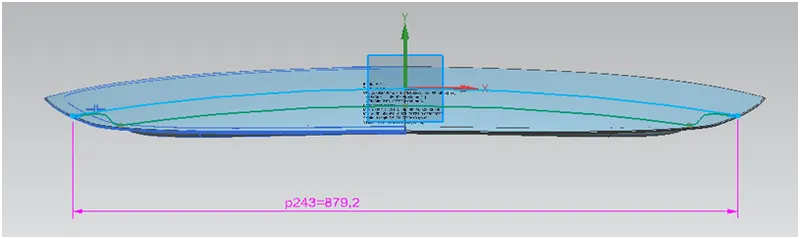
Total length of 'Y' value: 879.2mm
So, at neutral axis we need 'Y' value: Y/2=879.2/2
=439.6mm
Section modulus(s) = Imax /Y
= 7.593090795e+06[mm^4]/ 439.6mm
= 17.272×103 mm3 (Max strength)
Section modulus(s) = Imin/Y
= 2.681896506e+04[mm^4]/ 439.6mm
= 0.061×103 mm3 (Min strength)
As a result, the strength of a hood can vary between 17.272×103 mm3 (Max strength) and 0.061×103 mm3 (Min strength)
CONCLUSION:
- Section Modulus is directly proportional to the Moment of Inertia in the area
- Section modulus represents the strength so the section modulus depends on the area of the section
From the above point, we are comparing both cases 1 and 2
|
VALUE OF CASE 1: Section#: 1 At neutral axis we need 'Y' value: Y/2=897.9/2 = 448.95mm |
VALUE OF CASE 2: Section#: 1 At neutral axis we need 'Y' value:Y/2=879.2/2 =439.6mm |
|
1. Section modulus(s) = Imax /Y =15.688×103 mm3 (Max strength) 2. Section modulus(s) =Imin/Y = 5.542×103mm3 mm3 (Min strength) |
1. Section modulus(s) = Imax /Y =17.272×103 mm3 (Max strength) 2. Section modulus(s) =Imin/Y = 0.061×103 mm3 (Min strength) |
As a result, case 2 is more strength of a hood can vary between 17.272×103 mm3 (Max strength) and 0.061×103 mm3 (Min strength)