Underbody Coating
UNDER BODY COATING:
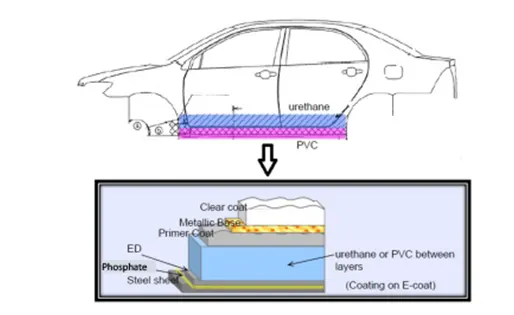
The undercarriage of the automobile is cladded with a dense layer of material that sprays or painted on when the car is freshly serviced and clean. But even if the undercarriage is already coated with rubber, it can still require repair.
Coatings for car under bodies protect them from corrosion for a long time, and they also protect parts that are not readily accessible, like internal body panels, frame rails, and other parts that are susceptible to corrosion.
The Difference between Rust Protection and Undercoating
Although undercoating and rust prevention are sometimes confused, they are two different concepts.
|
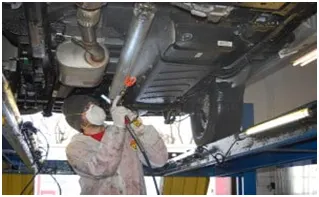
Rust protection is commonly applied inside the car, whereas undercoating is applied outside the vehicle and available in a range of coatings. |
Automotive undercoating you choose will be resolved by the extent of the damage and the level of protection you want for your vehicle. |
BENEFITS AND PURPOSE:
- Prevent Rust & Corrosion
- Stop or reduce existing rust from spreading
- Sound Deadening to reduce road noise
- Remains Pliable to resist Chips and Cracking
- Lasts 4x longer than Asphalt Based and Rubberized Undercoating
Type of under body coating:
- Rubberized Undercoating - Rubberized Undercoating Spray provides best-in-class protection for vehicle under bodies against minor road damage as well as rust, water, chemicals and salt. Specialized coating also deadens road noise and resists abrasion.
- Polyurethane Undercoating- This type of sealant works by seeping into all cracks and seams, displacing salt and moisture and oozing around rusty areas to bond with and protect unoxidized metal. It also sands quickly in case you'll need to perform bodywork and can be painted over.
- Wax or Paraffin-Based Undercoating- These undercoating does can be found in automotive parts stores in aerosol formats. Paraffin-based undercoating needs to be replaced at least once a year at the vehicle owner's expense. This type of coating is also thin set and relatively fast drying.
- Asphalt-Based Undercoating- Undercoating with an asphalt base has some benefits over undercoating with a wax base. They both stick well to a various surfaces and effectively seal off moisture, road chemicals, and oxygen. Asphalt undercoating, on the other hand, has the advantage of being less expensive. They last up to 5 years and dry to a Firm to Hard surface.If compared to Wax Based Undercoating, Asphalt Based Undercoating requires a thicker film thickness, which means you'll have to apply more products to the surface to be protected. Furthermore, because asphalt-based solutions can actually seal in rust and moisture, causing it to continue to grow, they require greater surface preparation. Finally, with time, asphalt-based products dry out, resulting in fissures in the surface.
|
ADVANTAGES: |
DISVANTAGES: |
|
· Rust Prevention · Sound insulation · Easy maintenance · Reinforcement · Increase life of car for rust
|
· Minor scratch protection · Enhances gloss · Not long-lasting · High cost · Risk of damage during application
|
APPLICATIONS OF UNDERBODY COATING:
- Commercial Vehicles - Tractor Trailers
- Passenger Cars and Light Trucks
- Utility Trailers
- Off-Road Vehicle
- Motor Homes
- Recreation Vehicles
- Or any surface where corrosion is a concern
THE FUNDAMENTALS OF CAR UNDERCOATING:
- If you want your car to be perfectly protected, you should apply an undercoating to the underside of your vehicle when it is new. This is because there is not yet debris, residue, and corrosion on the underside of the vehicle.
- Car undercoating is important because it defends vehicles from things like corrosive substances, road salt and minerals, and from the everyday wear and tear of travelling on the road. Traditional hard or rubberized undercoating versus soft oil undercoating is your choice.
- Many people use undercoating on their vehicles, but it is a personal preference whether it should be applied before or after the rust has formed.
- Debris, corrosion, and spill over from the road can spoil the new paint job. The best time to apply an undercoating to a car is when the car is new. This is because there is not yet debris, residue, and corrosion
- Prioritizing the removal of rust can be more successful, but it's difficult since rust, like cancer, creeps deep underground the metal surface. As a result, we believe that visualising corrosion is still not worth the time and effort or the money.
- Oil undercoating, unlike standard rubberized, paint, or wax undercoating, penetrates through rust to the good metal, displacing moisture and preventing oxidation.
MODERN AUTOMOTIVE COATING PROCESSES:
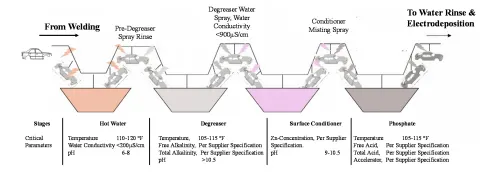
- Modern automotive coating methods consist of five main steps. They include the following: ‚ Pre-treatment: removes and cleans excess metal and forms an appropriate surface structure enabling bonding of a corrosion protection layer.
- The next step is electrode position (ED) of the anti-corrosion or rust prevention layer.
- A sealer like Poly Vinyl Chloride (PVC) is applied for anti-corrosion, elimination of water leaks, and minimization of chipping and vibration noise.
- A primer is then applied to promote adhesion between the surface and the basecoat; it also imparts a smoother surface for subsequent layers and has anti-chipping properties. ‚
- Finally, the topcoats that include a basecoat and clear coat are applied; they provide surface properties that are sought after, including colour, appearance, gloss, smoothness, and weather resistance.