Section Modulus calculation and optimization
AIM: Section Modulus calculation and optimization
THEORY:
Section Modulus is the geometric property of the given cross-section of any shaft or beam structures. It is the direct measure of the strength of the shaft section or the beam section. Higher the section modulus of a structure, the more resistive it becomes to bending.
The section modulus is classified into two types,
- Elastic section modulus
- Plastic section modulus
In our case, we need elastic section modulus (S), which is the ratio of moment of inertia (I) and the distance between the neutral axis and the extreme end of the object (y).
S = I/y
Also moment (M) = S * σ, where σ is the stress of the material. Because there is a relation in bending stress equation between this section modulus and moment.
Bending stress equation or simply bending equation implies a mathematical equation that aims to find the amount of stress on the beam. However, the bending moment equation stipulates a set of assumptions that one has to take into account to arrive at the exact data of flexure stresses.
M/I = σ/y = E/R
where,
M = Bending moment.
I = Moment of inertia exerted on the bending axis.
σ = Stress of the fibre at a distance ‘y’ from neutral/centroidal axis.
E = Young’s Modulus of beam material.
R = Curvature radius of this bent beam.
When we take the first relation ie,
M/I = σ/y
by rearranging we can write,
M/σ = I/y
therefore, M/σ = S, (because S = I/y)
So we can say that section modulus is directly proportional to moment and inversely proportional to stress.
Section Modulus Calculation of Hood
First, we create a section drawing from the hood as shown below,
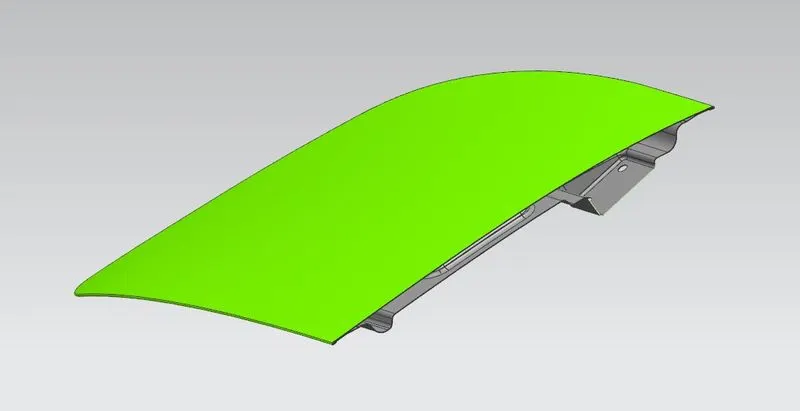
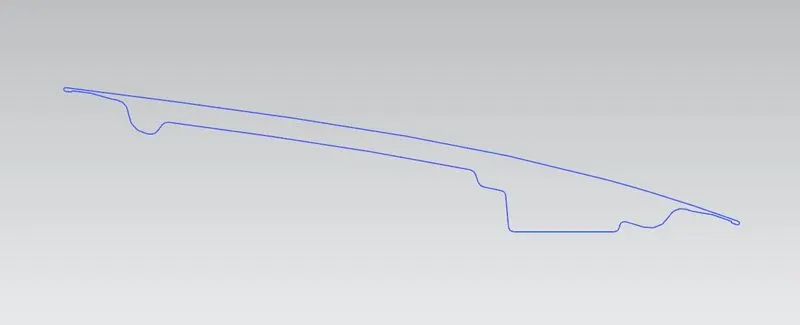
Case 1 Study - Actual Hood
We calculate section inertia using the analysis tool 'Section Inertia Analysis' in NxCAD. ie,
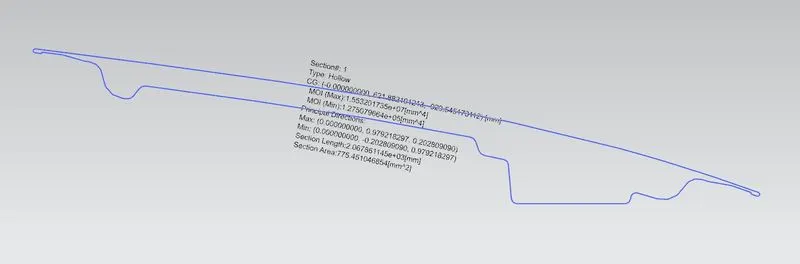
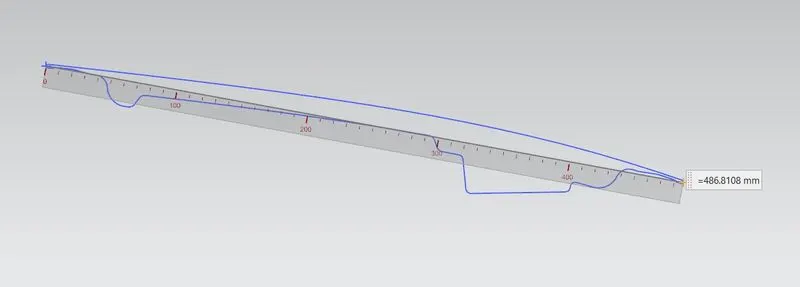
From this we get that,
Imin = 1.275 * 105 mm4
Section area (A) = 775.45 mm2
y = 486.811/2 mm = 243.405 mm
Therefore, S = Imin/y
= 1.275 * 105 /243.405 = 523.818 mm3
Case 2 Study - Improved Section Modulus
From the section modulus equation, we can find that section modulus is directly proportional to the moment of inertia. So by improving the moment of inertia value we can increase the section modulus, for that we give an extra emboss as shown in the figure,
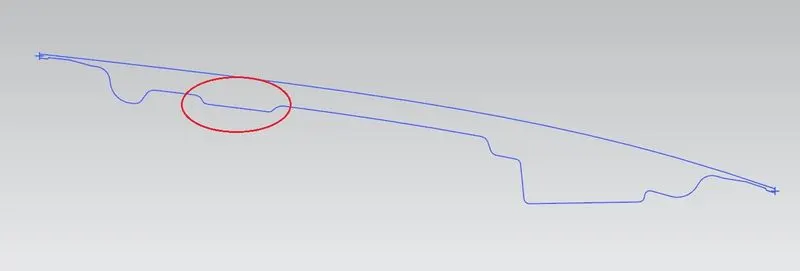
Then, we get
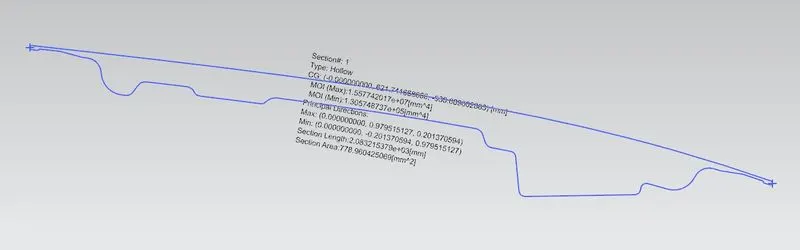
Section area (A) value is increased from 775.45 mm2 to 778.96 mm2
So, Imin value is also increased from 1.275 * 105 mm4 to 1.306 * 105 mm4
y = 243.405 mm (same value)
Therefore, S = Imin/y
= 1.306 * 105 /243.405 = 536.554 mm3
CONCLUSIONS:
- The study shows that section modulus can be improved by increasing the area, which will increase the moment of inertia of the section (S = I/y).
- And section modulus is inversely proportional to stress (M/σ = S) so, it helps to improve the resistance power of the structure against bending by increasing the section modulus.
- Therefore by increasing the section modulus, we can increase the strength.