Section Modulus calculation and optimization
CALCULATING THE SECTION MODULUS OF THE HOOD ASSEMBLY
SECTION MODULUS:
Before geting towards section modulus we need to understand what bending moment is and how we derive the expression of section modulus from the bending equation.
AREA MOMENT OF INERTIA: The area moment(I) of inertia is a property of two dimensional plane shape which characterises its deflection under loading. It is also known as second moment of inertia or second moment of area. The second moment of length has a dimension of length to the fourth power.
BENDING MOMENT: Bending moment(M) for any beam is defined as the ability of the beam to resist bending when an external bending force is applied on that particular beam. Higher the bending moment higher will be the value of bending strength of a beam.
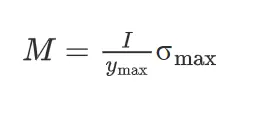
where M = Bending Moment
I= Area Moment Of Inertia
ymax=Maximum distance from the neutral axis
σmax= Maximum Bending Stress
For a beam which has been bent, the maximum stress σmax will occur at the maximum distance ymax from the neutral axis.
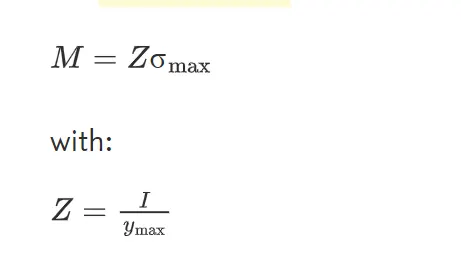
Section modulus(Z) is defined as the ratio of area moment of inertia to the distance of the fibre from the neutral axis.
From the expressions it is clear that more the value of section modulus more will be the strength of the beam under bending which means beam will be stronger and can sustain larger bending stresses.
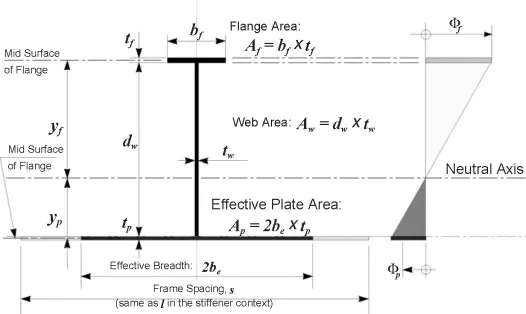
The section modulus(Z) depends upon shape, area as well as orientation hence hence sometimes it is also called as deposition of area, it means if the cross section which is having higher deposition of area will have higher bending strength.
METHOD TO CALCULATE SECTION MODULUS:
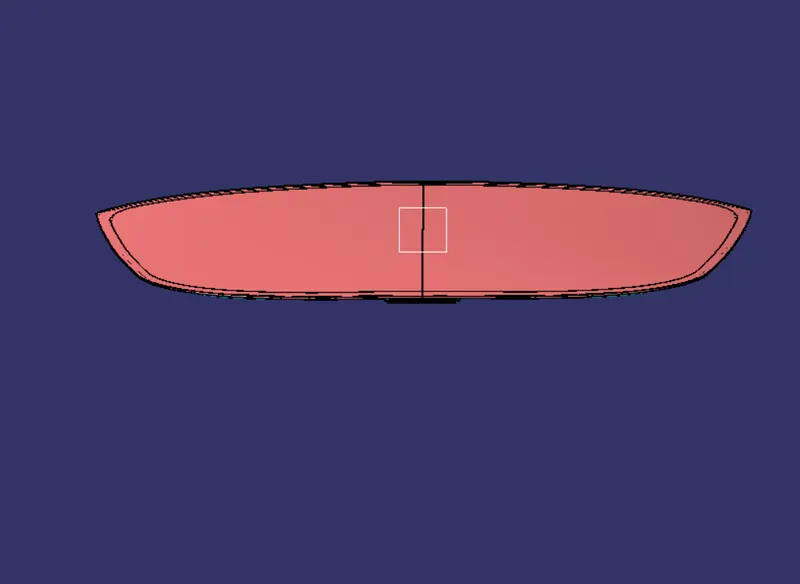
The hood outer panel and inner panel assembly model is being taken here to calulate the section modulus of the same.
Before doing any operations we'll first go to the tools section and we'll click on the "generate CATPart from product" option to convert the Hood Assembly product file into single CAT Part file where all the imported part files will be converted as a part body in the converted file. As we just want to measure the inertia of the part models so in that case we can make the tree structure simple and short by using that option.
Here we wanted to calculate the section modulus of the hood outer and inner panel assembly as a single unit. Since we know that for calculating the section modulus we need two parameters one is area moment of inertia and the other is the maximum distance from the neutral axis of the model.
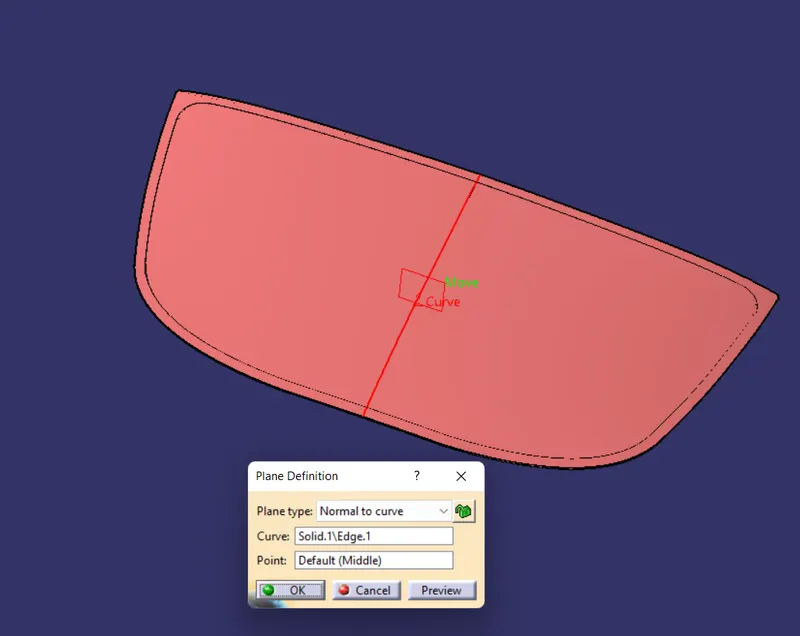
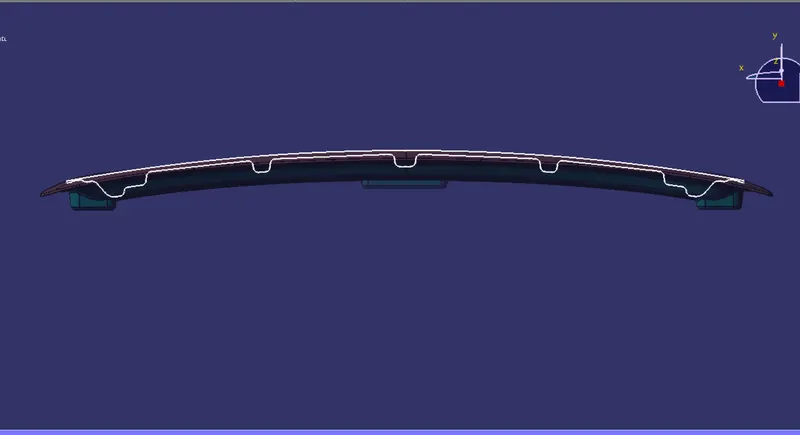
Hence in order to find out the value of area moment of inertia first we'll have to take out the cross section of the model, for that we'll create a plane normal to the curve line joining both the halves of the hood panels, that plane should be approximately in the middle of the hood panels.
After the plane creation we'll create a position sketch on that plane and we'll be using "intersect 3d element " command to project the cross-section of the hood panels in the sketch by intersecting the hood panels with the sketch plane itself.
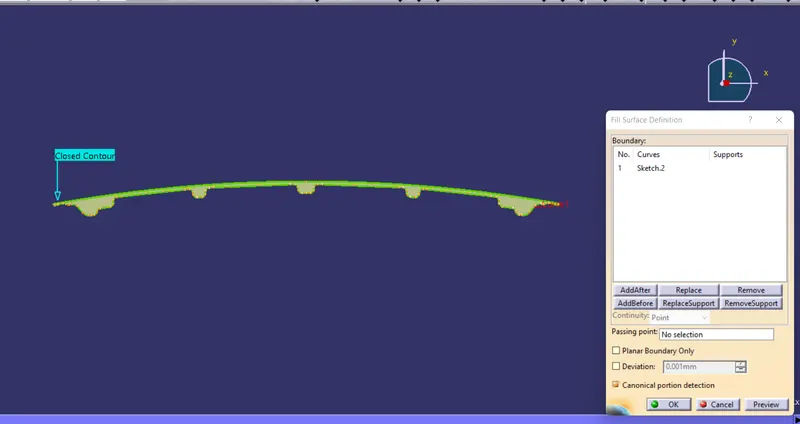
Since to calculate the area moment of inertia we need a single closed profile, so here we'll first isolate all the sketch profiles and we'll try to merge the exterior walls of the outer as well as inner panel by deleting off the interior walls and joining the disconnected exterior boundary line with the help of lines and splines.
As we are done with the closed profile of the cross-section of hood the next task will be to fill the closed profile using "fill" command which would to a surface formation which is nothing but the cross-sectional area of the hood.
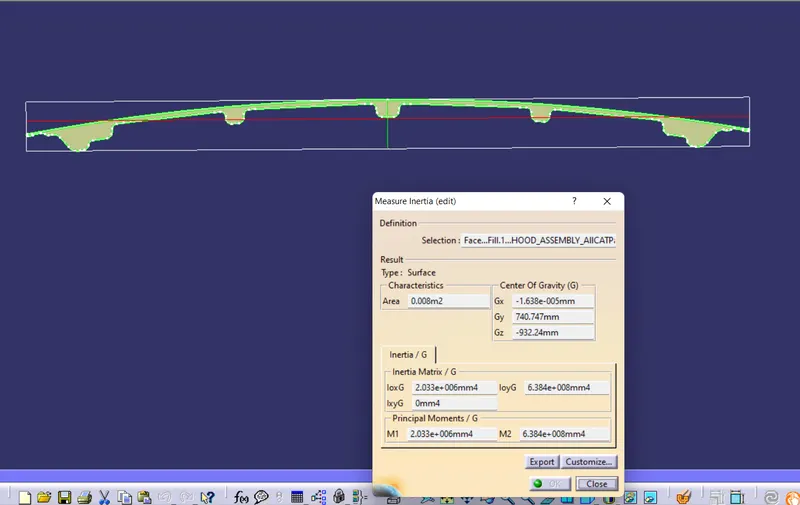
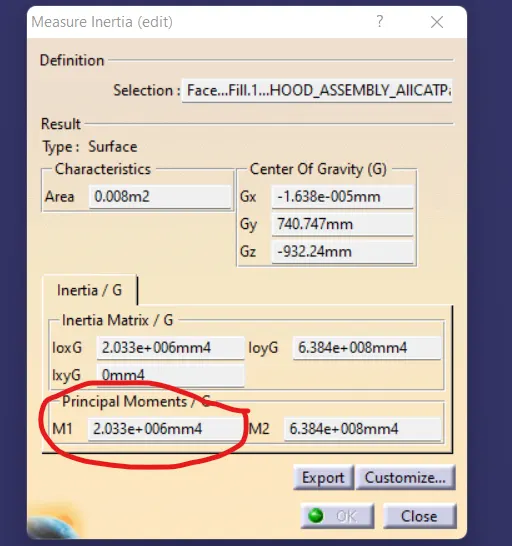
Now we'll pick up "measure inertia" tool from the measure toolbar and select the resulting fill as the selection and choose the measure inertia 2D option.
The Measure inertia dialog box will get opened and we can see several parameters here, M1 and M2 are the principle moments which shows the maximum and minimum values of area moment of inertia about X and Y axis of the cross- section.
The maximum value of the distance from the neutral axis of the cross-section can be calculated easily by measuring the length between the end most point and the centre most point of the cross-section profile.
SECTION MODULUS CALCULATION:
since we got the value of area moment of inertia from the above mentioned procedures and we can also find out the maximum distance of the beam from the neutral axis of the cross-section so now in order to find out the value of section modulus we'll apply the formula of section modulus which is nothing but the ratio of the area moment of inertia and maximum distance from the neutral axis.
Note: As we can from the measure inertia dialog box two values of moment of inertia are shown i.e maximum and minimum values of inertia. But for the calculation of section modulus we'll take minimum value of inertia because the portion having minimimum inertia will face deformation in the first place and the failure will start from that portion itself, that's why we need to design the component by taking into consideration the mimimum value of area moment of inertia.
RESULTS:
M=2.033x 10^6 mm4
Ymax = 440 mm
Z = 4620.45 mm3
OPTIMIZATION OF THE HOOD DESIGN FOR BETTER SECTION MODULUS.
As we know that section modulus is also called as deposition of area of cross section of a beam because larger the deposition of the cross-sectional area of the beam larger will be the value of section modulus and larger will be the strength of the beam against bending forces.
so here in order to improve the value of section modulus we can increase the cross- sectional area of the hood towards the extreme ends or side part of the hood where the hood faces greater values of bending stresses this is because these ends are at the maximum distance from the neutral axis.
And we'll reduce the same amount of area from the portion of the hood which is much nearer to the neutral axis as these areas faces less bending stresses.
IMPROVISED CROSS- SECTIONAL AREA:
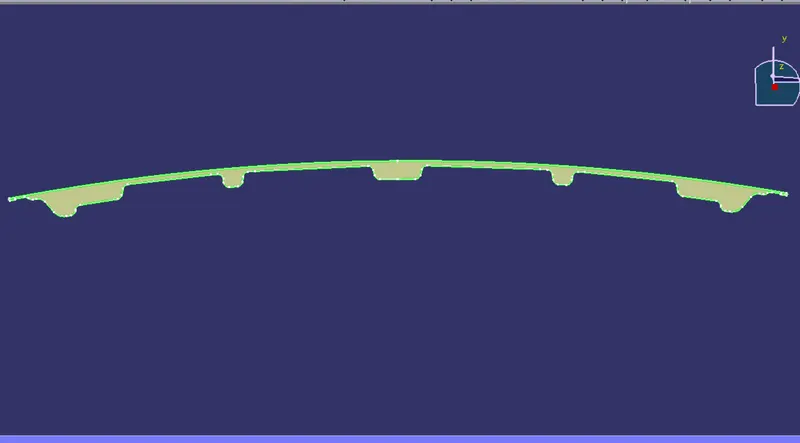
RESULTS:
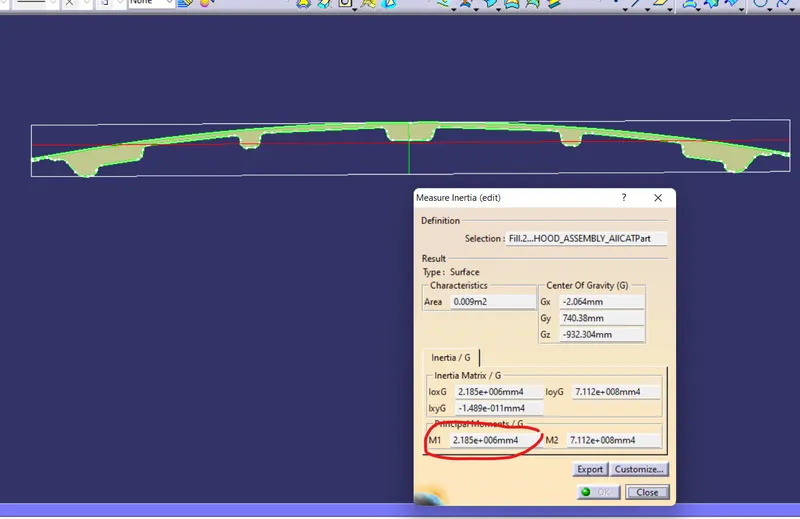
M=2.185X10^6 mm4
Ymax=440mm
Z= 4966 mm3
So, here we can see that the section modulus value has been improved by making changes in the cross-sectional area of the hood.