Section Modulus calculation and optimization
AIM: To calculate the Section Modulus of Hood by using the formula
INTRODUCTION
section modulus is a geometric property for a given cross-section used in the design of beams or flexural members. other geometric properties used in the design include an area for tension and shear, the radius of gyration for compression, and the moment of inertia and polar moment of inertia for stiffness. any relationship between these properties is highly dependent on the shape in question. equations for the section moduli of common shapes are given below
Section Modulus formula
section modulus is a direct measure of the strength of any sectional area of an object about a reference axis(neutral axis). Strength is nothing but the capability of supporting greater loads, so the higher the strength has high the capacity of supporting greater loads
S = I/y
Where,
S = Section Modulus
I = Moment of Inertia
y = distance between the neutral axis and the extreme end of the object
Moment of inertia: Moment of inertia is nothing but offering resistance against of moment, bending or twisting if we applied any external load on the body, how much resistance it offers to tend to deform, so higher the value of the moment of inertia has a higher resistance to deform under certain load hence we can say that moment of inertia directly proportional to the strength of the material, and it can be calculated by using section modulus
CASE 1
Calculate the Strength of a Hood panel
procedure:
- firstly take an existing hood model and by using the intersection curve we can extract the cross-section of the outer and inner panels.
- after can join the outer line and inner line and make it a completely closed sketch then only we can execute the section modulus.
- after trimming the remaining sketch then by using the command section inertia analysis we get the complete information.
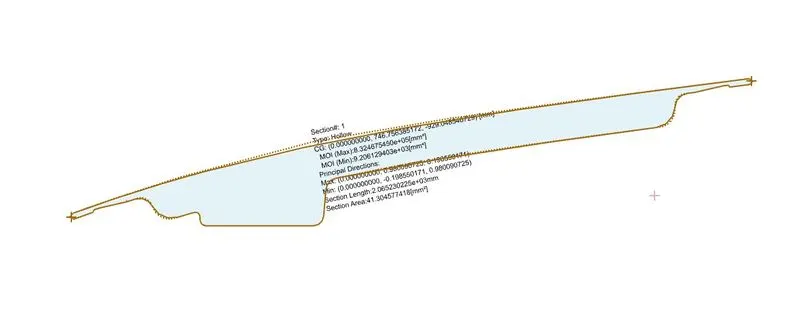
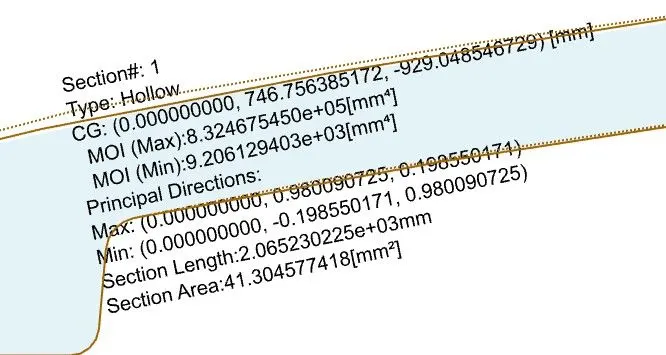
where
Max MOI = 8.324675450e+05 [`mm^4`]
Min MOI = 9.206129403e+03 [`mm^4`]
Total length of Y value 488.342 mm
At the neutral axis we need Y value = Y/2
= 488.342/2
Y = 244.171mm
- Section modulus at Max(S) = I/Y
SMax = 8.324675450e+05/244.171
SMax = 3.409x10^3 mm^3
- Section modulus at Min(S) = I/Y
SMin = 9.206129403e+03/244.171
SMin = 37.703615101711505461336522355235
SMin = 0.037x10^3 mm^3
From the result of these calculations, the strength varies from S Min 0.037x10^3 mm^3 to S Max 3.409x10^3 mm^3
CASE 2
Calculate the Strength of a Hood panel with case 2 (offsetting the inner panel curve 1mm)
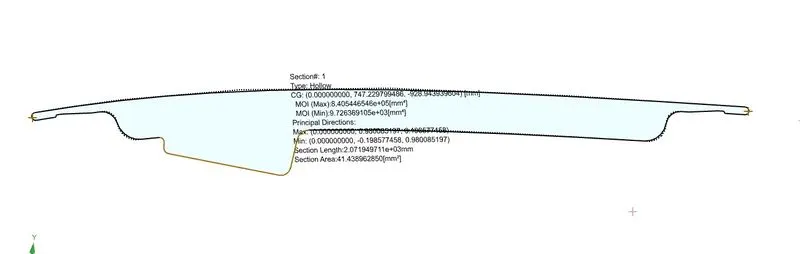
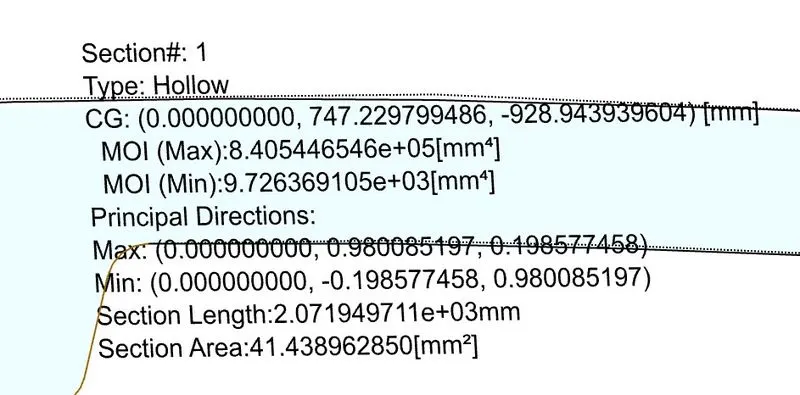
where
Max MOI = 8.405446546e+05 [`mm^4`]
Min MOI = 9.726369105e+03 [`mm^4`]
Total length of Y value 488.342 mm
At the neutral axis we need Y value = Y/2
= 488.342/2
Y = 244.171mm
- Section modulus at Max(S) = I/Y
SMax = 8.405446546e+05/244.171
SMax = 3.442x10^3 mm^3
- Section modulus at Min(S) = I/Y
SMin = 9.726369105e+03/244.171
SMin = 39.834251835803596659717984527237
SMin = 0.039x10^3 mm^3
From the result of these calculations, the strength varies from S Min 0.039x10^3 mm^3 to S Max 3.442x10^3 mm^3
CONCLUSION: Comparing both values there is a change in both maximum and minimum section modulus values, when I increased the cross-sectional area by 1mm the values increased. Thus the strength of the hood has been increased by increasing its cross-section or moment of inertia.