Section Modulus calculation and optimization
Aim- To calculate the section modulus of the designed hood and try out another way to increase the section modulus of the same hood by some means.
Theory-
What is Section Modulus (S)?
Section Modulus is the total moment resisted by the section to the stress in the extreme fibre. It gives an idea about how much load the structure can take. A high section modulus means better load-bearing capacity.
The formula for S is :
S = I / Y
- where S is the section modulus
- I is the moment of inertia
- Y is the distance between the neutral axis and extreme fibre.
What is a Moment of Inertia (I)?
Moment of inertia aka angular mass or rotational inertia can be defined w.r.t. rotation axis, as a quantity that decides the amount of torque required for a desired angular acceleration or a property of a body due to which it resists angular acceleration. The formula for the moment of inertia is the “sum of the product of mass” of each particle with the “square of its distance from the axis of the rotation”.
The formula of Moment of Inertia is expressed as
I = Σ miri^2
study 1
procedure
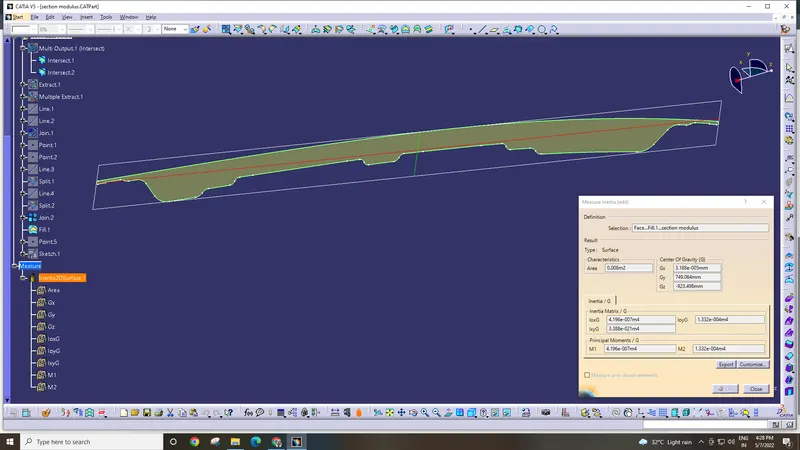
This is the designed hood previously made. yz plane is used to take the intersection of the part.
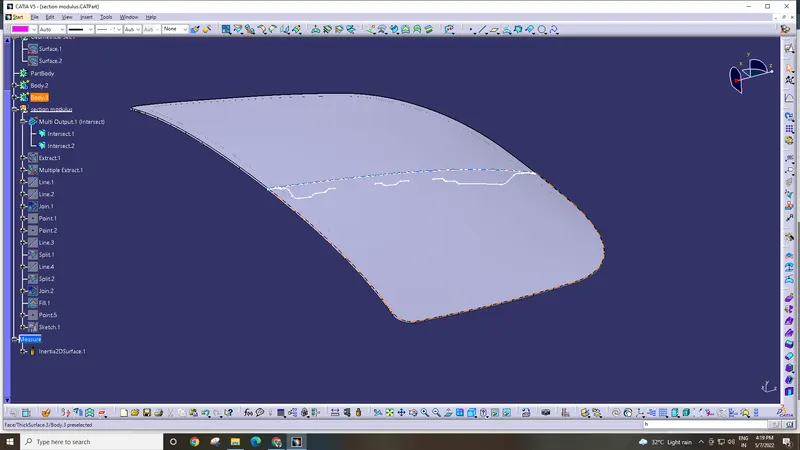
the extracting the outer curve of the outer panel and the inner curve of the inner panel.
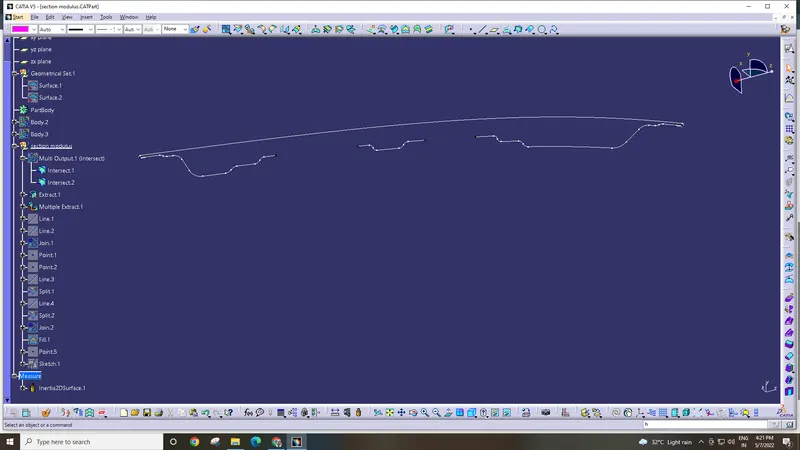
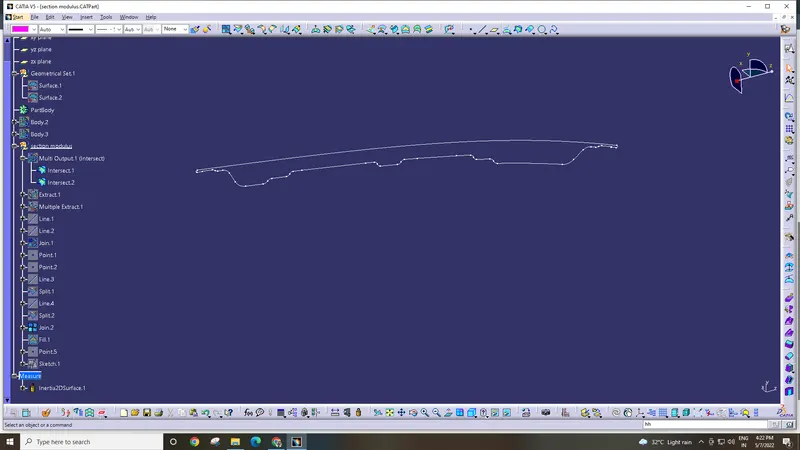
the connecting the gaps in the outer curve of the inner panel and joining the outer curve of the outer panel and the outer curve of the inner panel.
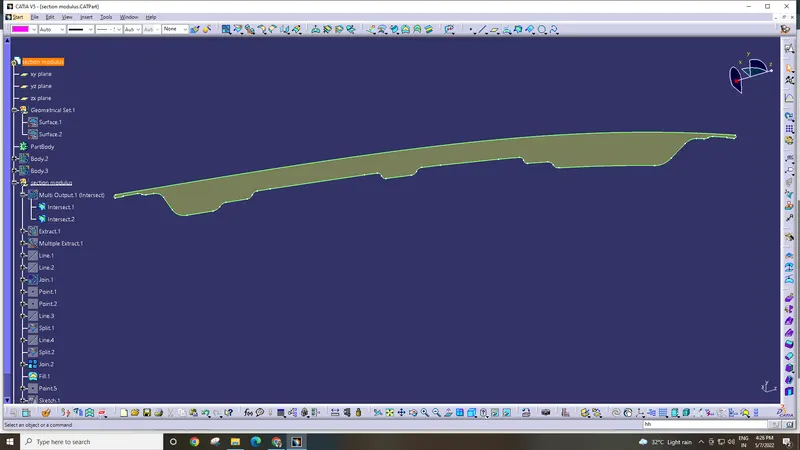
filling the closed sketch using the fill command
Measure the Moment of Inertia using the "Measure Inertia" tool
M1 and M2 are the inertia values. Convert these values to mm^4. For calculating the section modulus, we take the smaller value of M (which is M1 here)
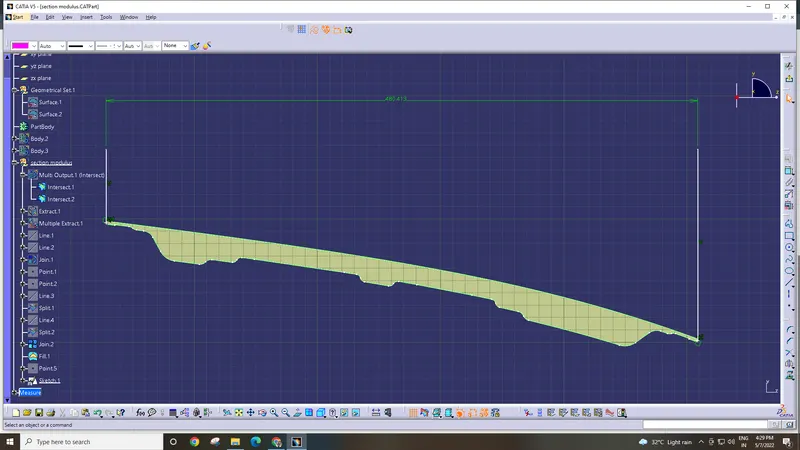
To get the Y value, we need to take the overall length of the section. For that, we can make a sketch and create 2 lines/axes and measure the distance between them. Half of that distance will be the value of Y.
Finally calculating the S1 (section modulus) value
M1 = 4.196 x 10^(-7) m^(4)
= 4.196 x 10^(-7) x 10^(14) mm^(4)
M1 = 4.196 x 10^(7) mm^(4)
M2 = 1.332X 10^(8) mm^(4)
We need to take the lowest value of M1. The lowest value of M determines the starting point of breakage. Here M1<M2, so M1 is to be taken.
Y is the distance between the neutral axis and the extreme end of the object. The overall length was found to be 480.413 mm. Taking half of this value will give us Y.
Y = 480.413 mm / 2 = 240.2065 mm
I / Y = 4.196 x 10^(7) mm^(4) / 240.2065 mm
So,
S1 = 174683.0331 mm^(3)
Study 2-
In this, we have to find a way to increase the section modulus of the hood by changing the section.
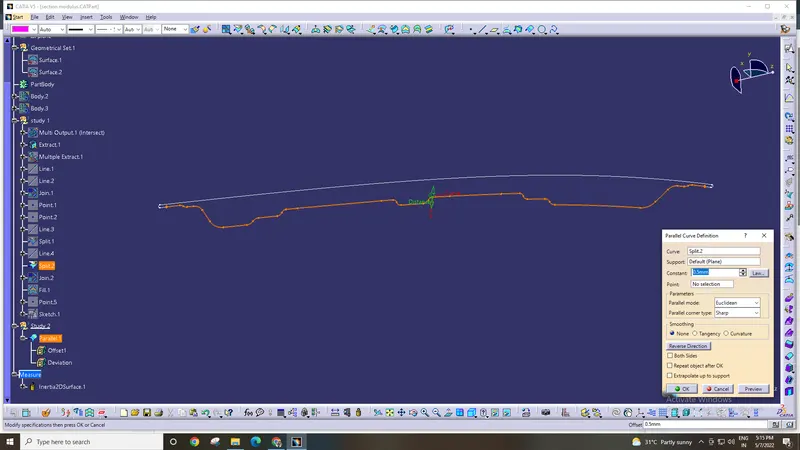
Make a parallel curve of the inner panel curve downwards for 0.5mm. Then try measuring the MI again.
In scenario 2, M1 has slightly increased to 2.742 x 10^6 mm^4 and M2 has become 0.001 x 10^12 mm^4.
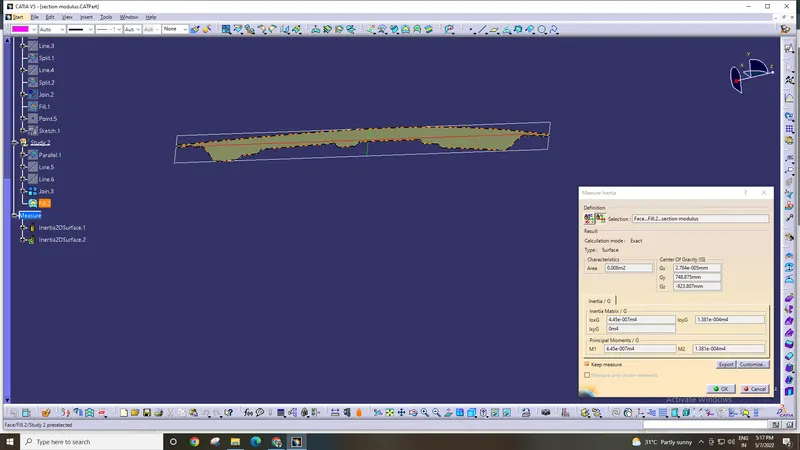
Finally calculating the S (section modulus) value
M1 = 4.45 x 10^(-7) m^(4)
= 4.196 x 10^(-7) x 10^(14) mm^(4)
M1 = 4.45 x 10^(7) mm^(4)
M2 = 1.381X 10^(8) mm^(4)
We need to take the lowest value of M1. The lowest value of M determines the starting point of breakage. Here M1<M2, so M1 is to be taken.
Y is the distance between the neutral axis and the extreme end of the object. The overall length was found to be 480.413 mm. Taking half of this value will give us Y.
Y = 480.413 mm / 2 = 240.2065 mm
I / Y = 4.45x 10^(7) mm^(4) / 240.2065 mm
So,
S1 = 185257.2682 mm^(3)
From this, we can see that
S1 = 174683.0331 mm^(3) and S2 = 185257.2682 mm^(3)
Hence we have successfully improved the section modulus by offsetting the inner panel curve downwards/inwards to 0.5mm.