Section Modulus calculation and optimization
Objective:
To analyze the Hood design we have created by undergoing section modulus on the model.
Section modulus:
Section modulus is a geometric property for a given cross-section used in the design of beams or flexural members. Other geometric properties used in design include area for tension and shear, radius of gyration for compression, and moment of inertia and polar moment of inertia for stiffness.
S = I/y (where S in the section modulus)
S = Section Modulus
I = Moment of Inertia
y = distance between the neutral axis and the extreme end of the object
Inertia is the inherent property of a body that makes it oppose any force that would cause a change in its motion. A body at rest and a body in motion both oppose forces that might cause acceleration. The inertia of a body can be measured by its mass, which governs its resistance to the action of a force, or by its moment of inertia about a specified axis, which measures its resistance to the action of a torque about the same axis.
The moment of inertia, otherwise known as the mass moment of inertia, angular mass, second moment of mass, or most accurately, rotational inertia, of a rigid body is a quantity that determines the torque needed for a desired angular accelaration about a rotational axis, and to how mass determines the force needed for a desired acceleration. It depends on the body's mass distribution and the axis chosen, with larger moments requiring more torque to change the body's rate of rotation.It is an extensive property: for a point mass the moment of inertia is simply the mass times the square of the perpendicular distance to the axis of rotation. The moment of inertia of a rigid composite system is the sum of the moments of inertia of its component subsystems (all taken about the same axis). Its simplest definition is the second moemnt of mass with respect to distance from axis.
Case study 1:
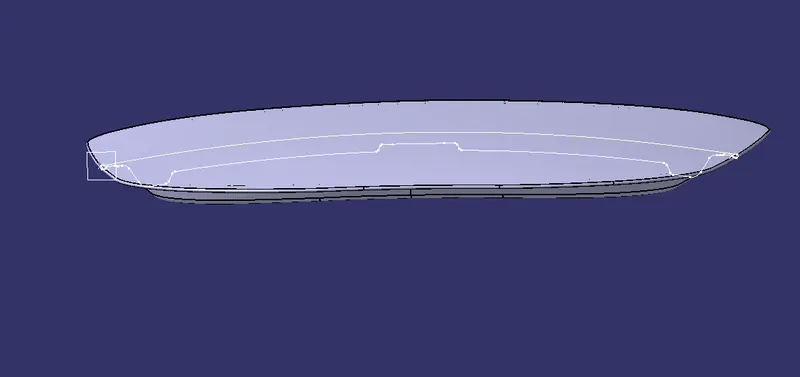
We now have the intersectionrunning through the inner and outer panel we take this intersection fill it with the surface and find its min and max intertia.
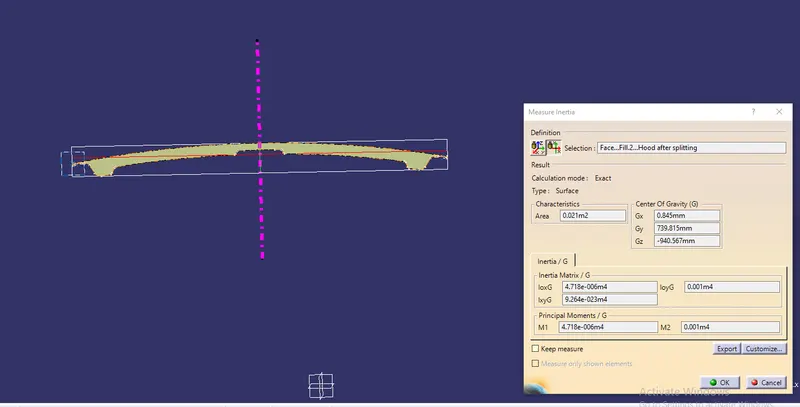
As we can see S= I/y
I= 4.718* 10^- 6 *10^12 mm^4.
y=442.4255
S=I/y
S=10,663.9422
Case study 2:
Now we have offseted the emboss surface to 0.5mm on the downside and find the sestion mouduls to get improved strength.
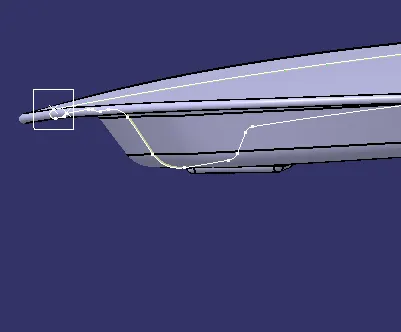
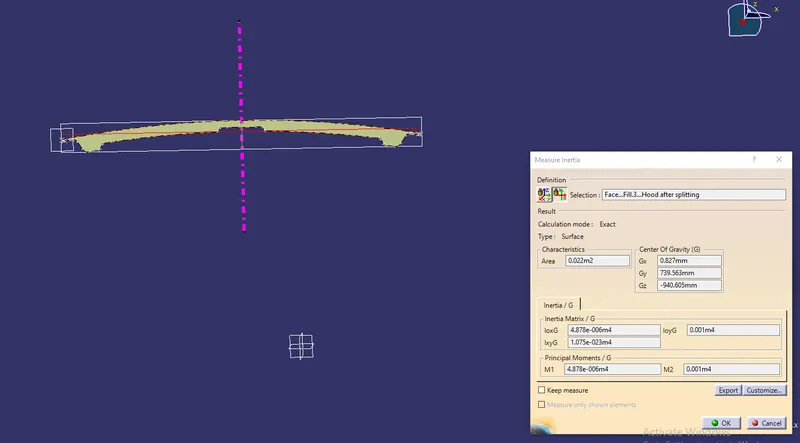
I=4.878 e^-6 *10^12mm^4
S=I/y=
=4.878*10^6/442.4255
S=11,025.59755
Case Study 3:
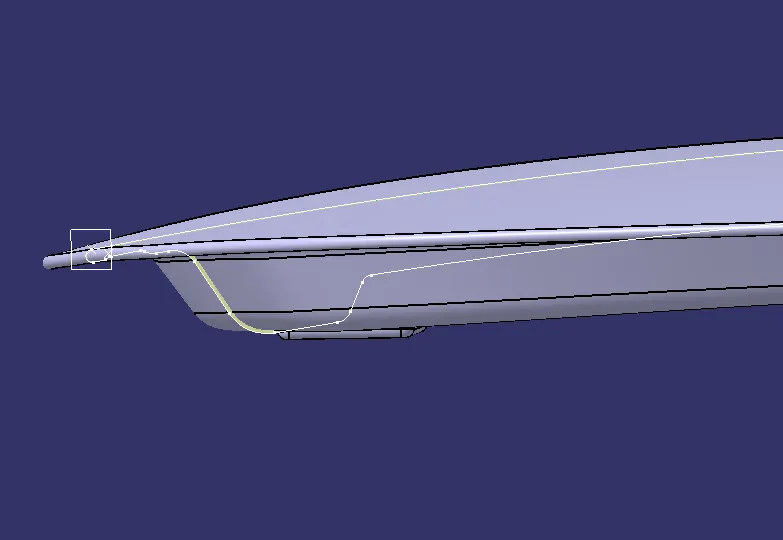
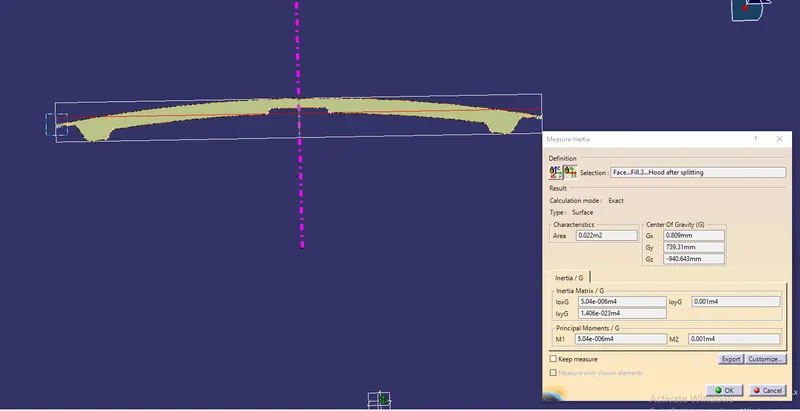
I=5.04*10^-6*10^12mm^4
S=11,391.7487
Conclusion:
As we can see clearly from the three case study that the section modulus value is increased with different surfaces. We take this data and use it for improvement of the Hood.