Section Modulus calculation and optimization
SECTION MODULUD CALCULATION AND OPTIMIZATION
OBJECTIVE: The main objective of this is to understand and learn the calculation and optimization of section modulus of hood design using NX CAD.
INTRODUCTION:
SECTION MODULUS: Section modulus is a geometrical property for a given cross section used in the design of beams or flexural members. Other geometrical properties used in the design include an area for tension and shear the radius of gyration for compression and the moment of inertia and polar moment of inertia for stiffness.
TYPES:
- Elastic section modulus(s)
- Plastic section modulus(z)
ELASTIC SECTION MODULUS:
For general design the elastic section modulus is used applying up to the yield point for most metals and other common materials.
The elastic section modulus is defined as S=I/Y, where I is second moment of inertia(or area moment of inertia, not to be confused with moment of inertia) and Y is the distance from the neutral axis to any given fibre. It is often reported using Y=C, where C is the distance from the neutral axis to the most extreme fibre
PLASTIC SECTION MODULUS:
The plastic section modulus is used for materials where elastic yielding is acceptable and plastic behavior is assumed to be an acceptable limit. Designs generally strive to ultimately remain below the plastic limit to avoid permanent deformations, often comparing the plastic capacity against amplified forces or stresses.
The plastic section modulus depends on the location of the plastic neutral axis (PNA).The PNA is defined as the axis that splits the cross section such that the compression force from the area in compression equals the tension force from the area in tension. So, for sections with constant yielding stress, the area above and below the PNA will be equal, but for composite sections, this is not necessarily the case.
The mathematical equation is K=Z/S
Where, K is shape factor
Z is plastic section modulus
S is elastic section modulus.
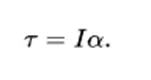
2.MOMENT OF INERTIA: The quantity expressing a body’s tendency to resist angular acceleration, which is the sum of the products of the mass of each particle in the body with the square of its distance from the axis of rotation.
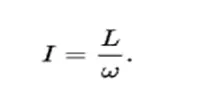
For simple pendulum the moment of inertia is
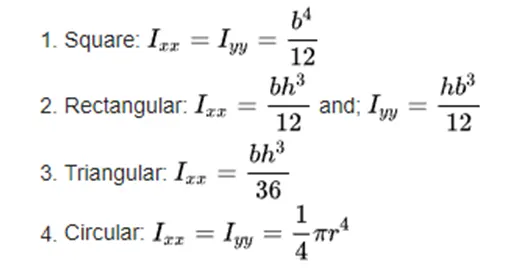
Moment of inertia for sectional areas are
SECTION MODULUS CALCULATION:
CASE 1:
Calculation of section modulus for hood design .
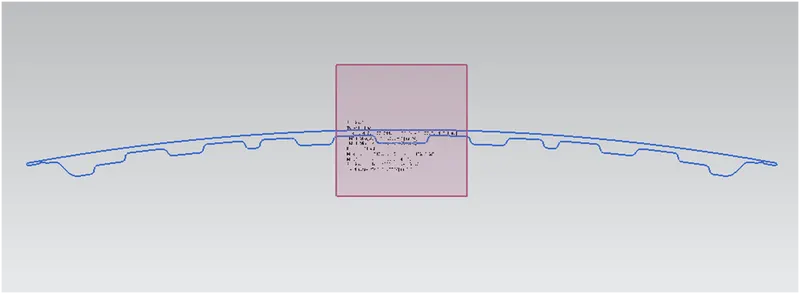
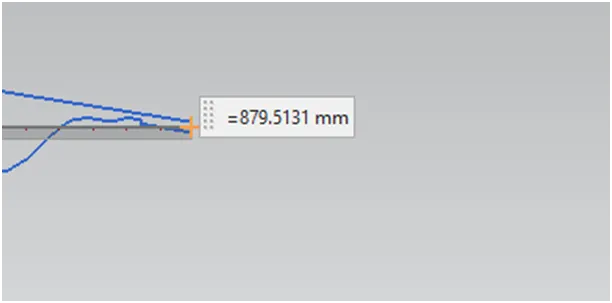
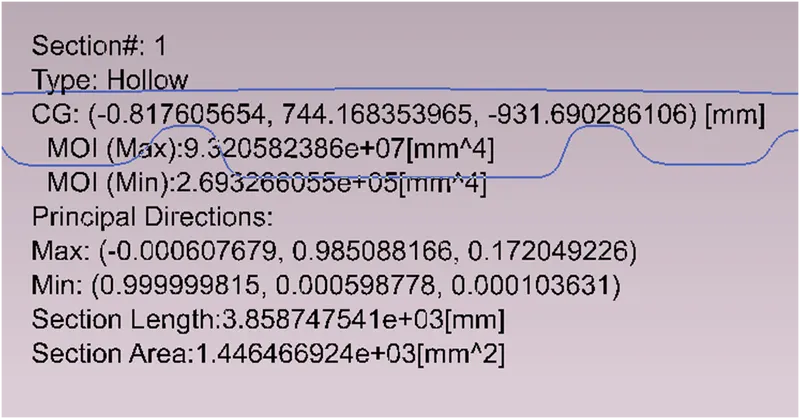
Maximum moment of inertia= 9.320585386*10^7 mm^4
Minimum moment of inertia= 2.693266055*10^5 mm^4
The total distance of the hood Y = 879.5131mm
Distance between the neutral axis to the extreme end = (879.5131)/2=439.75655
To find section modulus we have to calculate
S=I[minimum]/y
= [2.693266055*10^5]/439.75655
S=612.44 mm^3
CASE 2:
In this case we are modifying the sketch by adding some embosses at some places.
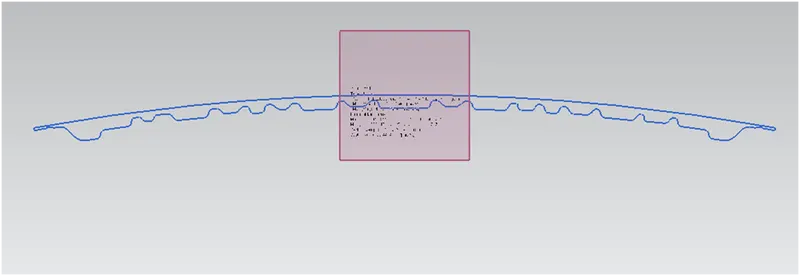
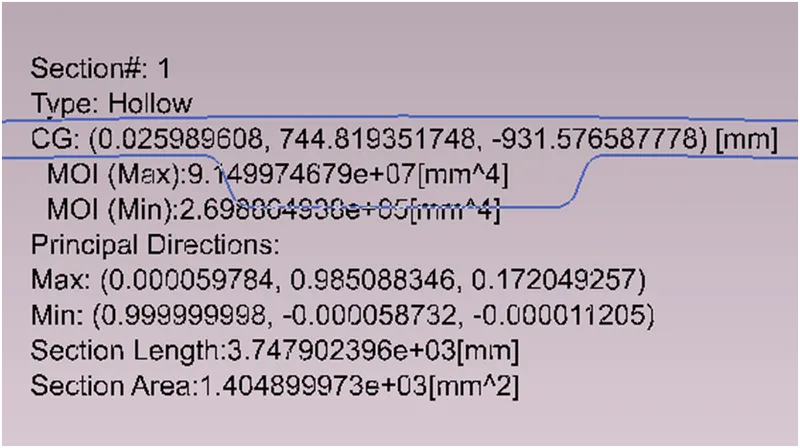
Maximum moment of inertia= 9.149974679 *10^7 mm^4
Minimum moment of inertia= 2.698864938*10^5 mm^4
The total distance of the hood Y = 879.5131mm
Distance between the neutral axis to the extreme end = (879.5131)/2=439.75655
To find section modulus we have to calculate
S=I[minimum]/y
= [2.698864938*10^5]/439.75655
S=613.71mm^3
RESULT:
Finally we got for case 1 it is 612.44 mm^3 and
for case 2 it is 613.71 mm^3
By comparing these two we can say that section modulus is directly proportional to the moment of inertia.
CONCLUSION: After the calculation of section modulus we can conclude that, as we increase the section area the moment of inertia as well as the strength also increases. These calculation is necessary to know the design actual withstand capability of product.