Section Modulus calculation and optimization
SECTION MODULUS AND OPTIMIZATION
The hood desing earlier carried out for the section modulus is taken from which the moment of inertia of the hood panel is calculated. Now for the same we are optimizing the hood section in order to increase the moment of inertia to increase the load and impact bearing capacity of the hood.
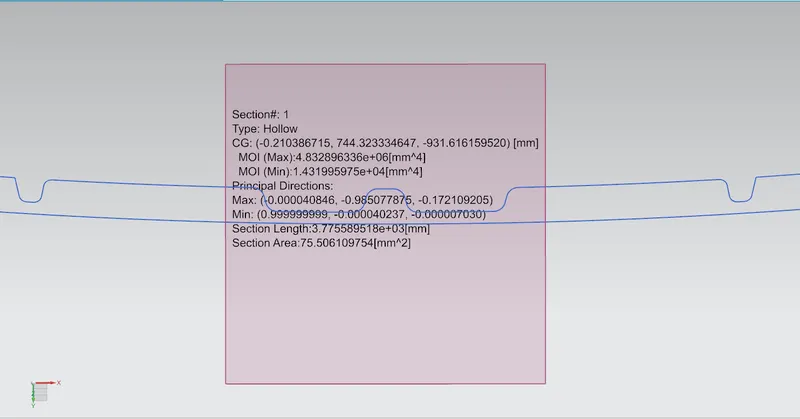
The observed Principal Moment of Inertia is given below for the hood panel.
Now, the governing equation for the section modulus is,
`S=I/y`
where, S is the section modulus,
I is the calculated moment of inertia
and y is the distance taken between the neutral axis and the outermost fibre.
S = 1.431995975*10^4 /(875.8365/2);
From the above equation the section modulus for the designed hood panel is calculated to be 0.03270 `mm`
Now, increasing the section modulus implies either increasing the moment of inertia or decreasing the neutral axis and the outermost fibre of the section.
By definition we are aware that section modulus is the direct measure of the strength of the component. Hence, higher it goes, the rigidity increases.
Since section modulus and the moment of inertia are diretly proportional, here we are trying to increase the torsional modulus of the hood.
Moment of inertia is a numerical value, which is based on the physical shape and the distribution of mass of the object.
Here, the steps carried in order to increase the moment of inertia is to increase the sectional area of the hood, as we can compare between the two images the sectional area has gone from 75.506 `mm^2` to 75.746 `mm^2`.
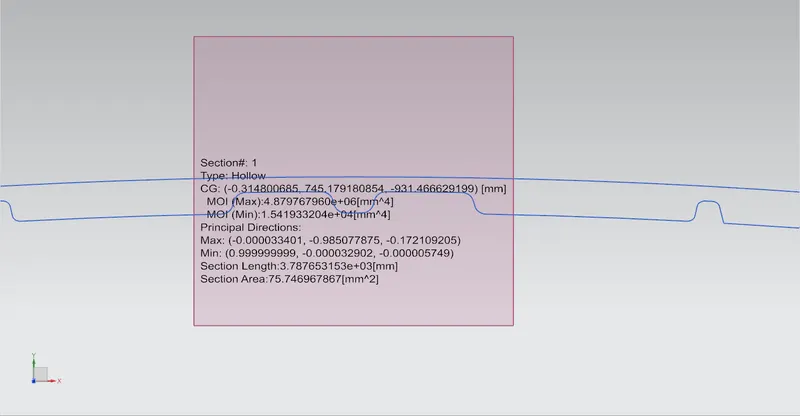
Now, calculating the moment of inertia for the devised and improved design:
S = 1.541933204*10^4 /(875.8365/2);
The new section modulus is found to be 0.03521 `mm`.
The sectional area increased increasing the principal moment of inertia of the hood. Implying the hood panel's minimum and maximum load bearing capacity has increased from the earlier design.
Conclusion:
Evidently from the above two desing calculations we found out that the minimal increase in the sectional area has resulted in a 0.00251`mm` of increase in the torsional modulus.