Section Modulus calculation and optimization
Aim:- To calculate the section of modulus of the designed hood and analyze the hood by increasing the depth of the inner panel.
Section Modulus
Section Modulus is the geometric property of the given cross-section of any shaft or beam structures. It is the direct measure of the strength of the shaft section or the beam section. Higher the section modulus of a structure, the more resistive it becomes to bending.
Section modulus is defined as the ratio of polar moment of inertia to the radius of the shaft or the distance from the neutral axis to the outer fibres.
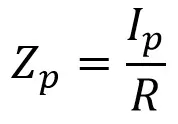
The common way of calculating Section_Modulus for a shaft requires is its diameters even if it is a solid or hollow shaft. If it is a beam (Square/rectangle in shape) then it will require the moment of inertia and the distance of the outer fibres from its neutral axes.
Following is the formula to calculate the section_modulus for the solid shaft
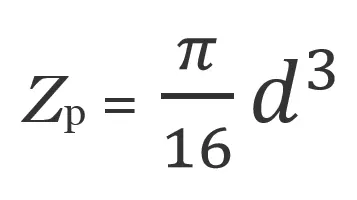
Where d is the diameter of the shaft.
If it is the hollow shaft then
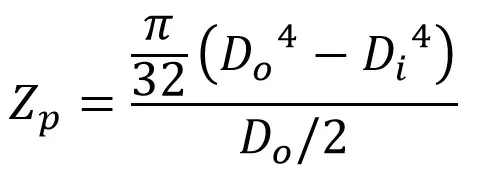
On the other hand, there are two types of section moduli, The Elastic Section_Modulus, and the Plastic Section_Modulus.
The Elastic Section Modulus has the same definition as the above-mentioned formula where it should be used for the materials which behave elastically under loading.
whereas the Plastic Section Modulus is used for the materials which have plastic behaviour as a dominant character.
The formula for the plastic section_modulus is defined as the sum of the product of the area of cross-section on each side of the plastic neutral axis and the distance from the local centroids of the areas to the plastic neutral axis.

What is Moment of Inertia?
Moment of inertia is defined as the quantity expressed by the body resisting angular acceleration which is the sum of the product of the mass of every particle with its square of a distance from the axis of rotation. Or in more simple terms, it can be described as a quantity that decides the amount of torque needed for a specific angular acceleration in a rotational axis. Moment of Inertia is also known as the angular mass or rotational inertia. The SI unit of moment of inertia is kg m2.
Moment of inertia is usually specified with respect to a chosen axis of rotation. It mainly depends on the distribution of mass around an axis of rotation. MOI varies depending on the axis that is chosen.
Moment of Inertia Formula
In General form Moment of Inertia is expressed as I = m × r2
where,
m = Sum of the product of the mass.
r = Distance from the axis of the rotation.
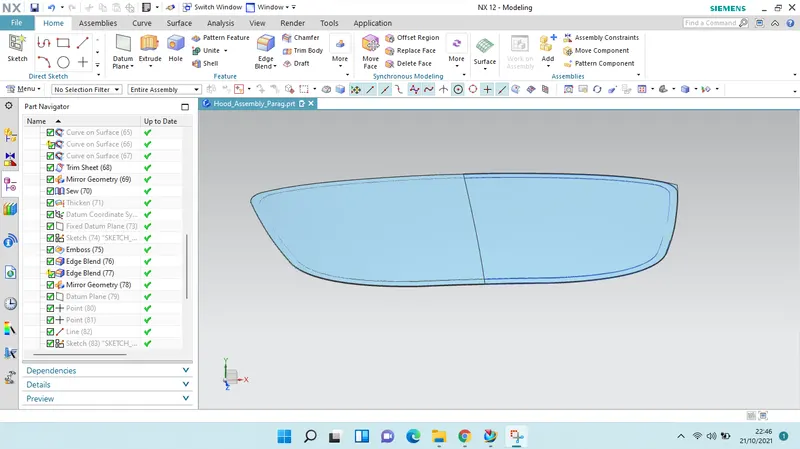
Case I
In this case have the results
moments of intertia (maximum) = 6.001514822e+06 mm^4
moments of intertia (minimum) = 1.665568058e+04mm^4
Y = 474.9
Hence.
S = I/Y
S = 1.665568058e+04/474.9
S = 95.33551034
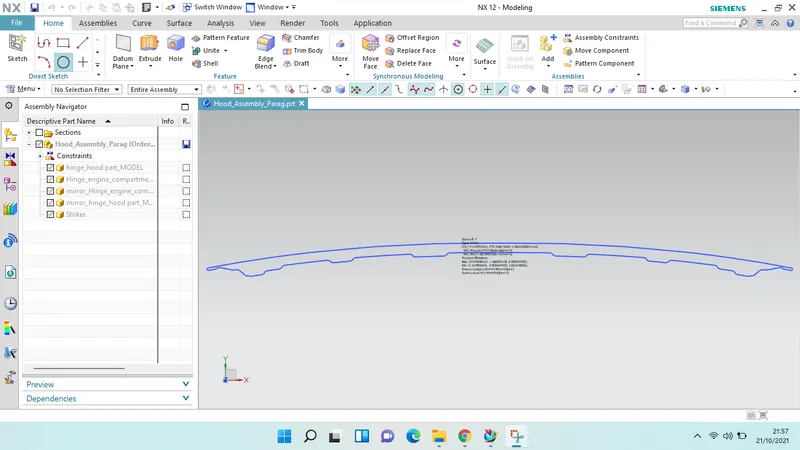
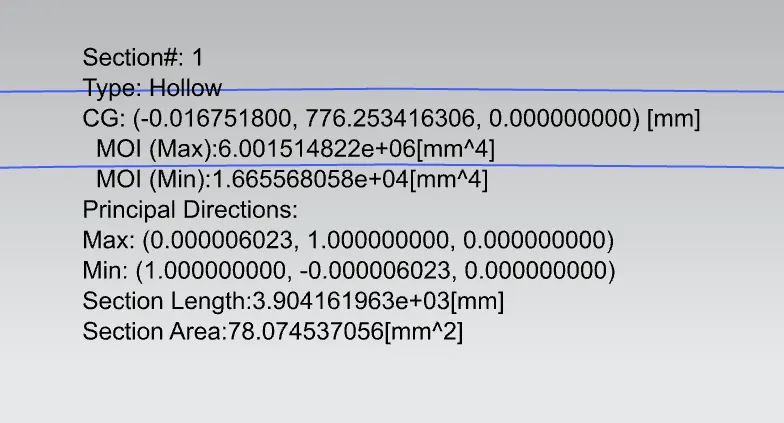
We have to find a way to increase the section modulus of the hood by changing the section.
Make a curve increase of the inner panel for 0.5mm.
Case II
In this case have the results
moments of intertia (maximum) = 6.293323436e+06 mm^4
moments of intertia (minimum) = 1.765783925e+04mm^4
Y = 474.9
Hence.
S = I/Y
S = 1.765783925e+04/474.9
S = 101.07177
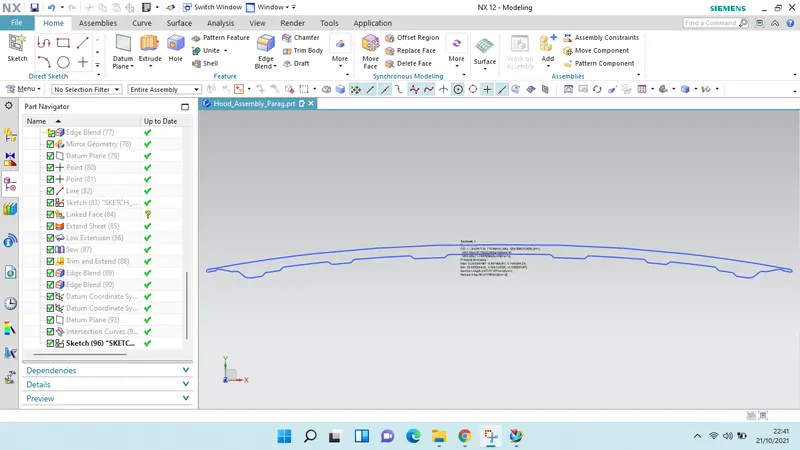
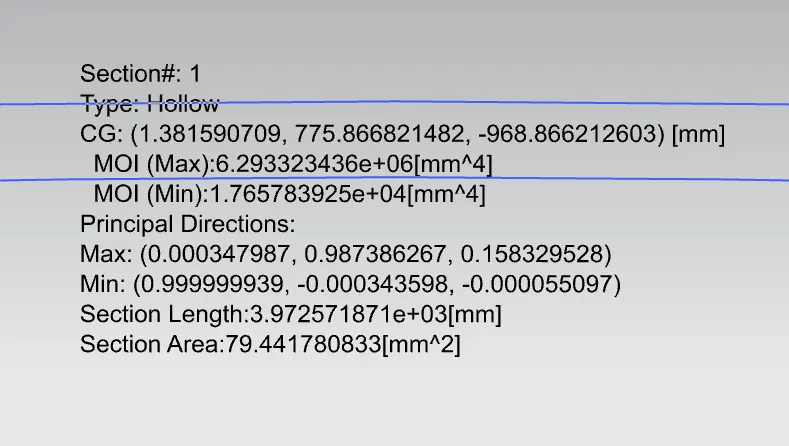
Conclusion
As I mention before we analyzed the hood and calculated the section modulus by changing the death of the hood 0.5mm, remain more valve will give more strength.