Section Modulus calculation and optimization
AIM:
To calculate the Section Modulus for the previously designed hood and to come up with the new section by optimization and altering the design.
Theory:
Use the Section from our Hood design and calculate the section modulus using the formula S = I/y
S = Section Modulus
I = Moment of Inertia
Y = distance between the neutral axis and the extreme end of the object.
Create a new section to improve the section modulus of the previous section.
Section Modulus
- Section modulus is a geometric property for a given cross-section used in the design of beams or flexural members. Other geometric properties used in the design include are for tension and shear, the radius of gyration for compression, and the moment of inertia and polar moment of inertia for stiffness
- It is formulated as the ratio of the moment resisted by the section to the stress in the extreme fiber.
- it gives us an idea about how much of the load the given structure can bear.
- if the section modulus increases the moment of resistance increases which in turn increases the load-bearing capacity of the body.
Moment of Inertia
The formula of MomenMoment of inertia is defined as the quantity expressed by the body resisting angular acceleration which is the sum of the product of the mass of every particle with its square of a distance from the axis of rotation. Or in more simple terms, it can be described as a quantity that decides the amount of torque needed for a specific angular acceleration in a rotational axis. Moment of Inertia is also known as the angular mass or rotational inertia. The SI unit of moment of inertia is kg m2.t of Inertia is expressed as I = Σ miri2.
Case I Analysis
Initially, we need to Extract the section of the previously designed hood
To get the section of the hood we need to take the intersection of the outer panel and inner panel
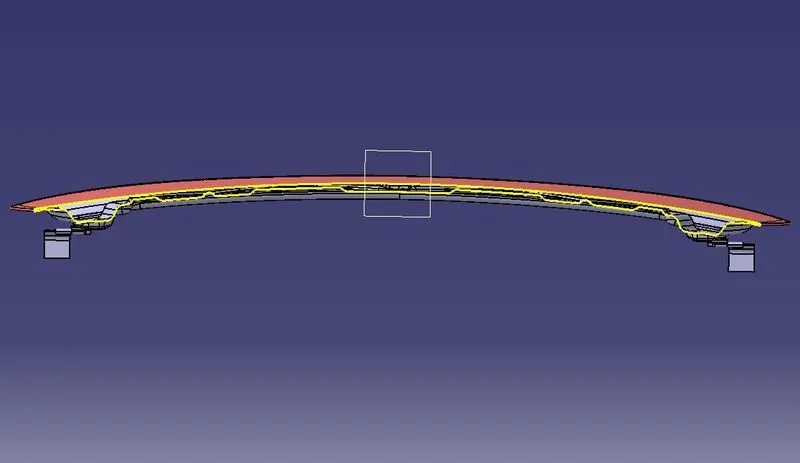
join both the outer lines of the outer panel and the inner panel and make it into a close profile
Now fill the closed contour using fill command.
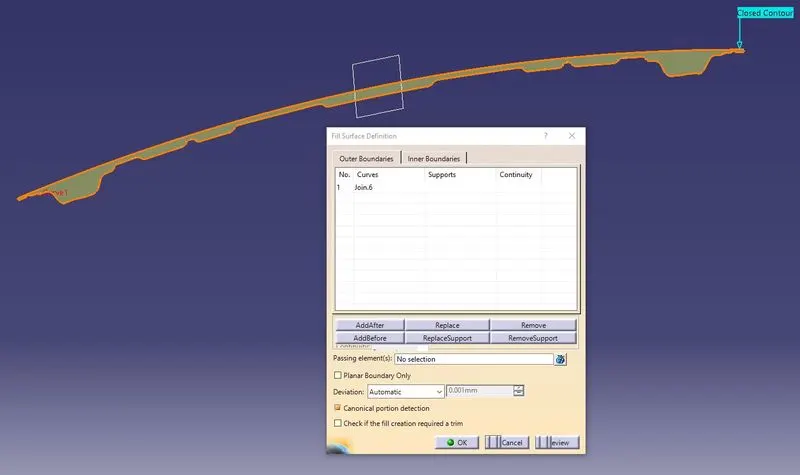
Now using the Mesure Inertia Command( ) measure the moment of inertia of the section we have created and calculate the section modulus
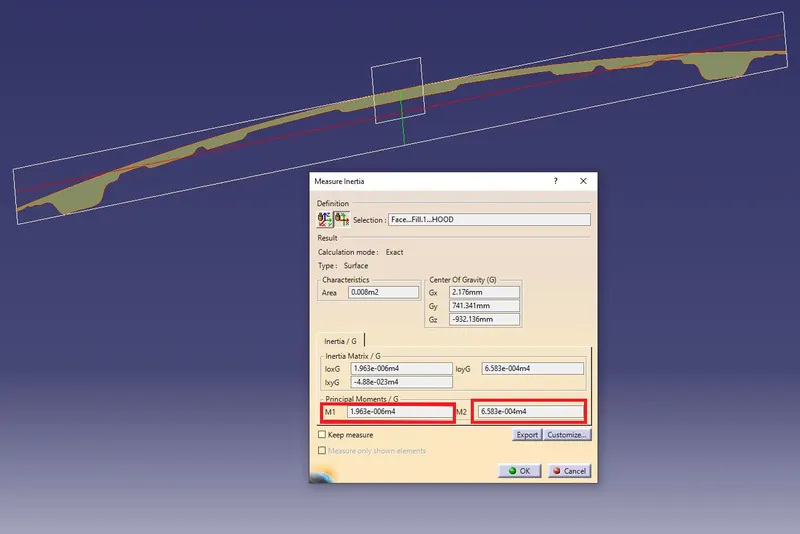
Note: M1 and M2 are the inertia values. as they are in meters (M) Convert them into mm4. For calculating the section modulus, we take the smaller value of M (which is M1 here)
For the value of "Y", we need to take two reference lines at the left and right most corners and measure the distance b/w them and take half of the total value as we need the distance between the neutral axis and the extreme end of the object.
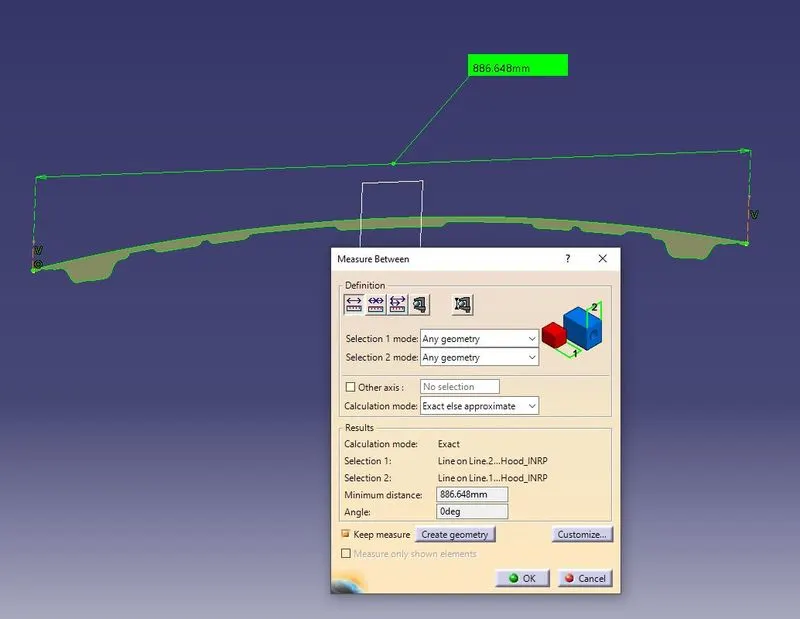
So from the above fig Y value = 886.648/2 =443.324mm
Calculation
M1 = 1.963 x 10⁻⁶ m4
= 1.963 x 10-6 x 1012 mm4
M1 = 1.963 x 106 mm4
M2 = 6.583 x 108 mm4
- We need to consider the lowest value. As the lowest value of M determines the starting point of breakage. Here M1<M2, so the M1 value should be considered.
- Y is the distance between the neutral axis and the extreme end of the object. The overall length was found to be 886.648 mm. Taking half of this value will give us Y.
Y = 886.648 mm / 2 = 443.324 mm
Section Modulus S =I / Y = 1.963 x 106 mm4/443.324 mm
So, S1 = 4,428 mm3
Case II Analysis
As we need to improve the strength of the new hood which we are designing we need to do some rework
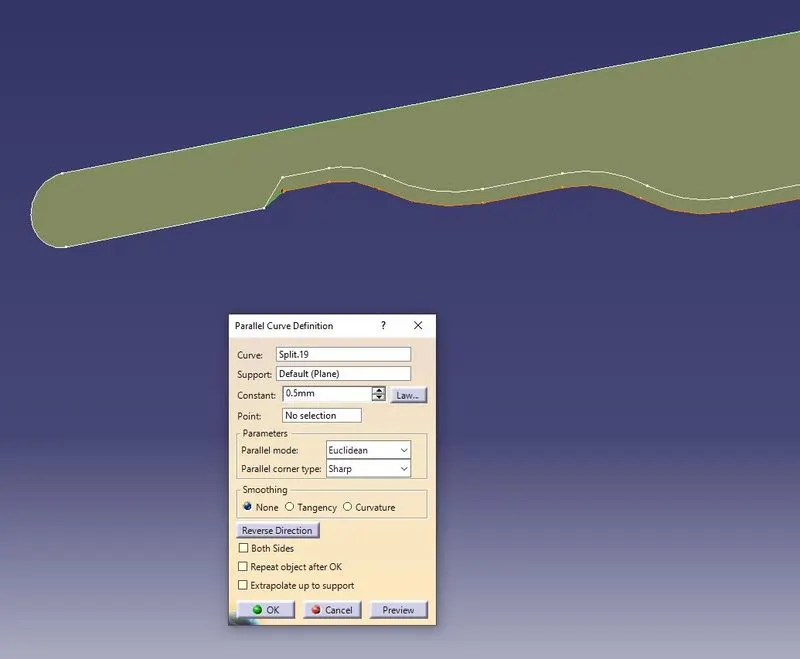
- Here I went with increasing the gap b/w the outer panel & the inner panel by offsetting the inner panel outer boundary at a value of 0.5mm
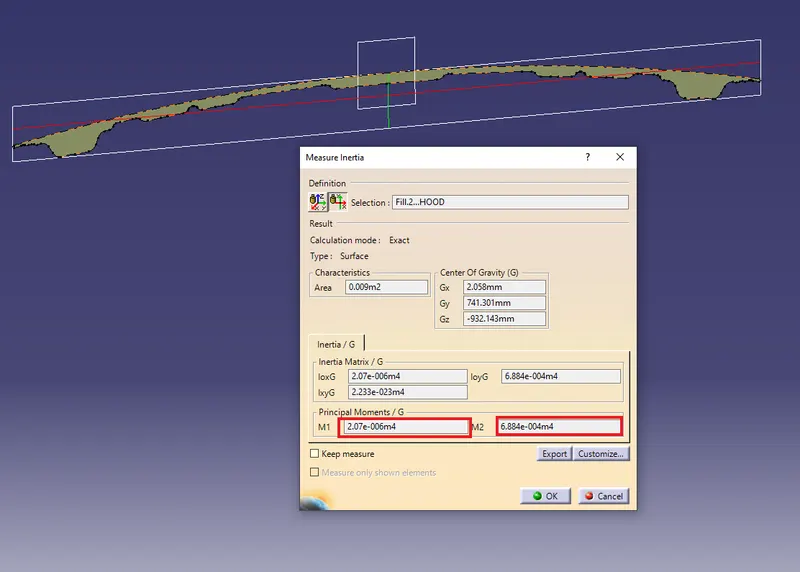
- Thereby making it into a close-loop and filling it. And go for the measure inertia to get the M values
Calculation
M1 = 2.07 x 10⁻⁶ m4
= 2.07 x 10-6 x 1012 mm4
M1 = 2.07 x 106 mm4
M2 = 6.884 x 108 mm4
here the value of the Y remains same So, Y = 886.648 mm / 2 = 443.324 mm
Section Modulus S =I / Y = 2.07 x 106 mm4/443.324 mm
So, S1 =4,669 mm3
Conclusion
From the above analysis, we knew that larger the area, in turn, increases the stiffness and capability of bearing greater loads.
In case II as we increase the area of the section of our new hood design, we got a positive output with good stiffness and load-carrying properties of the hood.