Section Modulus calculation and optimization
MOMENT OF INERTIA:
Moment of Inertia is the quantitative measure of the rotational inertia of the body i.e. the opposition that the body exhibits to having its speed of rotation about an axis altered by the application of a Torque. The axis may be internal or external and may or may not be fixed. The moment of inertia is always specified with respect to that axis and is defined as the sum of the products obtained by multiplying the mass of each particle of matter in a given body by the square of its distance from the axis.
the general form of Moment of inertia is `I = mr^2`
where,
m = mass distributed in the body.
r = distance from the axis.
The second moment of area is a measure of the 'efficiency' of a shape to resist bending caused by loading. A beam tends to change its shape when loaded. The second moment of area is a measure of a shape's resistance to change. Certain shapes are better than others at resisting bending as demonstrated in the diagram.
SECTION MODULUS:
For design purpose Section Modulus is used applying to the yield point for most metals and other common materials.
The Section Modulus is defined as `S = I/Y`
where
I = Moment of Inertia
Y = Distance from the neutral axis to the given fibre
In this assignment we will calculate the Moment of Inertia and Section Modulus of our Hood to determine how much force it can withstand and later on do some modifications to increase the strength of the hood.
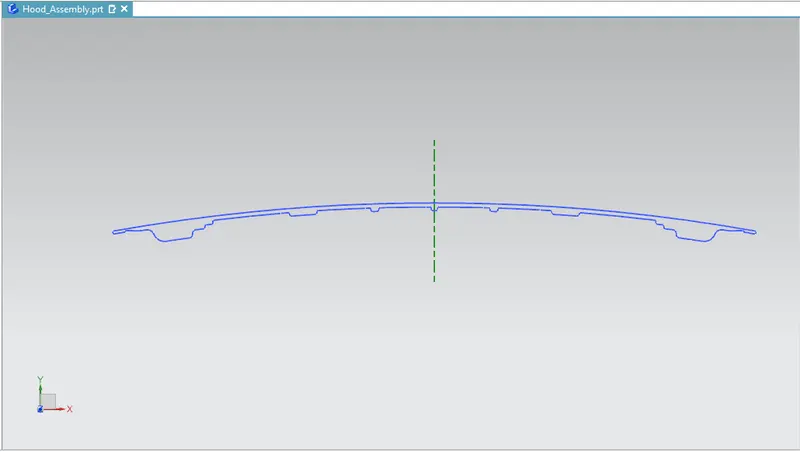
To calculate the Moment of Inertia we need to have the sketch of the cross-section of the hood so that we can calculate the same and we can calculate the Section Modulus of the Hood by creating a Neutral Axis.
SKETCH OF THE CROSS-SECTION:
CALCULATING THE SECTION MODULUS:
We can calculate the Moment of Inertia by using the predefined command 'Section Inertia Analysis' in NX.
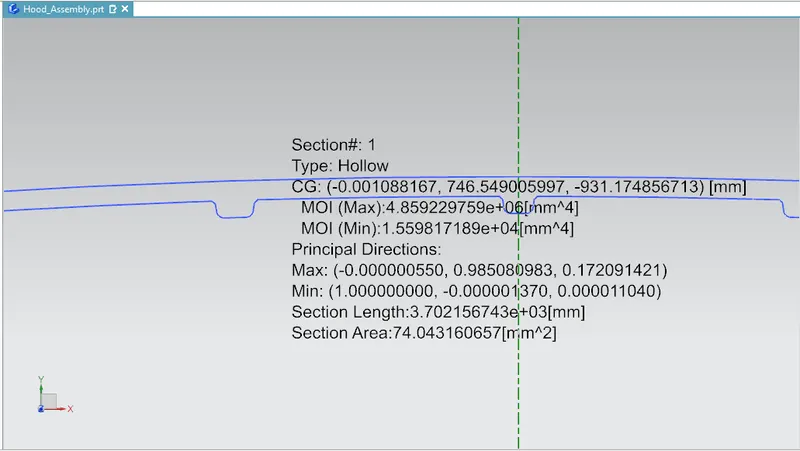
Moment of Inertia (MAX) = 4.859229759e+06 mm^4
Moment of Inertia (MIN) = 1.559817189e+04 mm^4
Section Area = 74.043160657 mm^2
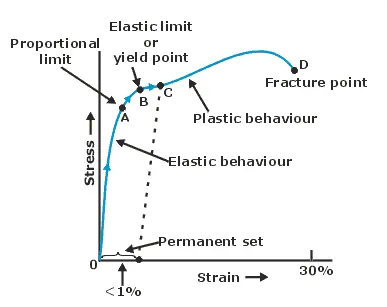
To calculate section Modulus we will consider the 'Minimum Moment of Inertia' as it is the threshold value or the proportional limit and after this point the hood will start to plastically deform and at the Maximum Moment of Inertia it will fail.
So we if need to increase the strength of the Hood we must calculate the Section Modulus at the Proportional limit by considering the Minimum Moment of Inertia.
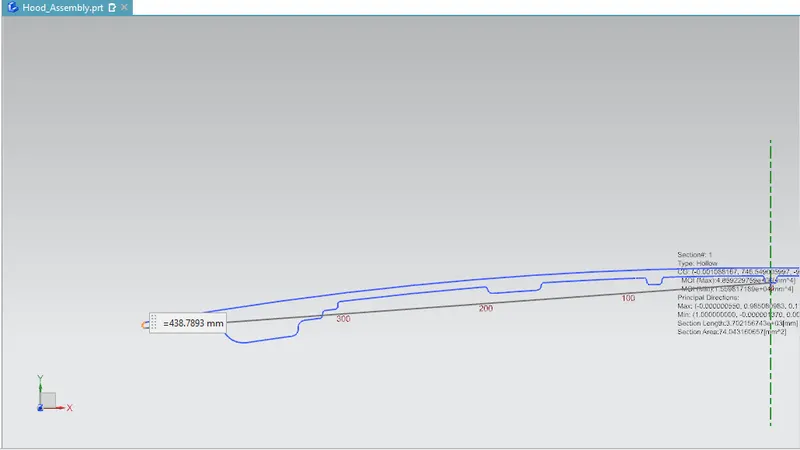
Y = 438.7893 mm
I = 1.559817189e+04 mm^4
S = I/Y
= 1.559817189e+04 / 438.7893
= 35.548204 mm^3
MODIFICATION:
1.
Increasing the distance between the Inner Panel and outer Panel by a distance of 1mm i.e. Increasing the thickness of the Hood by 1mm.
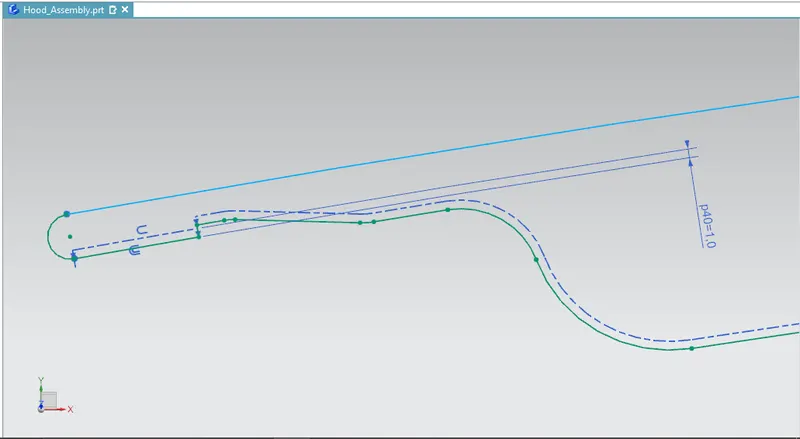
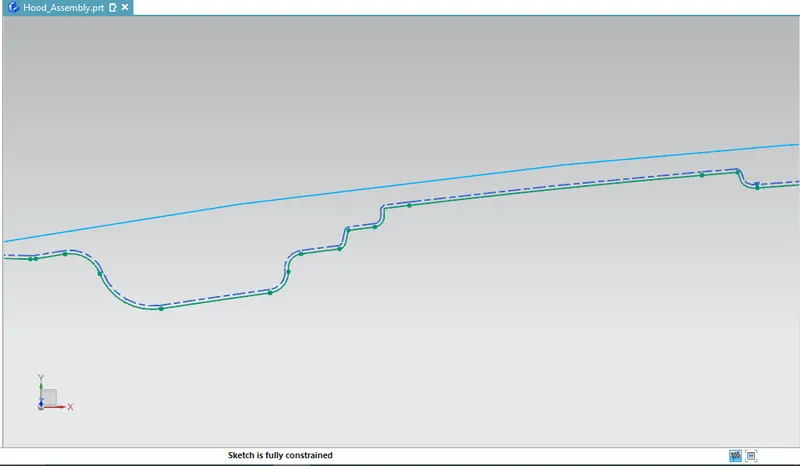
SECTION MODULUS OF THE ABOVE MODIFICATION:
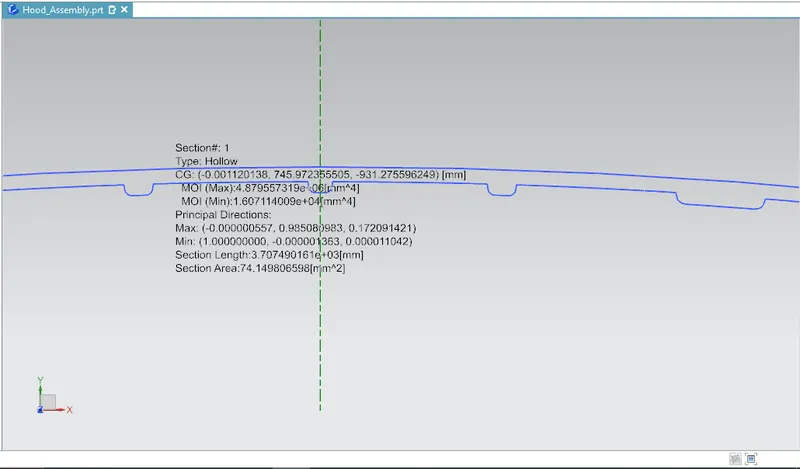
Moment of Inertia (MAX) = 4.879557319e+06 mm^4
Moment of Inertia (MIN) = 1.607114009e+04 mm^4
Section Area = 74.149806598 mm^2
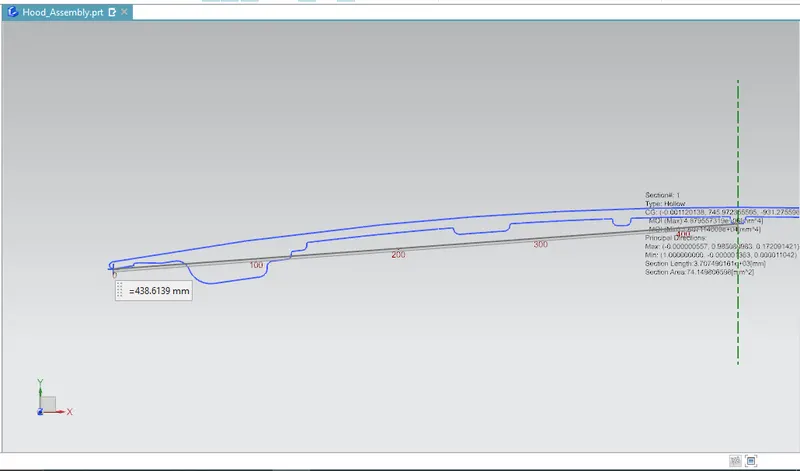
I = 1.607114009e+04 mm^4
Y = 438.6139 mm
S = I/Y
= 1.607114009e+04 / 438.6139
= 36.64074 mm^3
2.
Increasing the distance between the Inner Panel and outer Panel by a distance of 2mm i.e. Increasing the thickness of the Hood by 2mm.
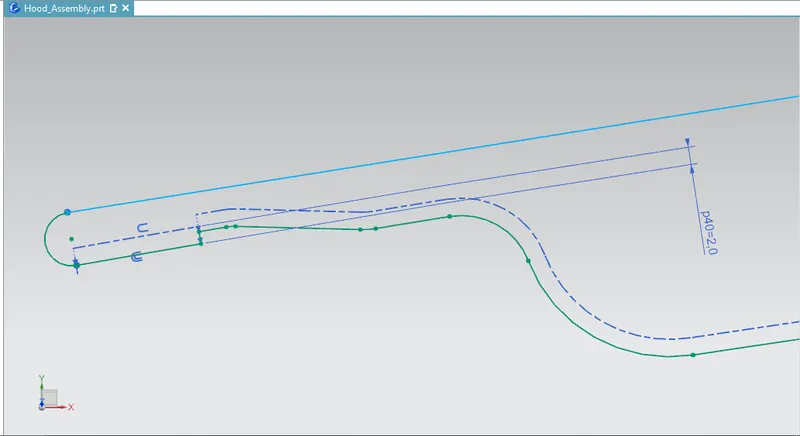
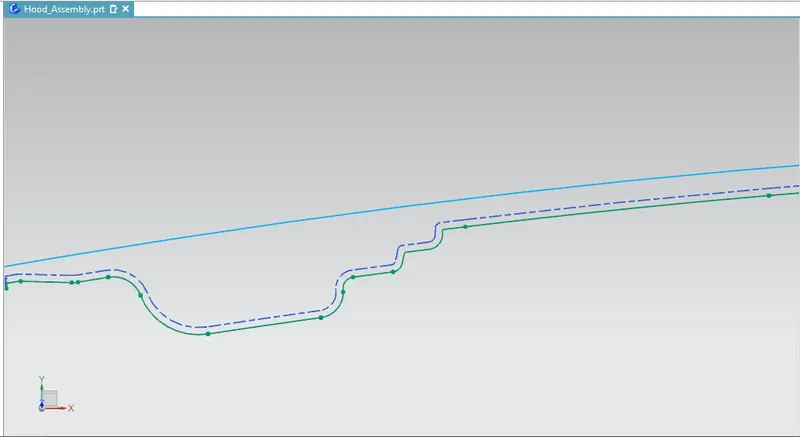
SECTION MODULUS OF THE ABOVE MODIFICATION:
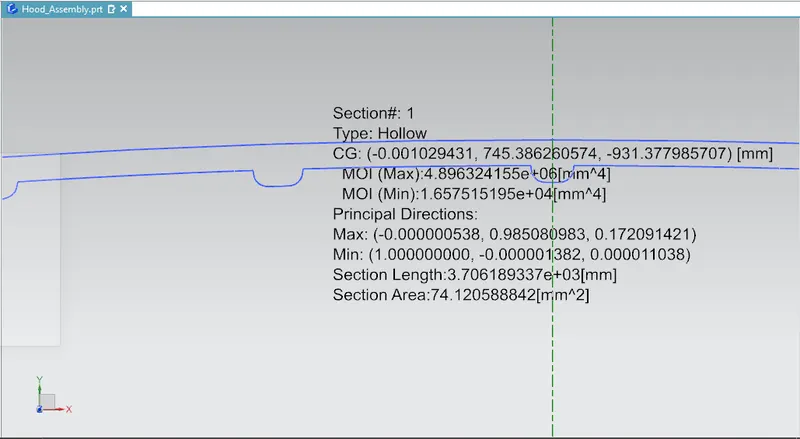
Moment of Inertia (MAX) = 4.896324155+06 mm^4
Moment of Inertia (MIN) = 1.657515195e+04 mm^4
Section Area = 74.120588842 mm^2
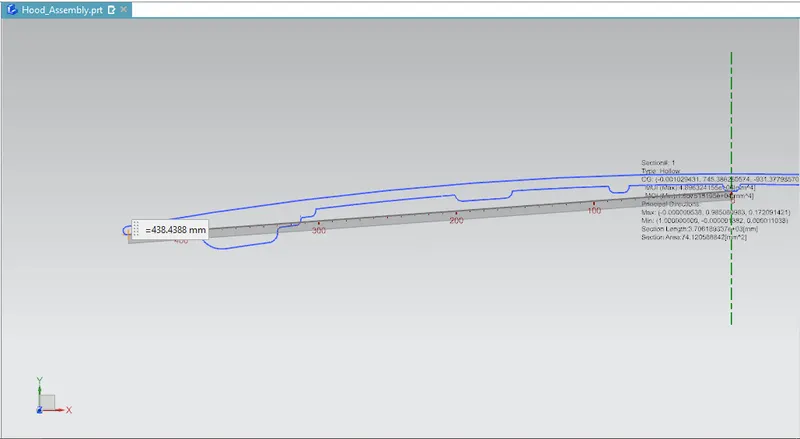
I = 1.657515195e+04 mm^4
Y = 438.4388 mm
S = I/Y
= 1.657515195e+04 / 438.4388
= 37.80493 mm^3
CONCLUSION
In our Original cross-section the Section Modulus is calculated to be 35.548204 mm^3, and when we increased the distance between the outer panel and Inner panel by a distance of 1mm and 2mm the respective Section Modulus is calculated to be as 36.64074 mm^3 and 37.80493 mm^3.
So from the above calculations we can conclude that by increasing the distance between the Outer panel and Inner panel or the thickness we can increase our Section Modulus and thus by increasing our Section Modulus we can increase the strength of our Hood.
As by increasing the distance between Outer panel and Inner panel our cross-sectional area increases and increase in our cross-section increases the Moment of Inertia and resulting in the increase of or Section Modulus which increases the strength of the hood.
So we can say that Cross-sectional area directly proportional to Moment of Inertia and
Moment of Inertia directly proportional to Section Modulus and
Section Modulus directly proportional to strength of the Hood.
So we can increase the thickness of our Hood in order to increase its strength and resist bending.