Section Modulus calculation and optimization
Objective
- To calculate the section modulus using the section of the hood designed.
- To make a change in the cross-section and to come up with a better section modulus value .
Introduction
Section modulus:
- It is termed as the ratio of total moment resisted by the section to the stress in the extreme fibre. Also it is the measure of strength of given member. The stress in the outermost section of beam is computed with the help of section modulus.
- It gives an idea about how much of load that the given strucuture can withstand.
- Section modulus is a geometric property for a given cross-section used in the design of beams or flexural members. Other geometric properties used in design include area for tension and shear, radius of gyration for compression, and moment of inertia and polar moment of inertia for stiffness.
- There are two types of section moduli, the elastic section modulus and the plastic section modulus.
- The elastic section modulus is defined as S = I / y, where I is the second moment of inertia (or area moment of inertia, not to be confused with moment of inertia) and y is the distance from the neutral axis to any given fibre. It is often reported using y = c, where c is the distance from the neutral axis to the most extreme fibre.
- `SpropI`, if the section modulus is increased the moment of resistance is also increased. Hence its load bearing capacity can be increased.
- It is also often used to determine the yield moment (My) such that My = S × σy, where σy is the yield strength of the material.
-
The plastic section modulus is used for materials where elastic yielding is acceptable and plastic behavior is assumed to be an acceptable limit. Designs generally strive to ultimately remain below the plastic limit to avoid permanent deformations, often comparing the plastic capacity against amplified forces or stresses.
-
The plastic section modulus depends on the location of the plastic neutral axis (PNA). The PNA is defined as the axis that splits the cross section such that the compression force from the area in compression equals the tension force from the area in tension. So, for sections with constant yielding stress, the area above and below the PNA will be equal, but for composite sections, this is not necessarily the case.
-
The Plastic Section Modulus can also be called the 'First moment of area'.
Procedure:
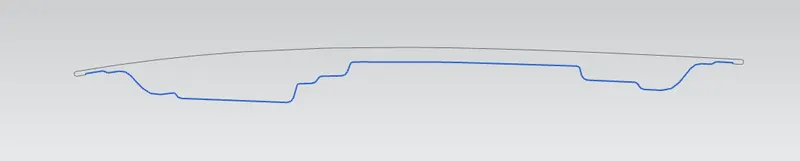
- In this case, I did the elastic section modulus calculation for the hood design.
- From the hood outer panel and inner panel design, the cross-section geometry has to be taken at OY plane.
- The thickness of the panel is ignored and the upper most curve of the outer panel geometry and the lower most curve of the inner panel geometry are taken.
- The gaps are filled with lines and the cross-sectional geometry is made as a whole composite curve.
- Then using the section inertia analysis command, the minimum moment of inertia is obtained and noted.
- The distance between the 2 outermost fibres are measured and noted.
- From the obtained values the section modulus can be calculated by substituting the values in the formula appropriately.
Section 1-
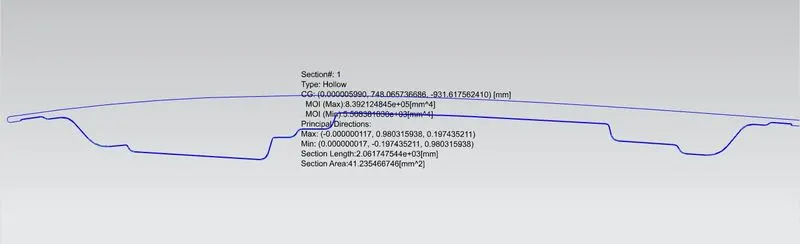
Fig shows: Section 1 of the hood
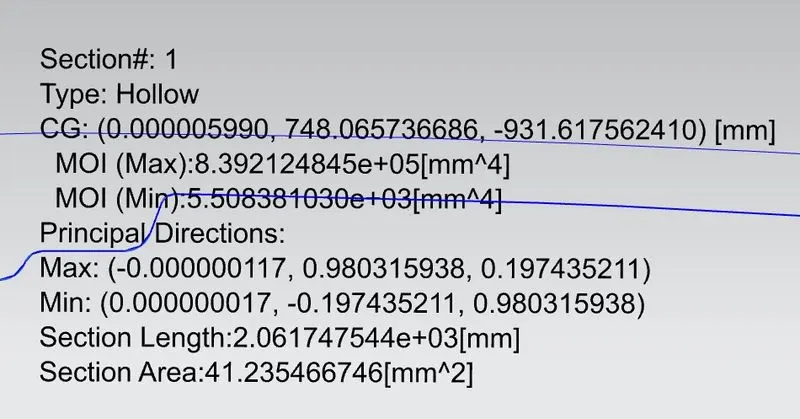
- Minimum moment of Inertia(MOI) = `5.508381030e^(+03)mm^4`
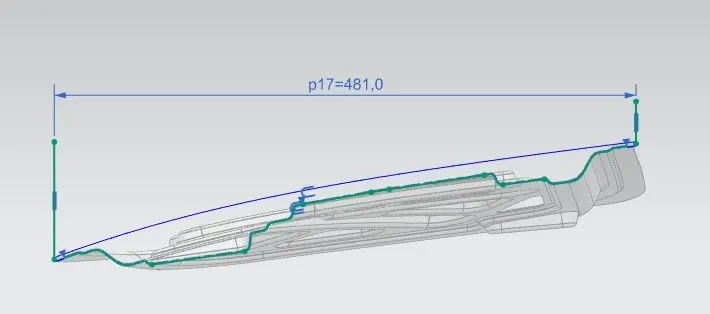
- Total length between the extreme fibres = 481mm
Calculation:
Given,
Minimum moment of inertia (I)= `5.508381030e^(+03)mm^4`
For the given material AISI 302-colled-rolled,
Yield strength of the material (σy) = 520 Mpa(or) N/mm2
Total distance = 481mm
Distance between the neutral axis and the extreme fibre (y) = `481/2`
y = 240.5mm
Solution,
Section modulus, `S = I/y`
`S = 5.508381030/(240.5)xx10^3`
`S = 22.903mm^3`
Yield moment, My = S × σy
My `= 22.903xx520`
My `= 11.91e^(+03)mm`
Section 2-
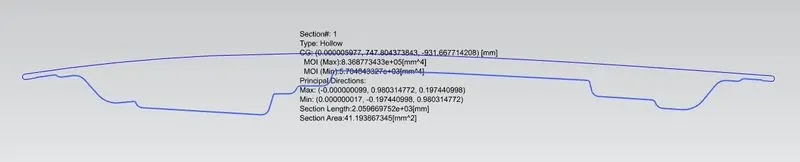
Fig shows: Section 2 of the hood
- `In this, the depth(or) distance between the outer panel and inner panel is increased by `0.5mm` to increase the section modulus value so as to increase the load bearing capacity of the hood.
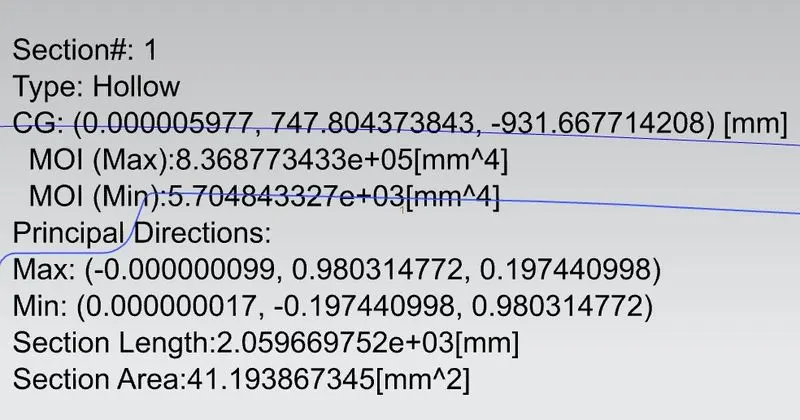
- Minimum moment of inertia (MOI) `= 5.5704843327e^(+03)mm^4`
- The distance remains the same as to section 1, hence the distance between the neutral axis to the extreme fibre is directly taken as, y = 240.5mm
Calculation:
Given,
Minimum moment of inertia (I) `= 5.5704843327e^(+03)mm^4`
For the given material AISI 302-colled-rolled,
Yield strength of the material (σy) = 520 Mpa(or) N/mm2
Total distance = 481mm
Distance between the neutral axis and the extreme fibre (y) = 240.5mm
Solution,
Section modulus, `S = I/y`
`S = 5.704843327/(240.5)xx10^3`
`S = 23.72 mm^3`
Yield moment, My = S × σy
My `= 23.72xx520`
My `= 12.33e^(+03)mm`
Comparing both sections,
| Geometric properties | SECTION 1 | SECTION 2 |
| Moment of Inertia (I) | `5.508381030e^(+03)mm^4` | `5.5704843327e^(+03)mm^4` |
| Length (y) | 240.5mm | 240.5mm |
| Section modulus (S) | `22.903mm^3` | `23.72 mm^3` |
| Yield strength (σy) | 520 Mpa(or) N/mm2 | 520 Mpa(or) N/mm2 |
| Yield moment (My) | `11.91e^(+03)mm` | `12.33e^(+03)mm` |
- Since Section 2 has greater Section modulus value than Section 1, the strength of the hood with Cross-section 2 is greater than hood with Cross-section 1.
Conclusion:
- Thus from the comparison table it is clear that the section modulus can be increased by increasing the distance between the outer panel and inner panel(or depth) and by changing the cross-section geometry as well.
- Hence the strength of the geometry also increases with increase in section modulus. In other cases, if the distance between the neutral axis and extreme fibre(y) is increased ,the section modulus(S) will be decreased since it is inversely proportional to eachother.
- From the section area, the volume can also be derived.
Suggestion:
- It is suggested to provide the necessary embosses wherever recquired without compensating the strength of the panel as the depth of the emboss affects the cross sectional area which in turn affects the section modulus.