Section Modulus calculation and optimization
SECTION MODULUS CALCULATION AND OPTIMIZATION
AIM
To calculate and comapre a section modulus value of hood car.
SECTION MODULUS
Section modulus (S) is a geometric property for a given cross-section used in the design of beams or flexural members.
The section modulus of the cross-section shape is of significant importance of designing beams. It is a direct measure of the strenght of the beam. A beam that has larger section modulus hence strength also increased.
It is known that the stress in a fibre is proportional to its distance from the neutral axis. If y is the distance of the extreme fibre from neutral axis then. S represent Section Modulus, i.e S=I/y.
THEORY
The ratio of Area Moment of inertia to the Distance from the Neutral Axis to the Point where the Bending Normal Stress is determind.
Section Modulus(S)=I/y.
S= Section Modulus
I= Moment of Inertia
y= Distance from neutral axis from extreme fiber
Note: A beam that has larger section modulus than it will be the capable for supporting greater loads.
Formula is Represent above
1. Trail
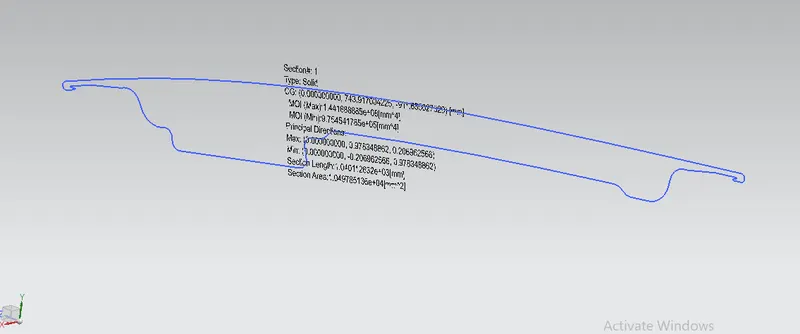
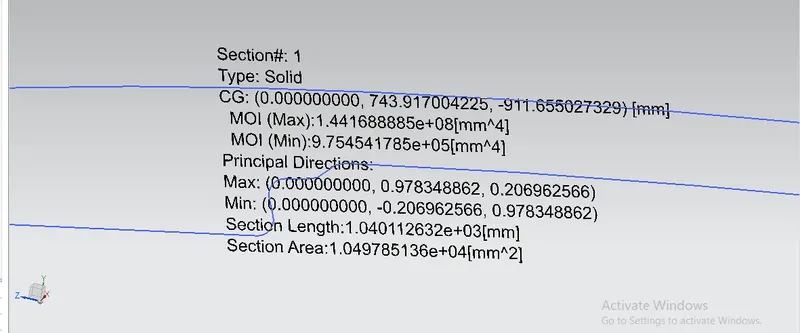
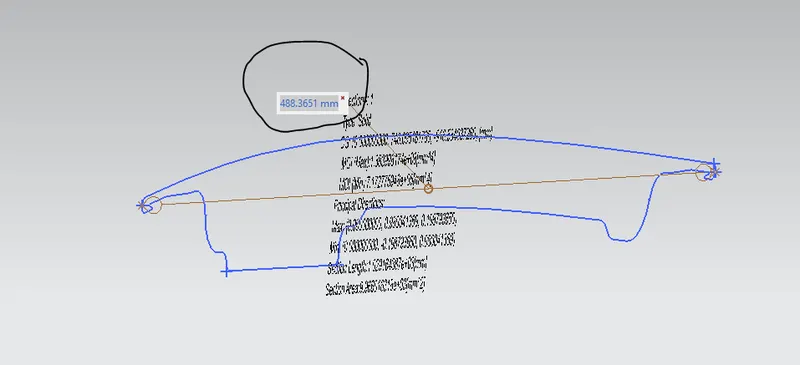
Here the moment of inertia calculated by using the NX software obtained value are.
lmax = 1.4416e+08 (mm^4)
lmin = 9.7545e+05 (mm^4)
Total value of Y is 488.3651
But we need half of neutral axis value Y/2 = 244.1825
1. Section Modulus(S)max= 5.9038x10^5 (mm^3)
2. Section Modulus(S)min= 3.9947x10^3 (mm^3)
So strength of an hood varies from 3.9947x10^3 (mm^3) to 5.9038x10^5 (mm^3)
2. Trail
Now we can use another trail to check te strength by increase one mm of inner panel offset
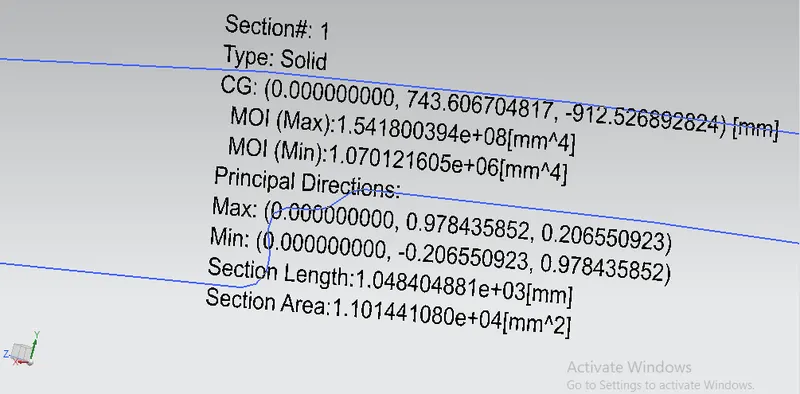
lmax = 1.5418e+08 (mm^4)
lmin = 1.0701e+06 (mm^4)
Total value of Y is 488.3651
But we need half of neutral axis value Y/2 = 244.1825
1. Section Modulus(S)max= 6.31412x10^5 (mm^3)
2. Section Modulus(S)min= 4.382x10^3 (mm^3)
So strength of an hood varies from 4.382x10^3 (mm^3) to 6.31412x10^5 (mm^3)
- Here we can compare both hood's strength when we increase the cross section area we obseved minimum strenth is increase from 3.9947x10^3 (mm^3) to 4.382x10^3 (mm^3) and maximum stenth also increase from 5.9038x10^5 (mm^3) to 6.31412x10^5 (mm^3).
- so newton's first low explain that if higher the mass, te force required to move object is also need high due to offering more resistance in order to move the object, This resistance is called the MOMENT OF INERTIA.
- In case of hood also same principle will work i.e when we increase the cross section area by 1 mm the minimum load carrying capacity or strenth was increase by approximate 8%.
- The strenth of the material also depend on the material, thickness and cress section area of the object.
CONCLUSION
The stength of the material is directly proportional to the moment of inertia hence increase in section area there is have increase in overall of an object hence increase in strenth.