Section Modulus calculation and optimization
Section Modulus calculation and optimization
OBJECTIVE:
- To Calculate the section modulus for the initially designed hood and optimized hood.
- To design new section that has improved section modulus of the previous section.
INTRODUCTION:
SECTION MODULUS:
Section modulus is the geometric property of a given cross-section used in the design of flexural members. Section modulus depends only on the cross-section shape of the beam or structure.
For symmetric sections, the value of section modulus is the same for both above and below of centroid of the cross-section. An asymmetric section has two values for the top and bottom of the centroid, the maximum section modulus (Smax) and minimum section modulus (Smin).
There are two types of section modulus:
- Elastic section modulus(S).
- Plastic section modulus(Z).
- Elastic section modulus - For general design, the elastic section modulus is used, applying up to the yield point for most metals and other common materials.
The elastic section modulus is defined as S = I / y,
where
I is the second moment of inertia (or area moment of inertia, not to be confused with the moment of inertia) and
y is the distance from the neutral axis to any given fibre.
It is often reported using y = c, where c is the distance from the neutral axis to the most extreme fibre. It is also often used to determine the yield moment (My) such that My = S × σy, where σy is the yield strength of the material.
Significance of Section Modulus:
- Section modulus is an important factor for designing beams and flexural members.
- Higher the section modulus, higher will be the resistance to bending.
- Easier to calculate strength and stresses in beams.
- If two beams are made of the same material and the section modulus of two beams are being compared and vice versa, the beam with larger section modulus will be tougher and more capable to withstand larger loads
DESIGN 1: Section Modulus of Initial Hood Design
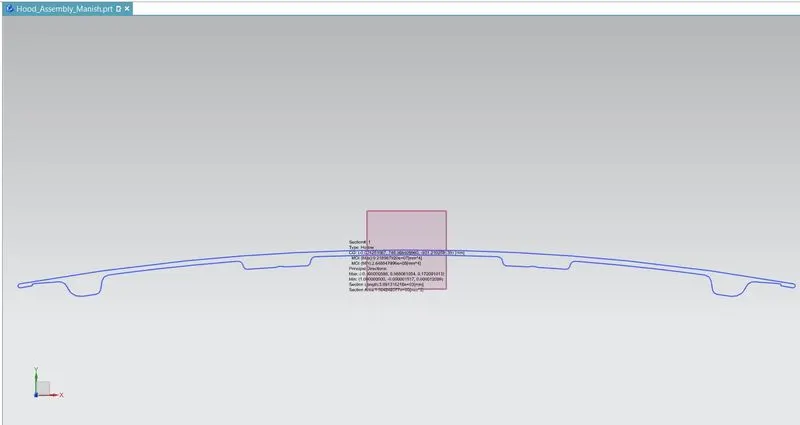
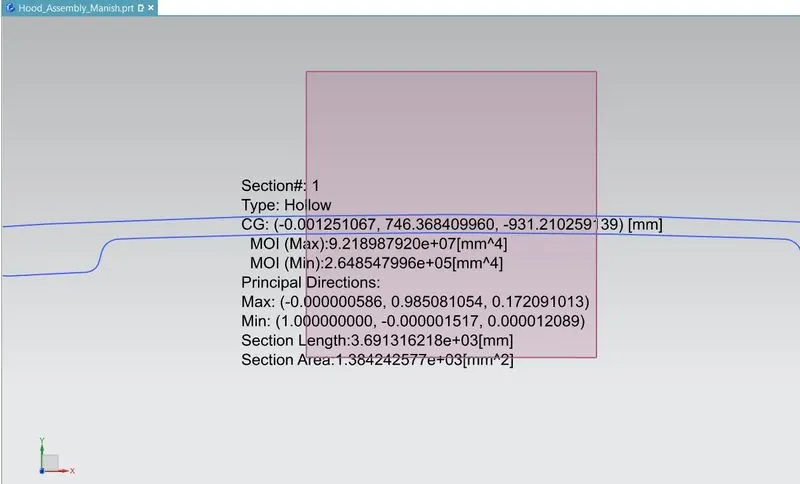
From the above analysis, following minimum and maximum moment of inertia are obtained
Imax = 9.218987920*10^7mm4
Imin = 2.648547996*10^4 mm4
y = 440 mm
Smax = Imax / y =9.218987920 *10^7/ 440 =209522.432mm3
Smin = Imin / y = 2.648547996*10^4/ 440 =60.20mm3
DESIGN 2: Section Modulus of Optimized Hood design
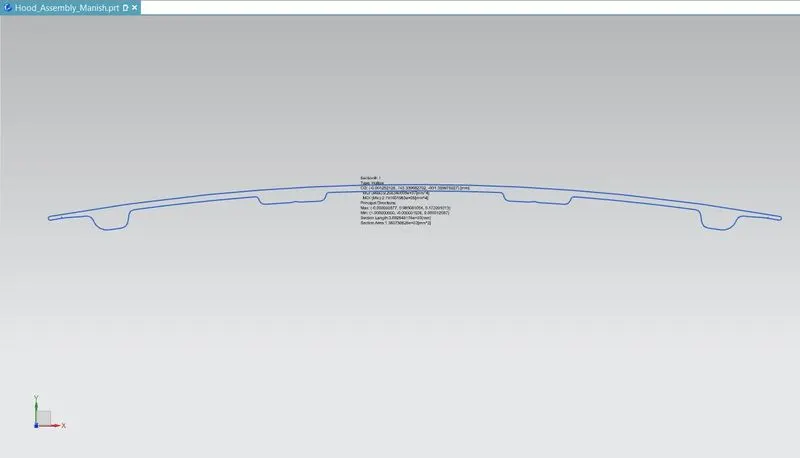
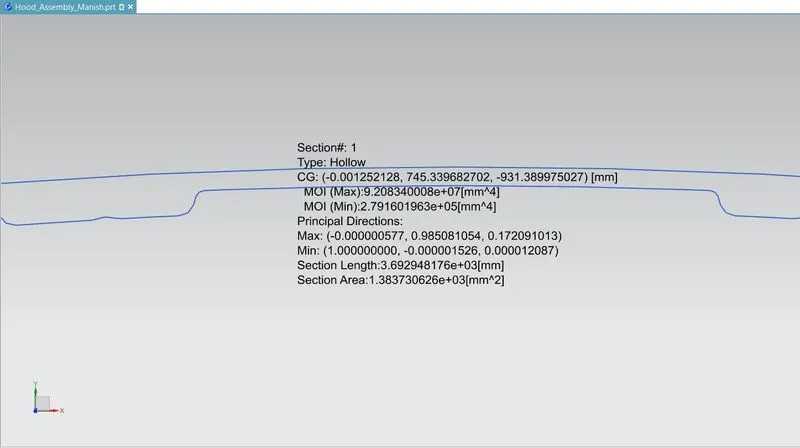
Section Modulus can also be represented as
S = Σ miAi2 / y where A is the area of the section and M is the mass of the body
From the above equation, it can be observed that the section modulus of the body is directly proportional to the sectional area of the body.
Here the section area is increased by reducing the embossing depth and offsetting the outer panel by 3 mm. This increases the value of section modulus.
From the above analysis, following minimum and maximum moment of inertia are obtained
Imax = 9.20834000*10^7 mm^4
Imin = 2.791601963*10^5 mm^4
y = 440 mm
Smax = Imax / y = 9.20834000*10^7/ 440 =209280.455mm^3
Smin = Imin / y = 2.791601963*10^4/ 440 = 63.45mm^3
CONCLUSION:
- By comparing the values, we can say that section modulus of the optimized hood is increased.
- MOI increases with the increase of section area.
- MOI increases with the increase of section length.
- If we increase the gap between the inner and outer panel of hood eventually section length will increase thus MOI will increase.