Section Modulus calculation and optimization
AIM:
In order to assess the hood's strength and optimize the design to see variations in the bending strength, we had to compute the section modulus of the hood. A structure becomes more resistant to bending as its section modulus increases.
OBJECTIVES:
Come up with a new section that has an improved section modulus compared to the previous one and mention what changes you made that resulted in the increased strength.
INTRODUCTION:
Section Modulus:
- Section modulus, also known as the Polar Modulus or the Torsional Sectional Modulus, is a geometric parameter for a certain cross-section that is utilized in the construction of beams or flexural components. Area for shear and tension, radius of gyration for compression, and moment of inertia and polar moment of inertia for stiffness are additional geometric parameters that are employed in design.
- Any correlation between these characteristics is heavily dependent on the particular form. Below are the equations for the section moduli of typical forms. The elastic section modulus and the plastic section modulus are the two different forms of section moduli.
Z = I/Y
- Where as
- Z = Section Modulus (mm^3)
- I = Area moment of Ineria (mm^4)
- Y = Distance from the neural axis to the outermost fiber (mm)
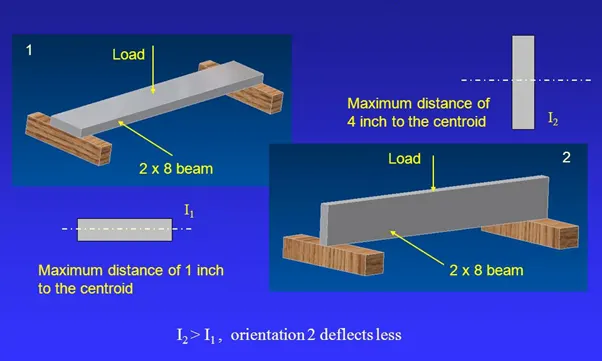
- Elastic Section Modulus:
It is the ratio of area moment of inertia about the netural axis and to the distance of outermost fiber from the netural axis
- Formula for Area moment of ineria: I = bd^3/12
- Relationship between area moment of inertia and resitance towards bending
M/I = Σ/Y = E/R
- Where as
- M - Bending moment or resistance towards bending
- I - Monent of Inertia
- Σ - Bending Stress
- Y - Distance from outermost netural axis
- E - Youngs modulus
- R - Curavature of particualar bending
we will take
M /I = Σ/Y
->M = I/Y * Σ
we know that -> Z = I/Y
-> M = Z* Σ
- This image shows the scene that follows: Diagram showing a beam with both ends supported on its thin edge. A guy is moving on a level platform. Diagram showing a beam with both ends supported and resting on its flat side. On the straight beam that bends in the center, a guy is walking.
- Plastic Section Modulus:
For materials when plastic behavior is taken to be an acceptable limit and elastic yielding is deemed acceptable, the plastic section modulus is employed. Designs frequently compare the plastic capacity against increased pressures or stresses in an effort to finally stay below the plastic limit and prevent irreversible deformations.

Another name for the Plastic Section Modulus is the "First moment of area."
The plastic moment, Mp, or full capacity of a cross-section is computed using the plastic section modulus. The two variables are connected by the material's yield strength, Fy, and Mp=Fy*Z. A form factor, represented by the letter "k," connects the plastic section modulus and elastic section modulus and is used to indicate capacity beyond the elastic limit of the material. The following formula might be used to mathematically demonstrate this:
- Case 1:
- After importing the previously prepared hood, the section inertia analysis is completed.
- It is imperative that we confirm the produced curve is a single, closed curve.It Look like this condition
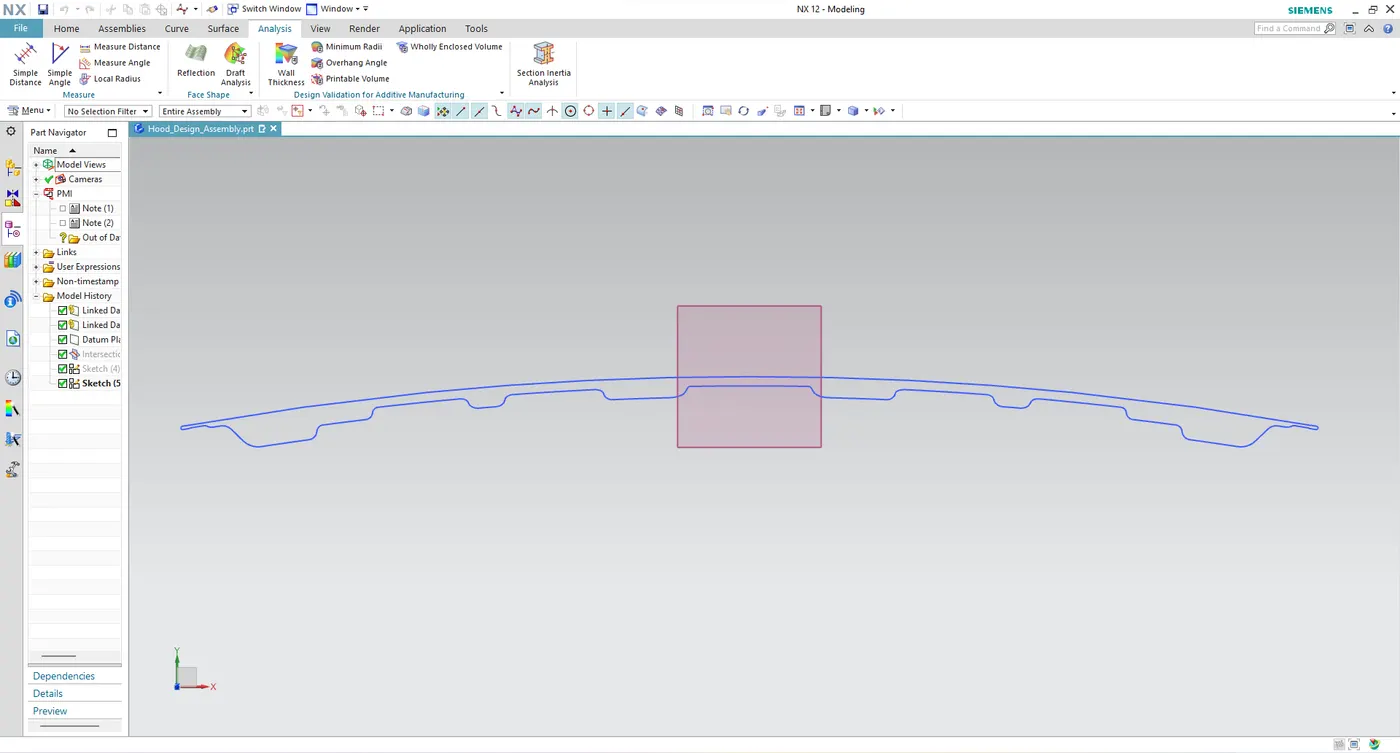
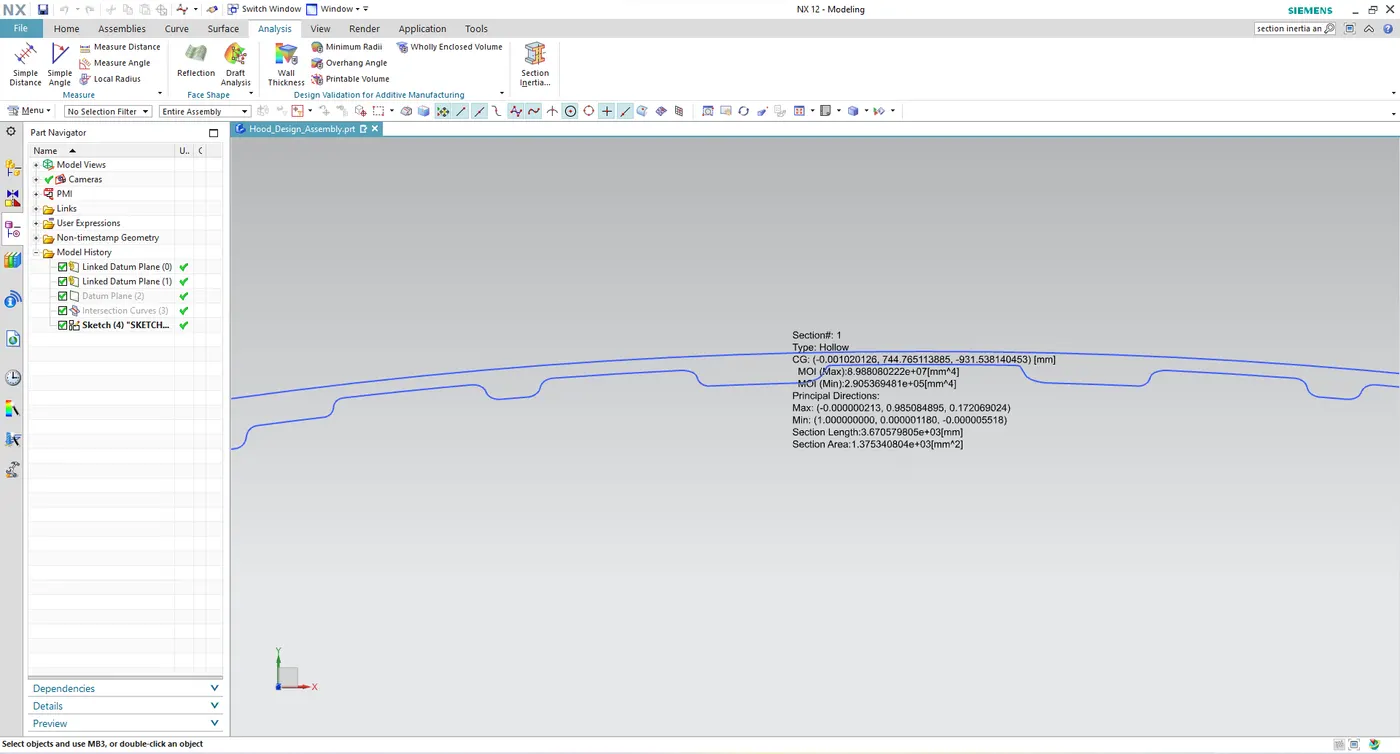
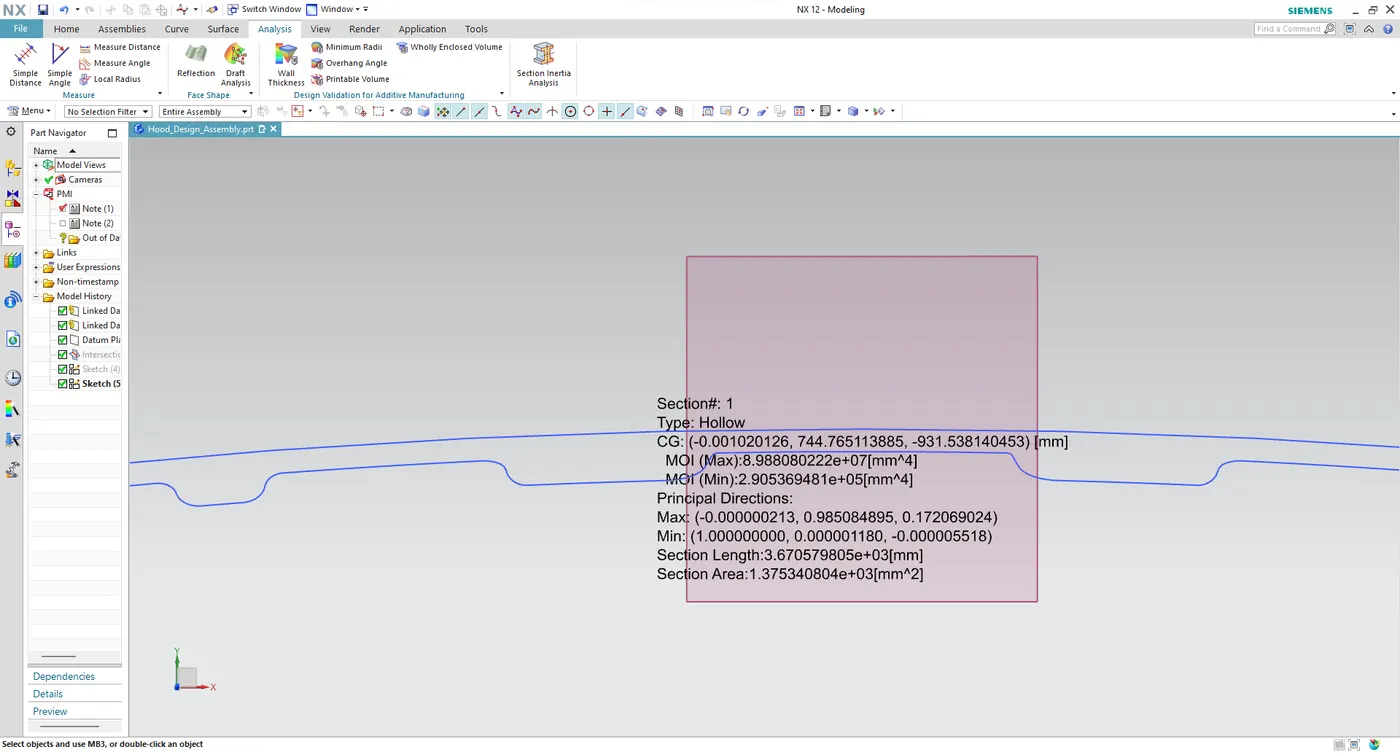
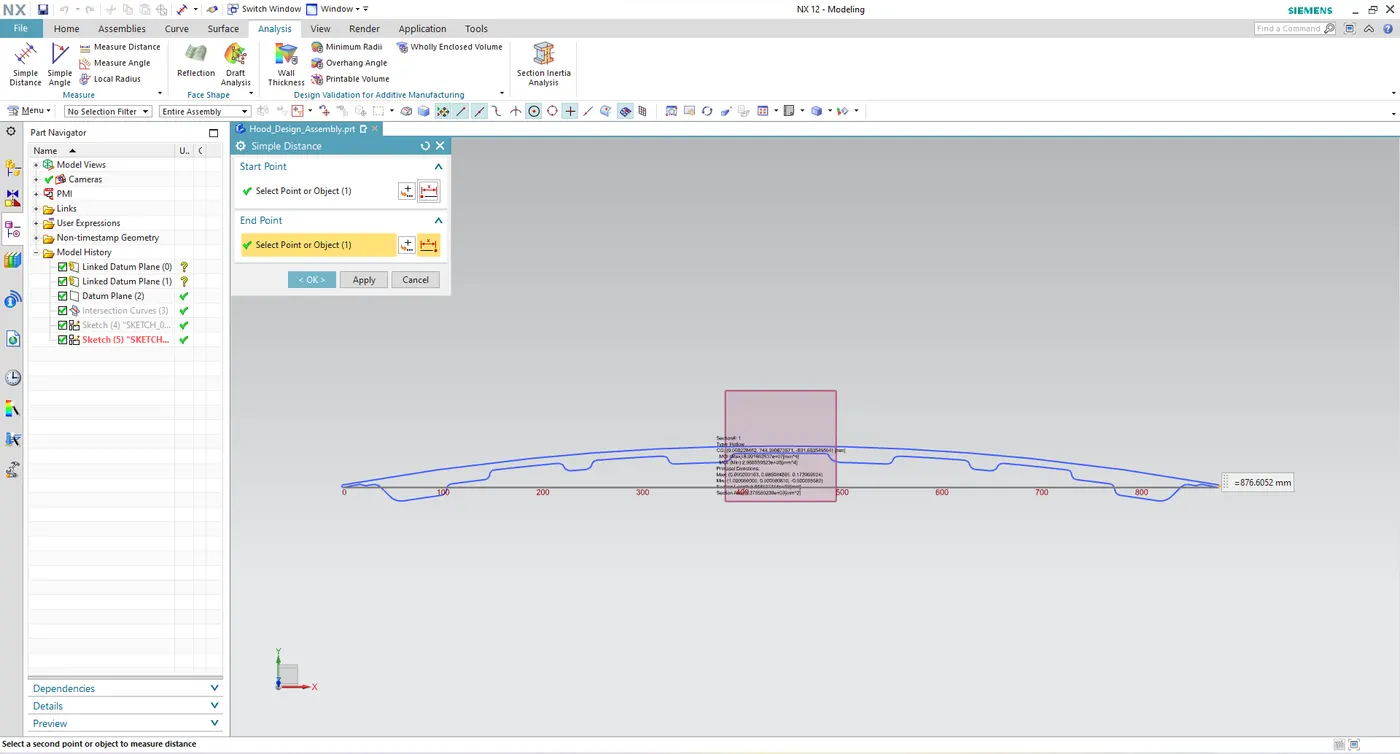
- Moment of Inetria (max) = 8.98808*10^5 [mm^4]
- Moment of Inertia (min) = 2.90536*10^3 [mm^4]
- Distance from netural axis to outermost fiber Y = 876.6052/2 = 438.3026 mm
- Therefore Z = I/Y -> Z = 2.90536*10^3 / 438.3026
- Z = 6.62866 mm^3
- Case 2:
- Now Incesing the depth of the Hood inner pannel with 0.7mm
- Then we got like this were mention below
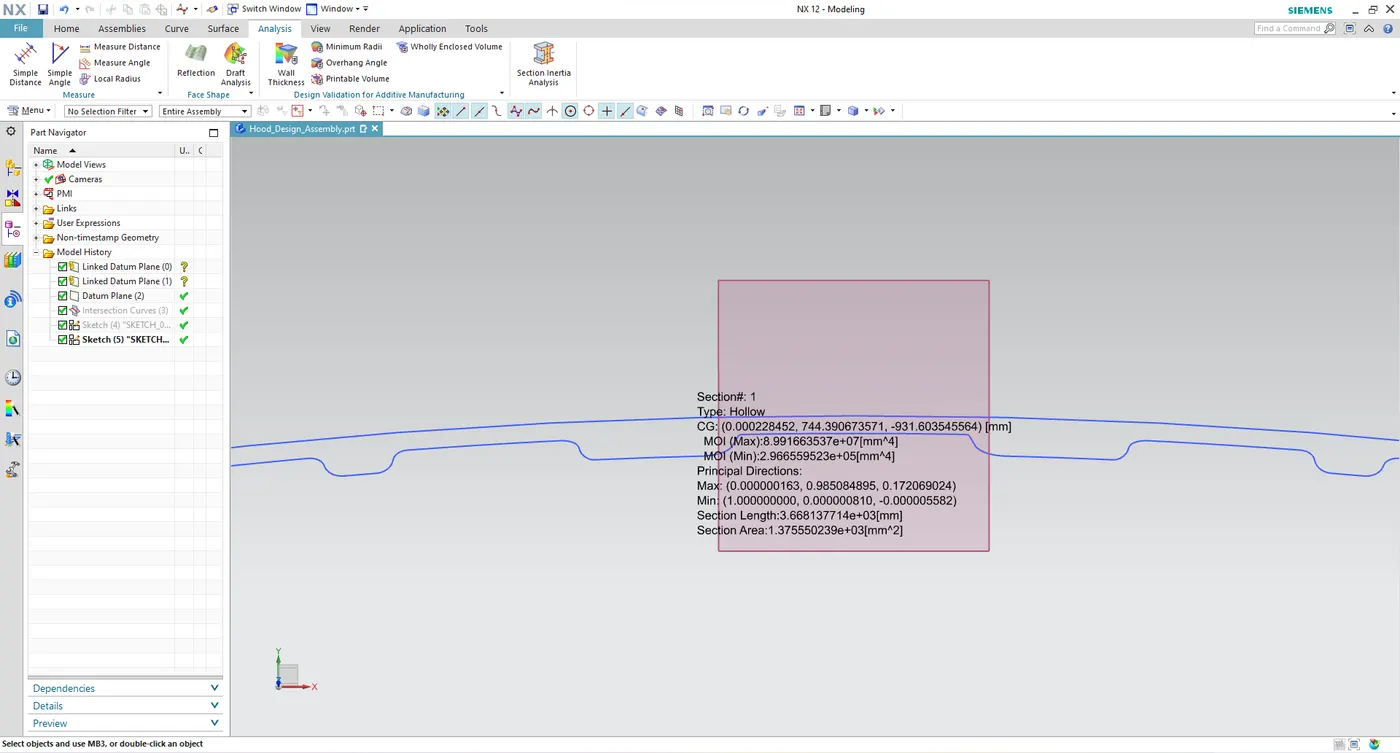
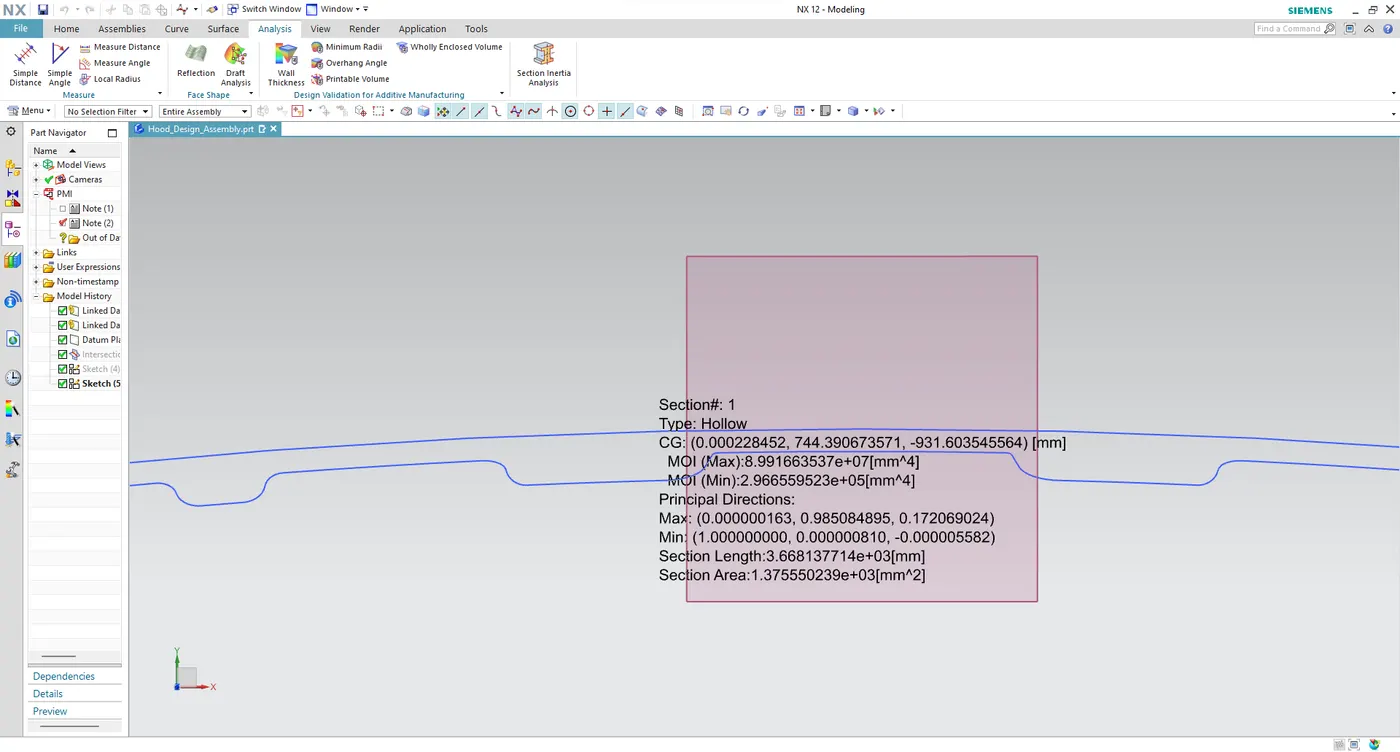
- Moment of Inetria (max) = 8.99166*10^5 [mm^4]
- Moment of Inertia (min) = 2.96655*10^3 [mm^4]
- Distance from netural axis to outermost fiber Y = 876.6052/2 = 438.3026 mm
- Therefore Z = I/Y -> Z = 2.96655*10^3 / 438.3026
- Z = 6.76826 mm^3
Conclusion:
- Here we checking both case and got different output, and comparatively, Case 2 is greater than Case 1 (Z2 > Z1)
- Strength and load material rise in tandem with an increase in section area due to increases in section modulus and moment of inertia. where the material's strength is directly correlated with the moment of inertia.