Section Modulus calculation and optimization
Section modulus is a geometric property for a given cross section used in the design of beam or flexural members.
Section modulus (S) is given by formula, S =I/y where I is the moment of inertia and y is the distance from the neutral axis to the most extreme fiber.
Section modulus is often used to determine yield moment(My) such that My = S x σy where σy is the yield strength of the material. It is a direct measure of the strength of the beam and a beam that has a larger section modulus than another will be stronger and capable of supporting greater loads.
So now I am calulating the section modulus for hood at two different sections:
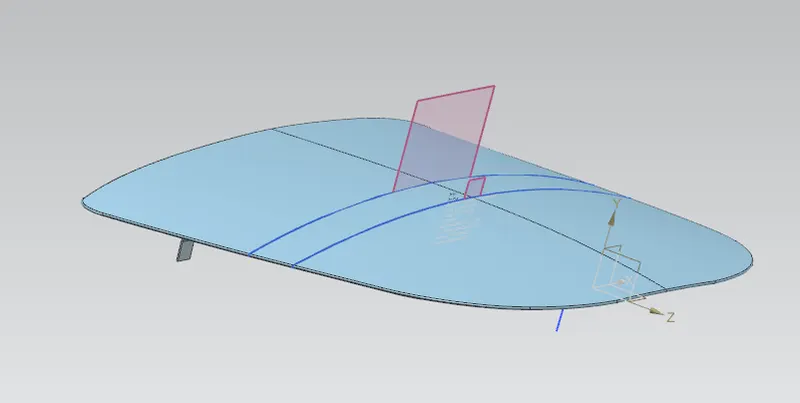
Using the section inertia analysis command in NX cad sofware we can calculate the moment of inertia (I) and measure the distance from the neutral axis to the neutral fiber (y) and therefore the section modulus can be calculated as such.
Case1 : In the first case scenario I have calculated the section modulus at half the cross section of the hood along the X-axis plane
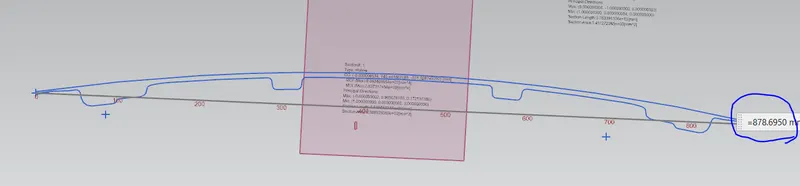
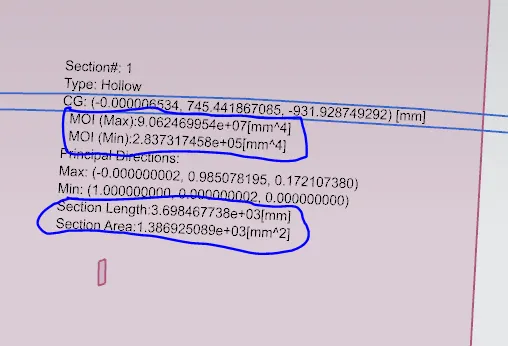
As we can see the results obtained for the first section are:
Moment of inertia, Imin = 2.83x10^5 mm^4
Cross sectional area, A = 1.38x10^3 mm^2
Distance fro the neutral axis to the extreme fibre, y = c/2 = (878.69/2) = 439.345 mm
As discussed above , Section modulus (S) = Imin/y
Therefore, S = Imin/y = (2.83x10^5)/(1.38x10^3) = 205.072 mm^3
Case 2 :In the next case I have considered the section to calculate the section modulus which has greater cross sectional area than the previous case.
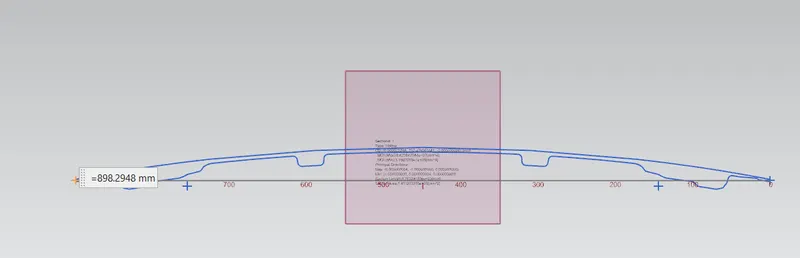
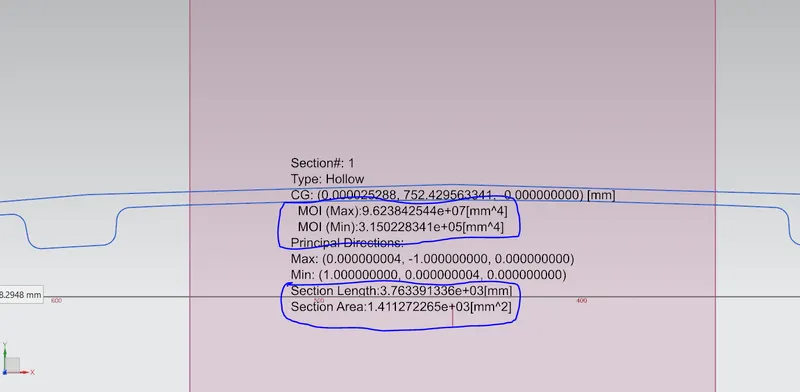
As we can see the results obtained for the first section are:
Moment of inertia, Imin = 3.15x10^5 mm^4
Cross sectional area, A = 1.42x10^3 mm^2
Distance fro the neutral axis to the extreme fibre, y = c/2 = (898.29/2) = 449.145 mm
Therefore Section modulus, S = Imin/y = (3.15x10^5)/(1.42x10^3) = 221.83 mm^3
Conclusion : Clearly as the results show, the section modulus is greater in the case2 than in comparison to the case 1. Thus we can conclude that the section modulus increases with the increase in the cross sectional area of the structural member and as the section modulus is directly proportional to the strength, the strength of the structural member will also increase simultaneously.