Section Modulus calculation and optimization
SECTION MODULUS
The section modulus is an important parameter in structural engineering and mechanics that describes a cross-sectional shape's resistance to bending. It is used to calculate and analyze the bending strength and stiffness of beams, columns, and other structural members.

When a structural member is subjected to bending moments, its cross-sectional shape determines how effectively it can resist those bending forces without undergoing excessive deformation or failure. The section modulus is a geometric property of the cross-sectional shape that directly relates to its ability to withstand bending.
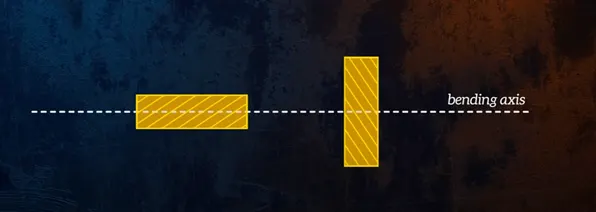
Simply, section modulus is the ratio of area of moment of inertia about the neutral axis to the distance between the end most point of the fiber and neutral axis. Mathematically,
Z = I / Y ; (units – mm3 or m3)
Where “Z” is section modulus, “I” is the area of moment of inertia about the neutral axis, “Y” is the distance between the end most point of the fiber to the neutral axis. From the bending equation,
M = Z * σ ; (units – Nm)
Where “M” stands for Bending Moment (resistance towards bending), “Z” is the section modulus and “σ” is the bending stress. In order to get maximum bending moment, “Z” should be max, i.e. “I” would be larger.
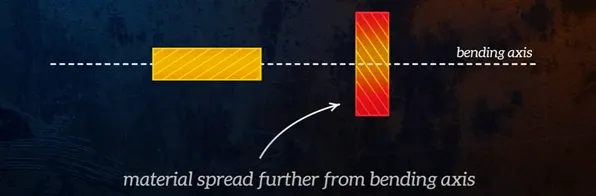
A larger section modulus indicates that the cross-sectional shape has greater resistance to bending, making it more suitable for supporting higher bending moments without failing.
The section modulus is important for hoods and other automotive components for several reasons:
- Bending Strength: Hoods are subjected to various loads, such as the weight of the hood itself, the forces exerted by the wind at high speeds, and potential impacts from debris or accidents. The section modulus helps determine how well the hood can resist these bending loads without deforming excessively or failing.
- Crash Safety: In the event of a collision, the hood may need to absorb or distribute the impact energy to protect the occupants and underlying components. A well-designed hood with an appropriate section modulus can help manage and disperse collision forces, minimizing damage to the vehicle's structure and passengers.
- Weight Optimization: Automotive manufacturers strive to balance structural integrity with weight reduction to improve fuel efficiency and overall vehicle performance. By optimizing the section modulus and cross-sectional shape of the hood, engineers can design a lightweight yet strong component that meets safety standards.
- Stiffness and Vibrations: A hood with the right section modulus can help control vibrations caused by road irregularities and engine vibrations. Excessive vibrations can lead to noise, discomfort for passengers, and potential structural fatigue over time.
- Design Flexibility: Different vehicles have varying design requirements, and hoods come in various shapes and sizes. Engineers can use the section modulus to evaluate and compare the structural performance of different hood designs, enabling them to choose the most appropriate design for a specific vehicle.
- Material Selection: The choice of materials for the hood, such as steel, aluminum, or composites, can affect its structural behavior. The section modulus helps engineers determine the suitability of a material by considering its strength-to-weight ratio and its ability to withstand bending loads.
- Aesthetics and Packaging: While structural considerations are paramount, the section modulus also influences the shape and curvature of the hood. Achieving the desired appearance while maintaining structural integrity requires careful manipulation of the section modulus and other design parameters.
Section Modulus Analysis of HOOD
The Section modulus of the designed Hood is analyzed using NX CAD tools such as “Section Inertia Analysis” from which “I” is calculated and “Measure” tool from which distance of neutral axis is derived.
On the preliminary design;
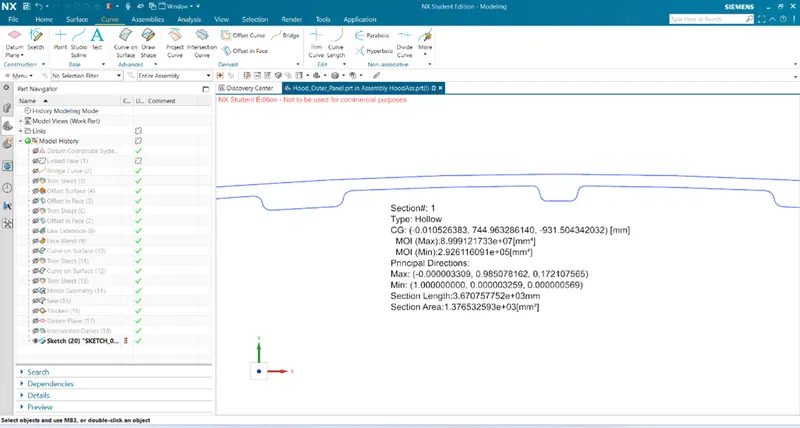
We get the MOI (Moment of Inertia) as 2.92611e+05 mm4. The distance of the endpoints is as shown below;
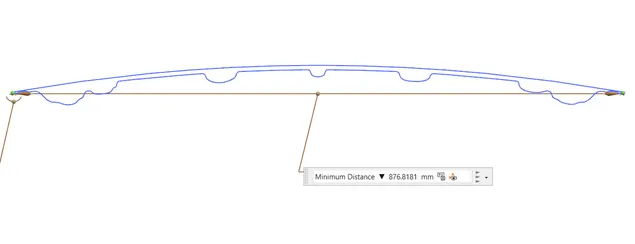
The distance from the neutral axis to the outermost fiber is 438.409 mm (876.818 ÷ 2).
Therefore, Section modulus, Z = I ÷ Y = 2.92611e+05 ÷ 438.409. That is we have,
Z = 667.438 mm3.
Secondary analysis of HOOD by offsetting the inner panel to 2 mm;
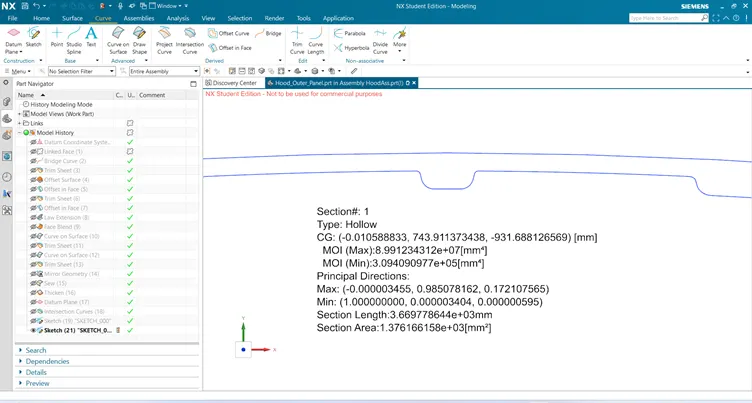
We have MOI as 3.09409e+05 mm4 and same distance. Therefore Z = 705.754 mm3.
Tertiary analysis of HOOD by modifying the emboss features;
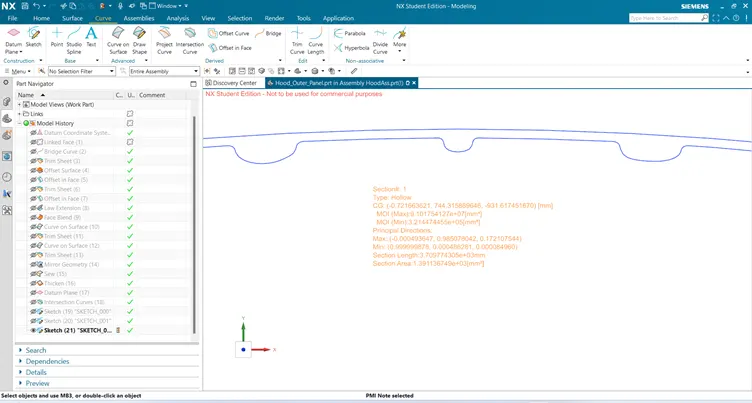
We have MOI as 3.21447e+05 mm4 and calculating the section modulus with the same distance since the outer structure is not modified, we get Z = 733.212 mm3.