Section Modulus calculation and optimization
Section Modulus calculation and optimization
Use the Section from your Hood design and calculate the Section Modulus using the formula
S = I/y
Where,
S = Section Modulus
I = Moment of Inertia
y = distance between the neutral axis and the extreme end of the object
Come up with a new section that has an improved Section Modulus compared to the previous one and mention what changes you made which resulted in the increased strength.
Basics of Strenght of Material
Centre of Gravity
The center of gravity of a body is defined as the point through which the whole weight of a body may be assumed to act.
Centroid or Centre of area
The centroid is defined as the point where the whole area of the figure is assumed to be concentrated.
Moment of Inertia
1. First Moment of Force:- About any point, the product of the force and the perpendicular distance between them is known as Moment of a force or the first Moment of a force. The moment is the term used to describe the turning effect of a force. It is the result of multiplying the force by separating the force's line of action and the pivot point or point at which the object will turn. The SI unit for the moment of force is the Newton meter (Nm). It is a vector quantity. The right-hand grip rule, which is parallel to the plane of the force and has a pivot point parallel to the axis of rotation, determines its orientation.
𝝉 = F×d
Where,
𝝉 is the moment of force
F is the force
d is the perpendicular distance between the force's line of action and the pivot.
The moment of force is classified into the following categories:
- Turning moment
- Bending moment
- Twisting moment
Turning Moment
This moment causes a body to revolve around a fulcrum. The body can freely rotate around a fulcrum in this scenario.
Bending Moment
This moment causes a body to bend around one of its fixed ends.
Twisting Moment
This event causes a shaft to twist around one of its fixed ends.
2. Second Moment of Force:- This first moment is again multiplied by the perpendicular distance between them to obtain the second moment of force. The second moment of force is also known as torque or moment. It is a measure of the force required to rotate an object around a particular axis. The second moment of force is represented by the symbol M and has units of N*m.
Second Moment of Area:- In the same way if we consider the area of the figure it is called the second moment of area or area moment of Inertia. It is the measure of resistance to bending and forms the basis of the strength of materials.
Second Moment of Mass:- If we consider the mass of a body it is called the second moment of mass or mass moment of inertia. It is the measure of the resistance of the body to rotation and forms the basis of the dynamics of rigid bodies.
I = ∑ Mi Ri^2
Where I = moment of inertia
Mi = Mass of body at instant 'i'
Ri = Radius about perpendicular axis through its centre
Area Moment of Inertia (MOI) or Second moment of area:-
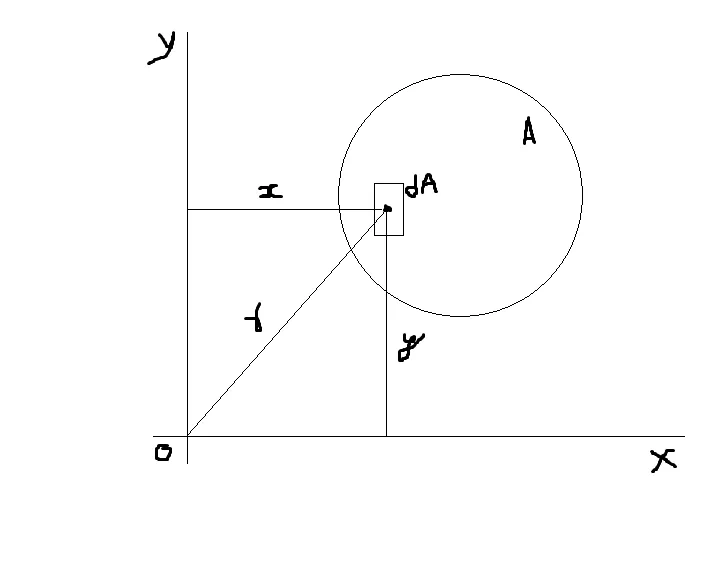
Let us suppose a body with area 'A'. Now if we have to find the moment of area of body about 'O' we will consider a small area 'dA' whose centroid is situated at 'r' distance from 'O'. To find the centroid of an area by the first moment of area about an axis was determined (∫ xdA). The integral of the second moment of area is called moment of inertia (∫ x^2 dA). By definition, the moment of inertia of the differential area about the x and y axes are dIxx and dIyy.
dIxx = y^2 dA
Ixx = ∫y^2 dA
dIyy = x^2 dA
Iyy = ∫x^2 dA
Parallel axis theorem for an area
The moment of inertia of a body about an axis parallel to the body passing through its centre is equal to the sum of the moment of inertia of the body about the axis passing through the centre and the product of the mass of the body times the square of the distance of between the two axes.
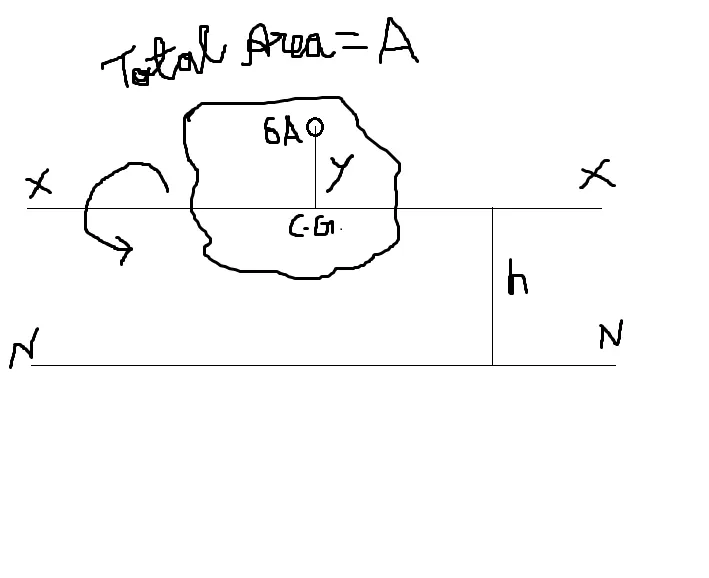
(I)nn = (I)c.g. + Ah^2
Where (I)nn = moment of inertia about neutral axis
(I)c.g. = moment of inertia about centroid
h = distance between neutral axis and axis of rotation of body.
Perpendicular axis theorem for an area:-
Perpendicular axis theorem is used when the body is symmetric in shape about two out of the three axes. If the moment of inertia about two of the axes are known the moment of inertia about the third axis can be found using the expression:
(I)zz = Ixx + Iyy
Say in an engineering application, we have to find the moment of inertia of a body, but the body is irregularly shaped, and the moment of in these cases, we can make use of the parallel axis theorem to get the moment of inertia at any point as long as we know the centre of gravity of the body. This is a very useful theorem in space physics, where the calculation of the moment of inertia of spacecraft and satellites makes it possible for us to reach the outer planets and even deep space. The theorem of the perpendicular axis helps in applications where we don’t have access to one axis of a body, and it is vital for us to calculate the moment of inertia of the body on that axis.
Euler Bernoulli's Equation or Bending Stress formula or Bending Equation
The bending stress formula is:
M/I = σ/y = E/R
where;
- M: Bending moment of the section passing through a point
- I: Moment of Inertia of the section
- σ: Bending stress at a point
- y: Distance from NA
- E: Modulus of elasticity of the material
- R: Radius of Curvature
NOTE:
- The radius of curvature is represented by EI/M
- The curvature of the section is represented by M/EI
- The radius of curvature is represented by EI
- Elastic Section Modulus
- Plastic Section Modulus

Section Modulus calculation
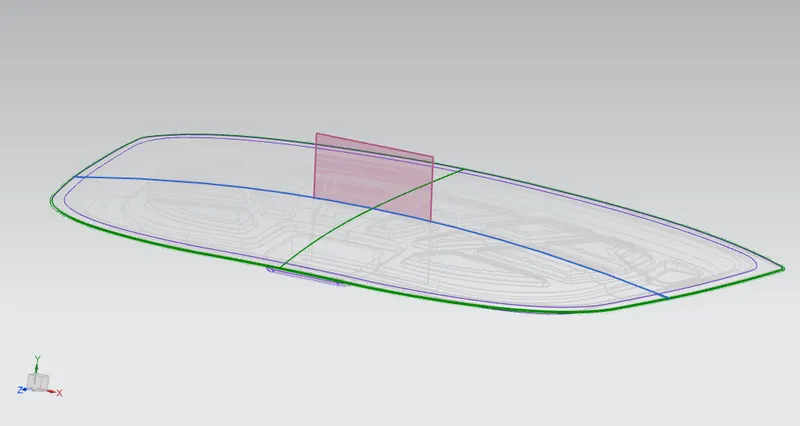
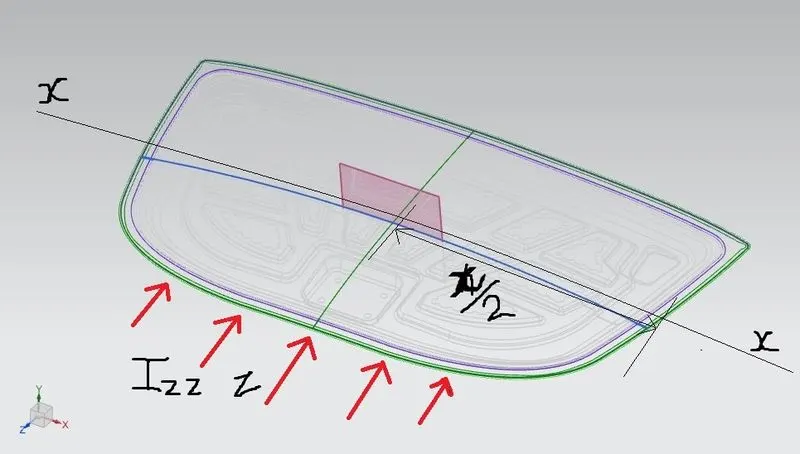

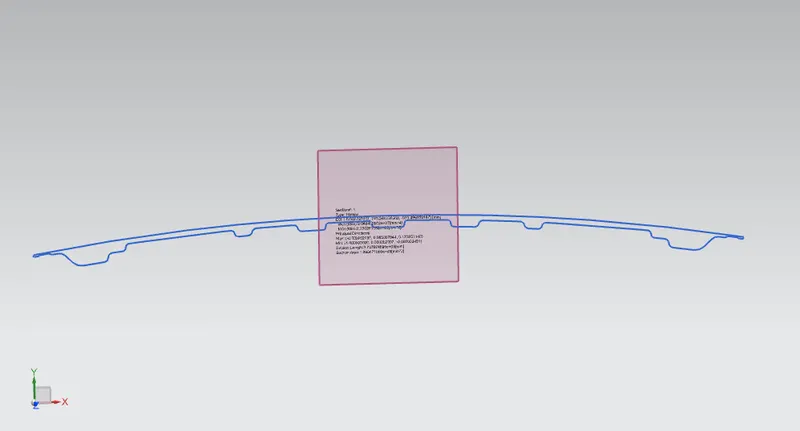
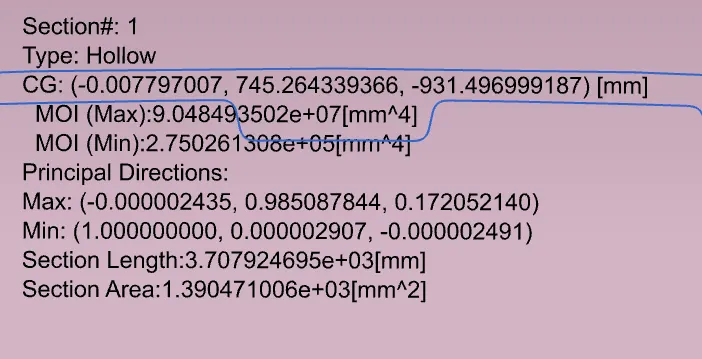
(MOI)min = Izz = 2.7503 e+05 mm^4
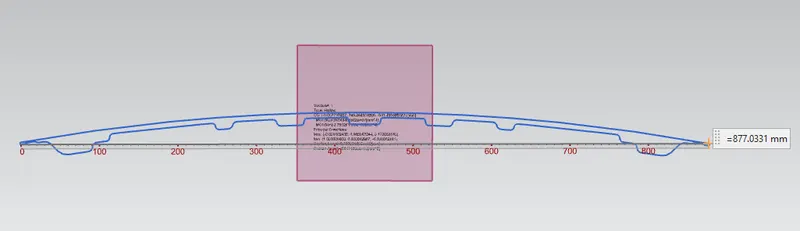
y = 877.0331 mm
Section Modulus Z = (I)zz/(y/2) = (2.7503 e+05 )/(877.0331/2 ) = 62.7183 mm^3
Section Modulus Calculation for modified section
After doing some small modifications, we observe slight changes in the results.

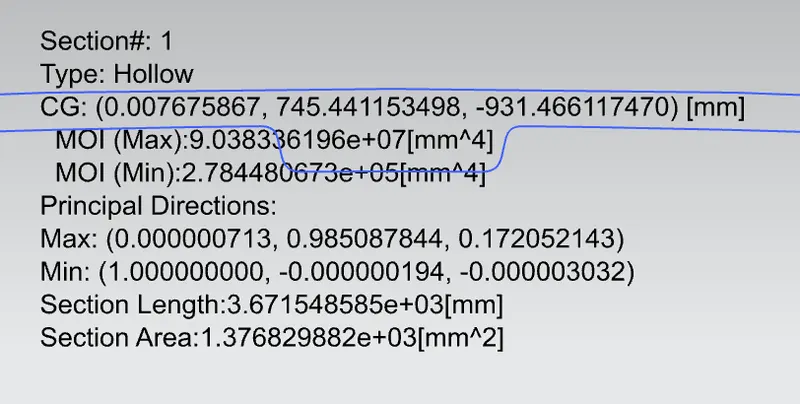
(MOI)min = Izz' = 2.7845 e+05 mm^4
y = 877.0331 mm
Section Modulus Z' = (I)zz'/(y/2) = (2.7503 e+05 )/(877.0331/2 ) = 63.4982 mm^3
Therefore, a small modification in the Sectional area results in a variation of the section modulus between the initial and New hood.