Section Modulus calculation and optimization
Objective:-
- Using the section of the hood design and calculating the section modulus.
- Writing a detailed report on Section Modulus.
- Come up with a new section that has an improved Section Modulus compared to the previous one and mention what changes you come up with a new section that has an improved Section Modulus compared to the previous one and mention what changes you made which resulted in the increased strength. made that resulted in increased strength.
Section Modulus:-
Section modulus is a geometric property used to quantify the strength and resistance of a structural member, typically in the field of structural engineering and mechanics. It provides valuable information about a cross-sectional shape's ability to withstand bending moments and flexural stresses.
When a beam or any other structural element is subjected to bending, it experiences internal forces and moments that can cause deformation or failure. The section modulus is a measure of a shape's resistance to these bending forces. It indicates how far the material is from the neutral axis of the section, and thus how effectively it can resist bending moments.
The section modulus is calculated based on the moment of inertia (also known as the second moment of area) of the cross-sectional shape. The moment of inertia represents the distribution of an object's mass around an axis, and in this case, it describes how the area is distributed around the neutral axis. The moment of inertia is denoted by the symbol "I" and has units of length^4.
The section modulus is defined as the moment of inertia divided by the distance from the neutral axis to the extreme fiber of the shape. It is denoted by the symbol "S" and has units of length^3. Mathematically, it can be expressed as:
S = I / y
where: S = Section modulus I = Moment of inertia of the cross-sectional shape y = Distance from the neutral axis to the extreme fiber
The bending equation is given as follows:
σ = (M * y) / I
where: σ = Bending stress M = Bending moment acting on the beam y = Distance from the neutral axis to the extreme fiber (also known as the distance to the point of interest) I = Moment of inertia of the cross-sectional shape
Area moment of Inertia:
The area moment of inertia of a beam's cross-sectional area measures the beam's ability to resist bending. The larger the moment of inertia less will be the bend.
Neutral Axis:- The neutral axis is an imaginary line or plane passing through the centroid of a cross-sectional shape, where there is no stress during bending. It is a key consideration in analyzing and designing beams under bending loads, as it influences the distribution of stresses and strains within the structure.
Formulas to calculate the section modulus:
In the following table, you can look at the elastic and plastic section modulus formulas, which are the ones this section modulus calculator uses. Scroll sideways to display the whole table.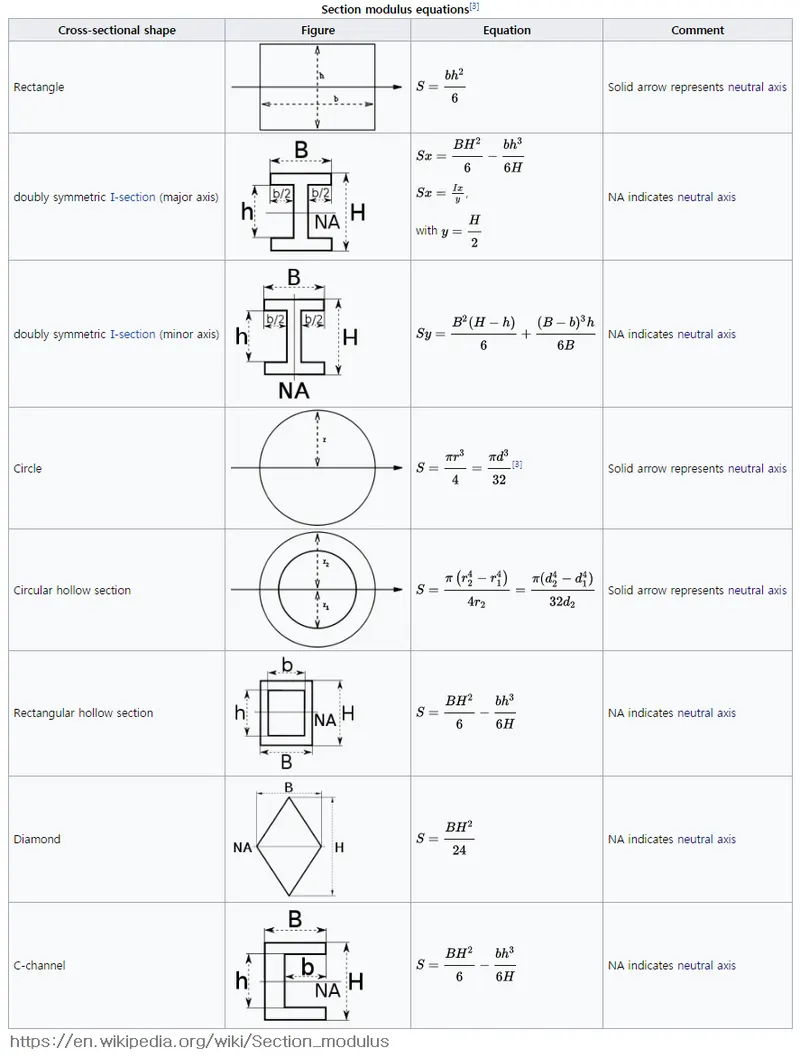
Calculation:-
CASE 1: Before Optimization
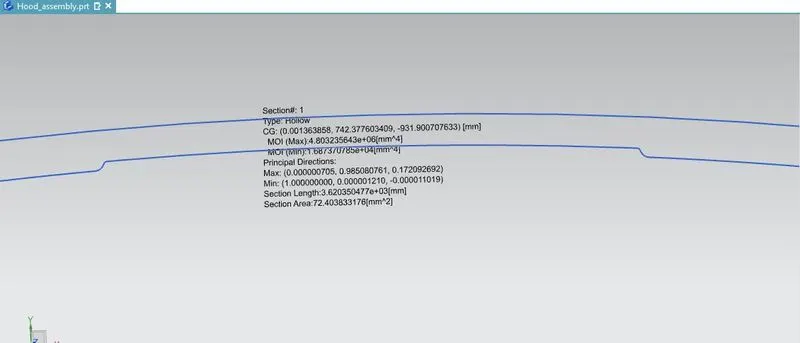
The Hood which was already created is imported and the section inertia analysis is done.
We have to make sure that the curve obtained is a single/closed curve.
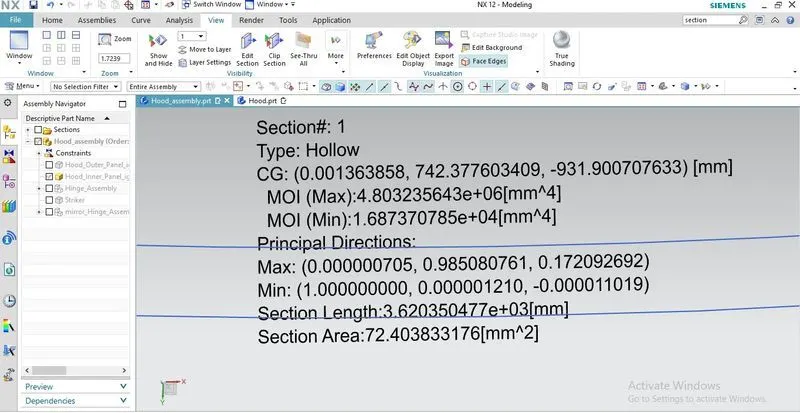
Moment of inertia(max) = 4.803235643×10^6×mm^4
Moment of inertia(min) = 1.68730785×10^4×mm^4
Y=485.7599/2=242.8799 mm
S=I/Y
S=1.68730785×10^4 /242.87=69.44mm^3
CASE 2: After Optimization
By increasing the depth of the inner panel by 0.45 mm
Moment of inertia(max) = 4.501403273×10^6×mm^4
Moment of inertia(min) = 1.71358471×10^4×mm^4
Y=485.7599/2=242.8799 mm
S=I/Y
S= 1.71358471×10^4/242.87= 70.55mm^3
Conclusion:-
We have concluded that the more the Inertia value the more the section modulus as both are directly proportional to each other. The more the section modulus, the more the member is resistant to the bending which results in the increased strength of the material.