Section Modulus calculation and optimization
SECTION MODULUS CALCULATION AND OPTIMIZATION:
Section modulus:
Section modulus is mainly used to calculate bending stress in a structural member.
Definition:
It is defined as the ratio of moment of inertia of a section about its centroidal axis and to distance of the extreme layer from the neutral axis.
S = I/y
S = Section modulus
I = Moment of inertia
y = Distance from the neutral axis to the extreme end of the object
Claculation with hood assembly:
Case 1:
Section modulus:
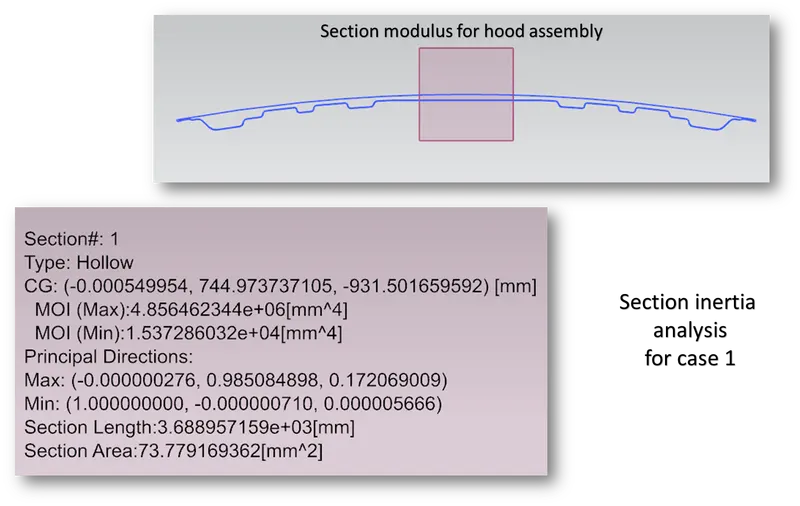
Moment of inertia maximum: 4.886462344e+06 (mm^4)
Moment of inertia minimum: 1.537286032e+04 (mm^4)
S = I/y
I - MOI (min)
y - Total distance / 2
Total distance = 880.14mm
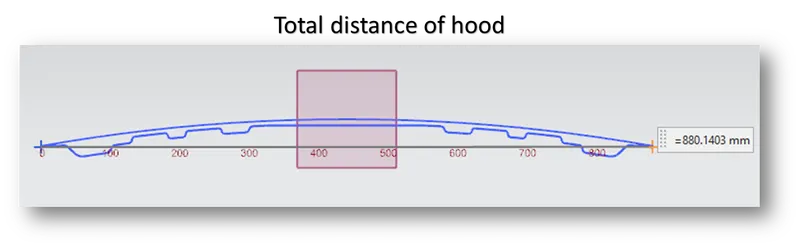
y = 880.14 / 2
y = 440.07
S = I / y
S = 1.537286032e+04 (mm^4) / 440.07 (mm)
= 15372.86032 / 440.07
Therefore, S1 = 34.933 mm^3
Case 2:
Section modulus:
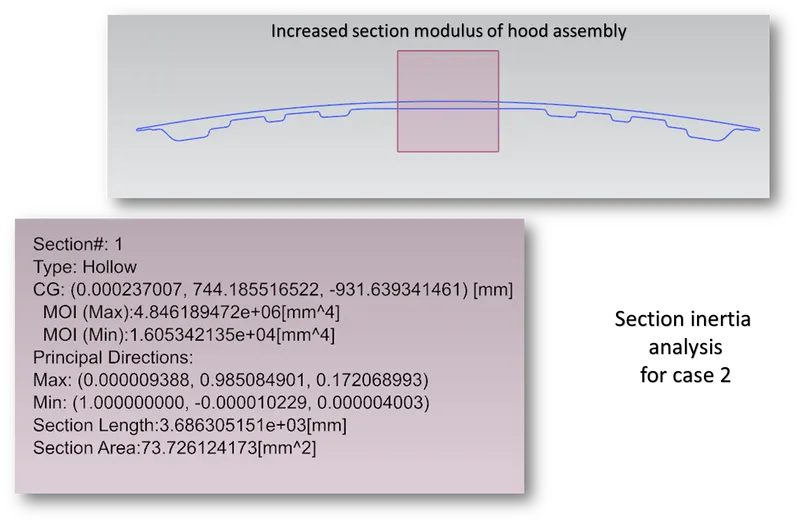
Moment of inertia maximum = 4.846189472e+06 (mm^4)
Moment of inertia minimum = 1.605342135e+04 (mm^4)
S = I / y
I (min) = 16053.42135
y = 440.07
S = 16053.42135 (mm^4) / 440.07 (mm)
Therefore, S2 = 36.48 mm^3
Result:
- The difference between case 1 ans case 2 is 1.547 mm^3
- The section modulus value for case 2 higher than the case 1.
- Therefore if we increase the section area the section modulus increase, so the strength and impact load resistance increases.