Section Modulus calculation and optimization
Challenge: Come up with a new section that has an improved Section Modulus compared to the previous one and mention what changes you made which resulted in the increased strength.
Section Modulus
Section modulus is a geometric property for a given cross-section used in the design of beams or flexural members. Other geometric properties used in the design include an area for tension and shear, the radius of gyration for compression, the second moment of area, and the polar second moment of area for stiffness. Any relationship between these properties is highly dependent on the shape in question.
- Elastic Section Modulus:- The elastic section modulus is applicable up to the yield point of the material.
- Plastic Section Modulus:- The plastic section modulus is generally used for material in which plastic behavior is observed.
Elastic Section Modulus
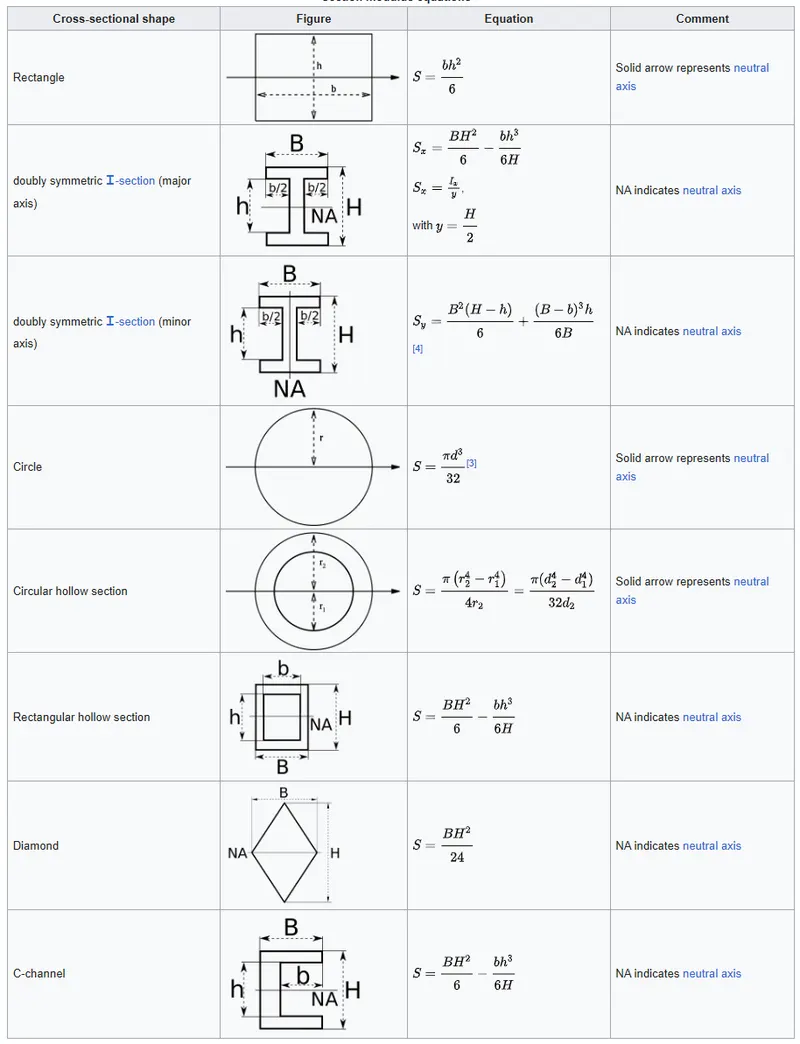
The plastic section modulus is used for materials where elastic yielding is acceptable and plastic behavior is assumed to be an acceptable limit. Designs generally strive to ultimately remain below the plastic limit to avoid permanent deformations, often comparing the plastic capacity against amplified forces or stresses.
The plastic section modulus depends on the location of the plastic neutral axis (PNA). The PNA is defined as the axis that splits the cross-section such that the compression force from the area in compression equals the tension force from the area in tension. So, for sections with constant, and equal compressive and tensile yielding stress, the area above and below the PNA will be equal, but for composite sections, this is not necessarily the case.
The plastic section modulus is the sum of the areas of the cross-section on each side of the PNA (which may or may not be equal) multiplied by the distance from the local centroids of the two areas to the PNA:

The Plastic Section Modulus is not the 'First moment of area'. Both relate to the calculation of the centroid, but Plastic Section Modulus is the Sum of all areas on both sides of PNA (Plastic Neutral Axis) multiplied by the distances from the centroid of the corresponding areas to the centroid of the cross-section, while the First moment of area is calculated based on either side of the "considering point" of the cross-section and it is different along the cross-section and depends on the point of consideration.
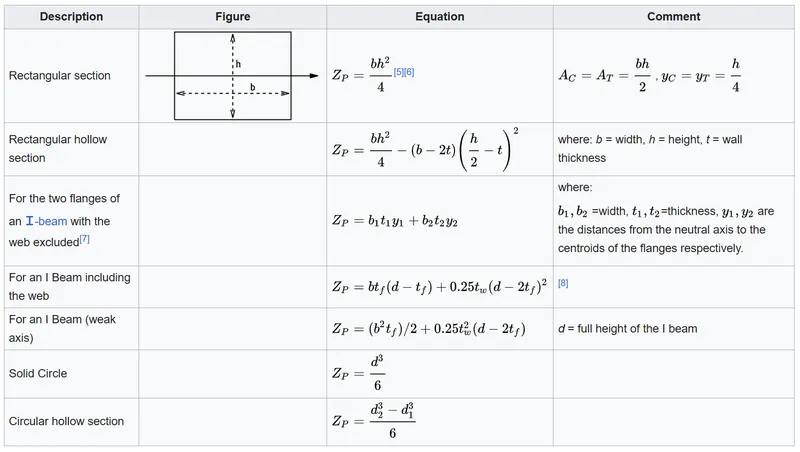
The plastic section modulus is used to calculate the plastic moment, Mp, or full capacity of a cross-section. The two terms are related by the yield strength of the material in question, Fy, by Mp = Fy ⋅ Z. Plastic section modulus and elastic section modulus are related by a shape factor which can be denoted by k, used for an indication of capacity beyond the elastic limit of the material. This could be shown mathematically with the formula:-

The shape factor for a rectangular section is 1.5.
Section Modulus calculation
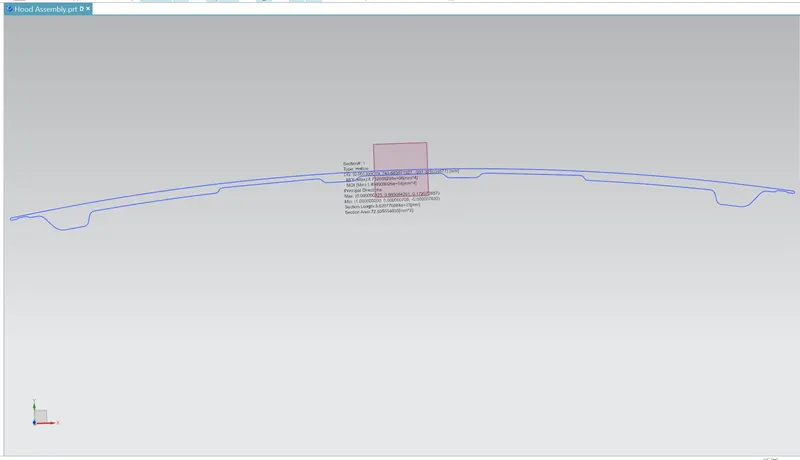
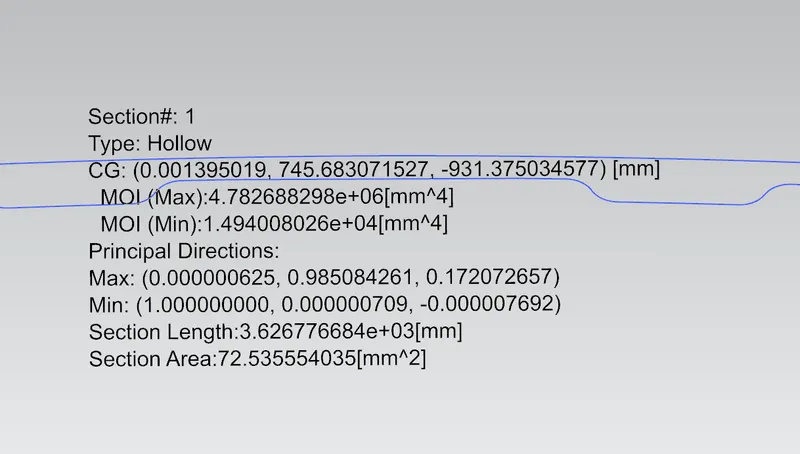
Maximum moment of inertia = 4.782688298e+06[mm^4]
Minimum moment of inertia = 1.494008026e+04[mm^4]
The total distance of the hood Y = 878.5851 mm
Distance between the neutral axis to the extreme end = (878.5851/2) = 439.29255 mm
1)Section modulus(S):-I/Y=4.782688298X106mm4/439.29255mm
=1.088X104mm3(Max strength).
2) Section modulus(S):-I/Y=1.49400802x104mm4/439.29255mm
=0.34x103mm3(min strength).
Optimization Section Modulus
To obtain better Section Modulus lowe profile is off set by 1 mm.
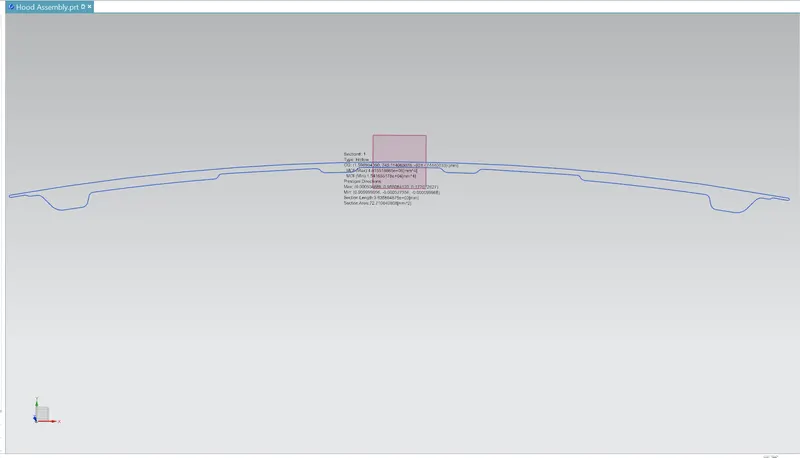
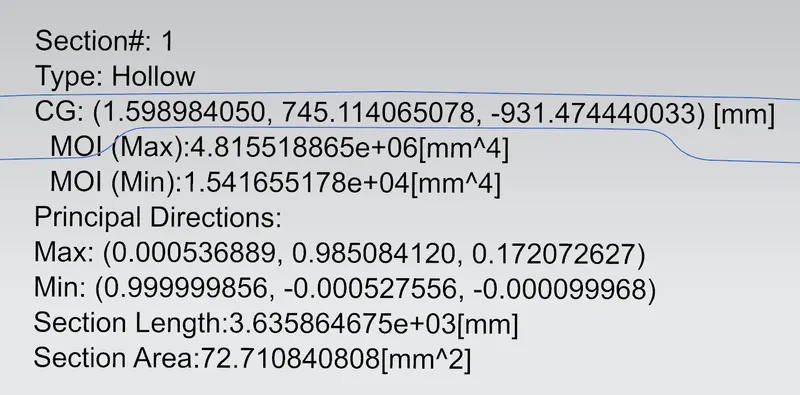
Maximum moment of inertia = 4.815518865e+06[mm^4]
Minimum moment of inertia = 1.541655178e+04[mm^4]
The total distance of the hood Y = 878.5851 mm
Distance between the neutral axis to the extreme end = (878.5851/2) = 439.29255 mm
1)Section modulus(S):-I/Y=4.815518865X106mm4/439.29255mm
=1.096X104mm3(Max strength).
2) Section modulus(S):-I/Y=1.541655178x104mm4/439.29255mm
=0.35x103mm3(min strength).
Conclusion:
In the first case, the Section modulus was calculated without altering the cross-section of the Hood Assembly. And the Maximum Shear Modulus is 1.088X104mm3
In the second case, the Section modulus was calculated by altering the cross-section of the Hood Assembly by 1 mm. And the Maximum Shear Modulus is 1.096X104mm3
With these calculations, it is concluded that the Section modulus is optimized by increasing the cross section.