Section Modulus calculation and optimization
AIM:-
To calculate the Section Modulus of Hood and Optimize the value of it by increasing the inner panel to a certain distance and calculate the point where the breaking of material starts.
OBJECTIVE:-
- Calculate Section Modulus (S)
- Calculate Neutral Axis (Y)
- Calculate Moment of Inertia (I)
THEORY:-
Section Modulus is a geometric property for a given cross-section used in the design of beams or flexural member. Other geometric properties used in design include area for tension and shear, radius of gyration for compression, and moment of inertia and polar moment of inertia for stiffness. Any relationship between these properties is highly dependent on the shape.
There are two types of Section Modulus,
The Elastic Section Modulus
The elastic section modulus is defined as S = I / Y, where I is the Minimum moment of inertia (or area moment of inertia) and y is the distance from the neutral axis to any given fibre.
The Plastic section Modulus
The plastic section modulus is the sum of the areas of the cross section on each side of the PNA (which may or may not be equal) multiplied by the distance from the local centroids of the two areas to the PNA:

the Plastic Section Modulus can also be called the 'First moment of area'.
Plastic section modulus and elastic section modulus are related by a shape factor which can be denoted by 'k', used for an indication of capacity beyond elastic limit of material. This could be shown mathematically with the formula :-

Moment of Inertia value is taken as minimum because of its Threshold Value.
Threshold Value is defined as the point where the part starts to break.
Section Modulus is calculated by,
{S = I/Y}
S = Section Modulus
I = Moment of Inertia
Y = Distance from Neutral Axis
There are two cases for calculation of Section Modulus,
Y = Distance from Neutral Axis
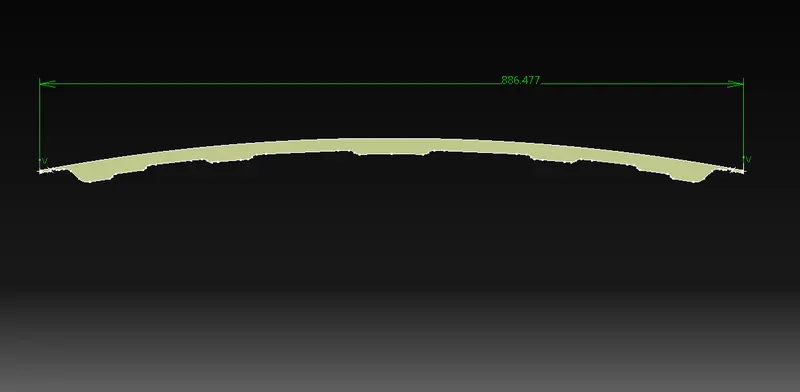
Y = 886.477/2
= 443.2385mm
CASE 1:-
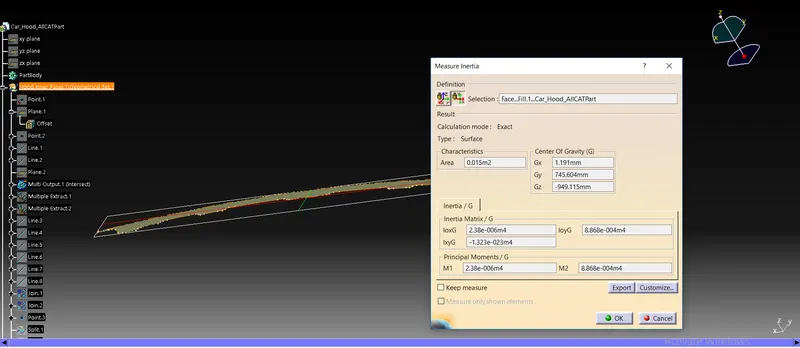
Minimum value of Moment of Inertia is 2.38e^-006m^4,
which is I = (2.38e-006m^4)x(10^12mm^4)
I = 2.38x10^6mm^4
Y = 443.2385mm
S = I/Y;
S = {2.38X10^6mm^4}/443.2385
The final obtained value of S is;
S = 5369.56mm^3
CASE 2:-
Now to find new value of Minimum Moment of Inertia we have taken Offset of 1mm for inner panel outer part from reference.
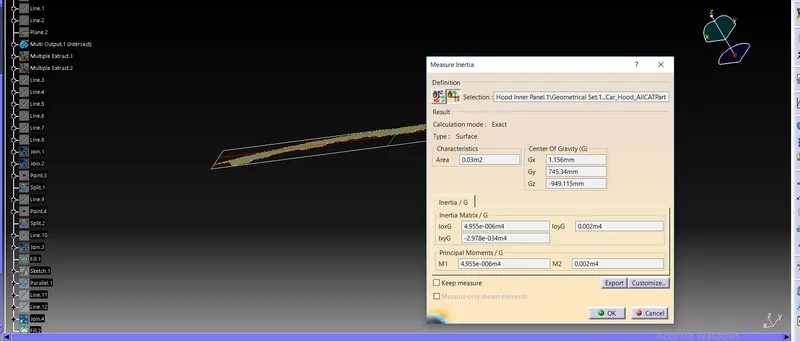
Minimum value of Moment of Inertia is, I = 4.955e-006m^4;
I = {4.955e-006m^4}X(10^12mm^4};
I = 4.955x10^6mm^4
Y = 443.2385mm
S = I/Y
S = {4.955x10^6mm^4}/{443.2385}
The final obtained value of S is;
S = 11179.08 mm^3.
CASE 1; S = 5369.56 mm^3
CASE 2; S = 11179.08 mm^3
Through the above difference in cases can be observed that, there is a difference between the values of S i.e. Section Modulus. This is because I have increased the value between inner and outer panel of hood by 1mm and through this the strenght of hood is also increased as we can see.
CONCLUSION
This is done to achieve the higher moment of inertia. Increasing the gap between the inner and outer panels has resulted in decreasing bending moments.So, the moment of inertia has been increased and the strength of hood increases as well.