Section Modulus calculation and optimization
AIM:
To calculate section modulus and optimizing the improve result to increase the stiffness of Hood.
FORMULA:
Section modulus = Moment of Inertia/distance between the neutral axis and the end of the object.
`S`=`I``/``y`.
PROCEDURE:
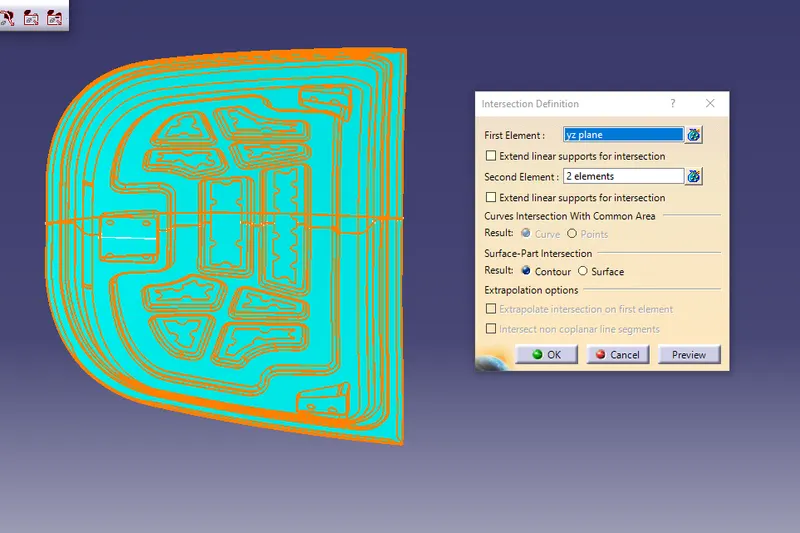
Initially, create an intersection using YZ-plane and extract the outer boundary.
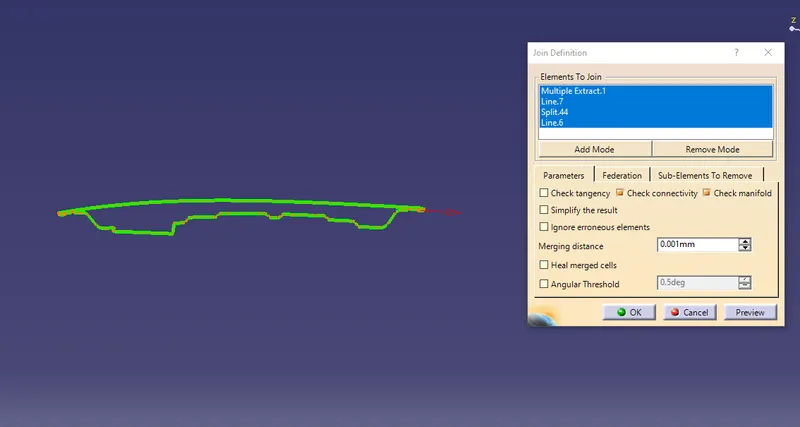
Join the boundary by splitting them with point and use the fill option.
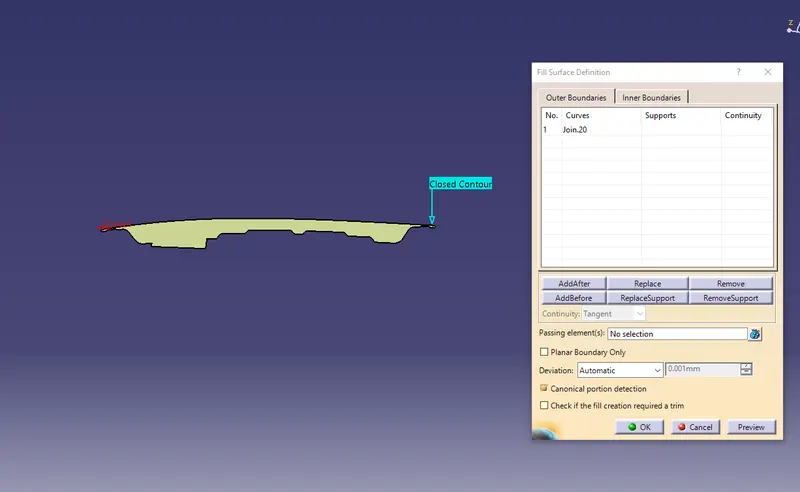
After a surface is created, use measure inertia, select 2D element and select the surface.
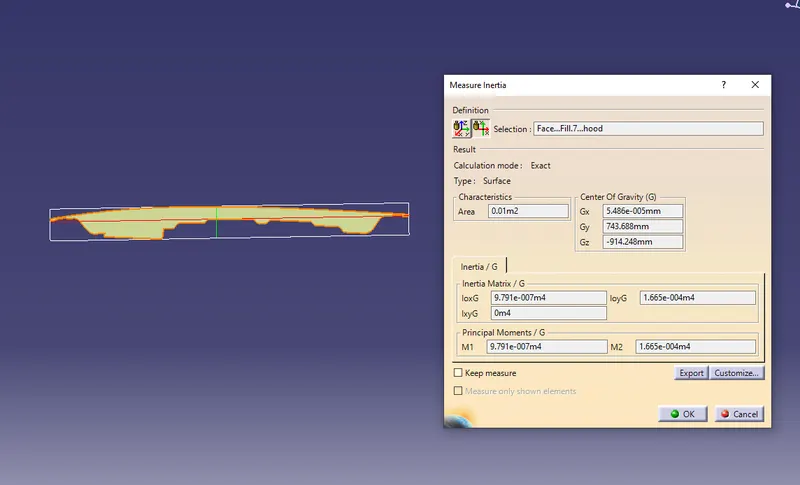
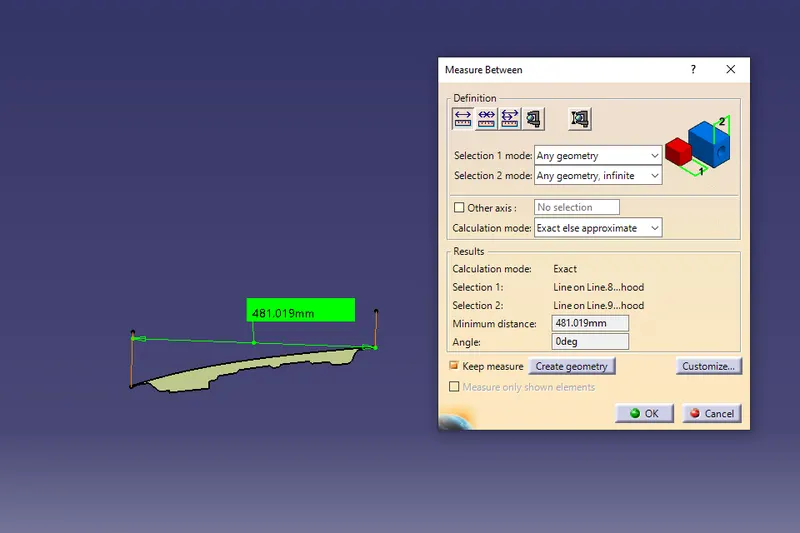
We get
minimum inertia=`9.791e-004mm^4`
maximum inertia=`1.665e-001mm^4`
y= 481.019mm.
S=9.791e-004/481.019
=`2.035470532349034e-6 mm^3`(Minimum Inertia)
S=1.665e-001/481.019
=`3.461401732571894e-4 mm^3`(Maximum Inertia)
The strength of Hood varies between `2.035470532349034e-6 mm^3` to `3.461401732571894e-4 mm^3`.
The Max Inertia is `3.461401732571894e-4 mm^3`comparing this value with all cases.
CASE 1:
In this case, we offset the inner panel intersection line to 0.5mm downwards.
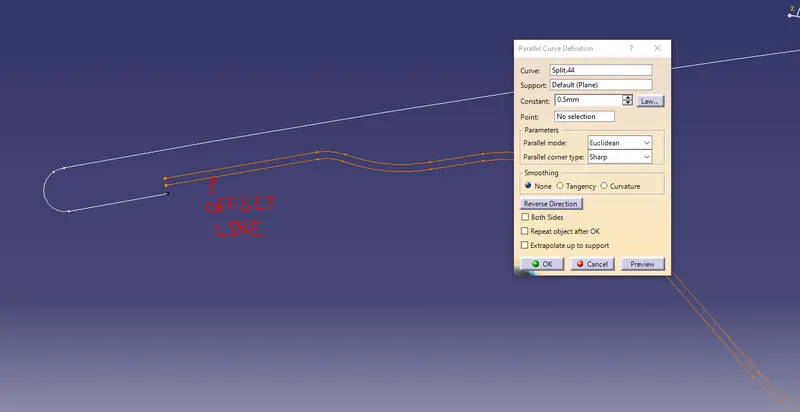
Fill the surface and measure the inertia.
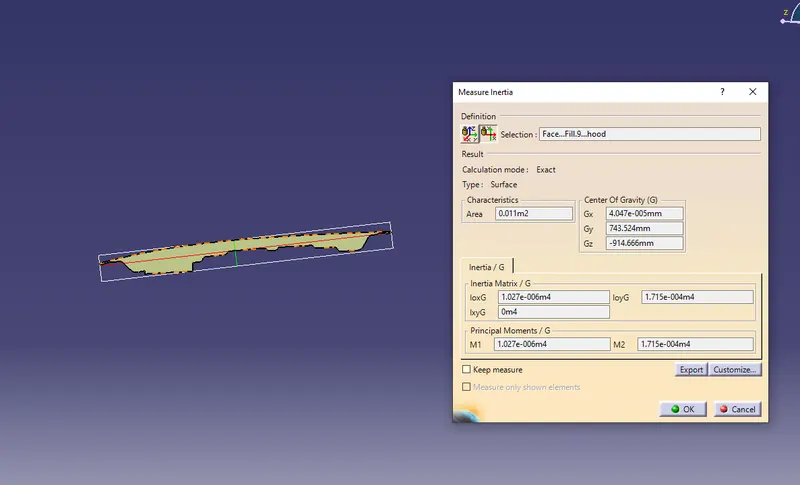
We got
minimum inertia=`1.027e-003mm^4`
maximum inertia=`1.715e-001mm^4`
y= 481.019mm.
S=1.027e-003/481.019
=`2.13505079840921e-6 mm^3`(Minimum Inertia)
S=1.715e-001/481.019
=`3.565347730547026e-4 mm^3`(Maximum Inertia)
The strength of Hood varies between `2.13505079840921e-6 mm^3` to `3.565347730547026e-4 mm^3`.
STUDY:
The main value is `3.461401732571894e-4 mm^3`
Case 1 value is `3.565347730547026e-4 mm^3`
There is a difference of `0.0000104 mm^3` between case 1 and the main value.
Hence, the strength of the Hood is improved a bit.
CASE 2:
In this case, we offset the inner panel intersection line to 0.7mm downwards.
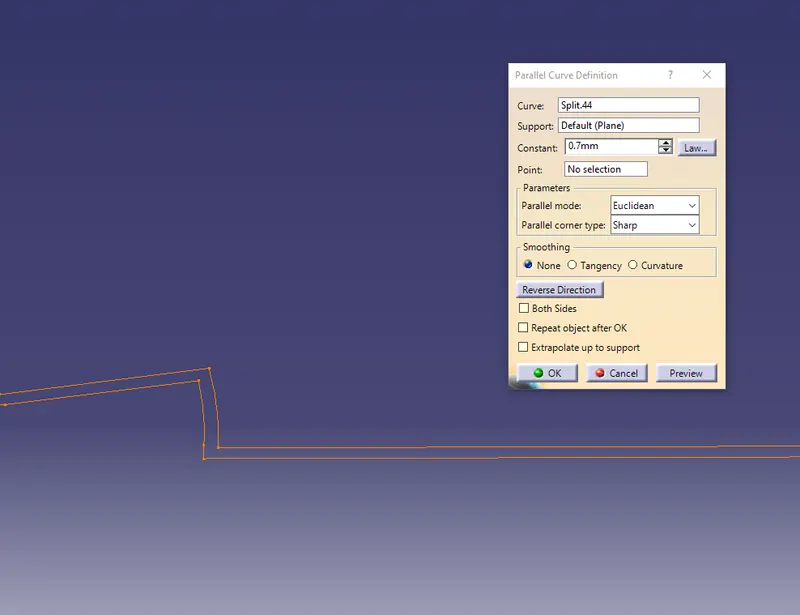
Fill the surface and measure the inertia.
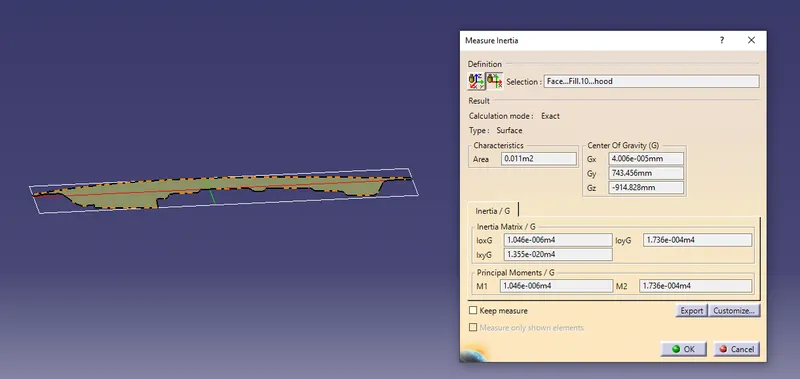
We get
minimum inertia=`1.046e-003mm^4`
maximum inertia=`1.736e-001mm^4`
y= 481.019mm.
S=1.046e-003/481.019
=`2.174550277639761e-6 mm^3`(Minimum Inertia)
S=1.736e-001/481.019
=`3.609005049696582e-4 mm^3`(Maximum Inertia)
The strength of Hood varies between `2.174550277639761e-6 mm^3` to `3.609005049696582e-4 mm^3`.
STUDY:
The main value is `3.461401732571894e-4 mm^3`.
Case 2 value is `3.609005049696582e-4 mm^3`.
There is a difference of `0.00001476 mm^3` between case 2 and the main value.
Hence, the strength of the Hood is improved a lot.
CASE 3:
In this case, we offset the inner panel intersection line to 1.1mm downwards.
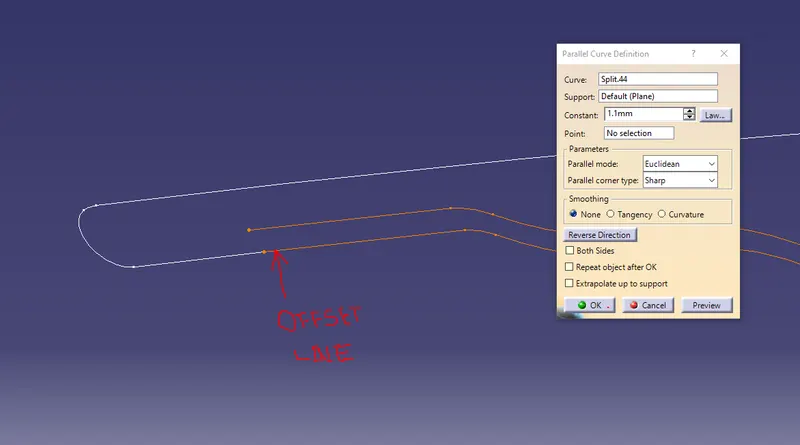
Fill the surface and measure the inertia.
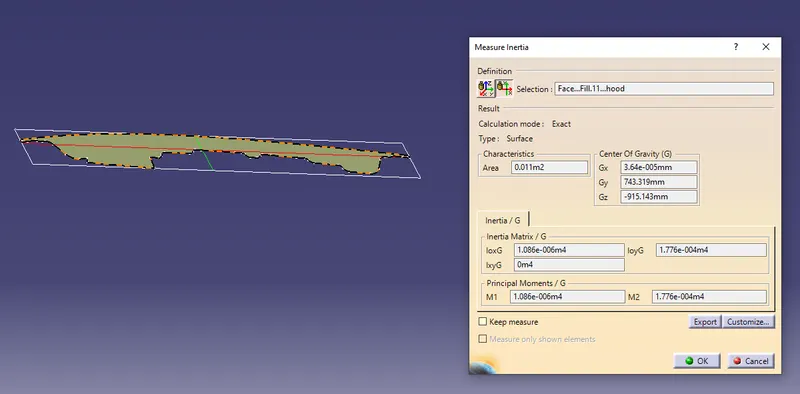
We get
minimum inertia=`1.086e-003mm^4`
maximum inertia=`1.776e-001mm^4`
y= 481.019mm.
S=1.086e-003/481.019
=`2.257707076019866e-6 mm^3`(Minimum Inertia)
S=1.776e-001/481.019
=`3.692161848076687e-4 mm^3`(Maximum Inertia)
The strength of Hood varies between `2.257707076019866e-6 mm^3` to `3.692161848076687e-4 mm^3`.
STUDY:
The main value is `3.461401732571894e-4 mm^3`.
Case 3 value is `3.692161848076687e-4 mm^3`.
There is a difference of `0.00002307 mm^3` between case 3 and the main value.
Hence, the strength of the Hood is improved.
RESULT:
I recommend case 3 because the strength of the material is directly proportional to the moment of inertia, hence an increase in the sectional area there is have increased the overall mass of an object hence has increased in strength.
Terms Used:
Section Modulus: Section modulus is a geometric property for a given cross-section used in the design of beams or flexural members. Other geometric properties used in the design include an area for tension and shear, the radius of gyration for compression, and moment of inertia and polar moment of inertia for stiffness
Formula: `S = I / y`
SI unit: `mm^3`
Moment of Inertia: A quantity expressing a body's tendency to resist angular acceleration, which is the sum of the products of the mass of each particle in the body with the square of its distance from the axis of rotation.
Formula: 
SI unit: `kg m^2`
Stiffness: It is the extent to which an object resists deformation in response to an applied force. The complementary concept is flexibility or pliability: the more flexible an object is, the less stiff it is.
Formula: 
SI unit: `N`