Section Modulus calculation and optimization
Section Modulus calculation and optimization
AIM: To perform section modulus calculation and design optimization of hood component.
INTRODUCTION:
Section modulus is a geometric property for a given cross-section used in the design of beams or flexural members. Other geometric properties used in design include area for tension and shear, radius of gyration for compression, and moment of inertia and polar moment of inertia for stiffness. Any relationship between these properties is highly dependent on the shape in question. There are two types of section moduli, the elastic section modulus and the plastic section modulus. The section moduli of different profiles can also be found as numerical values for common profiles in tables listing properties of such.
SECTION MOUDULUS CALCULATION:
For calculation of section modulus we use the formula S = I/Y ,
where S = Section Modulus(mm^3),
I = Moment of Inertia, and
Y = distance between the neutral axis and the extreme end of the object.
CASE-1:
Initially after the hood design I have created an intersection curve for the hood after that I have joined the ends of the free end open curves. Further I have performed section modulus calculation for this intersection curve.
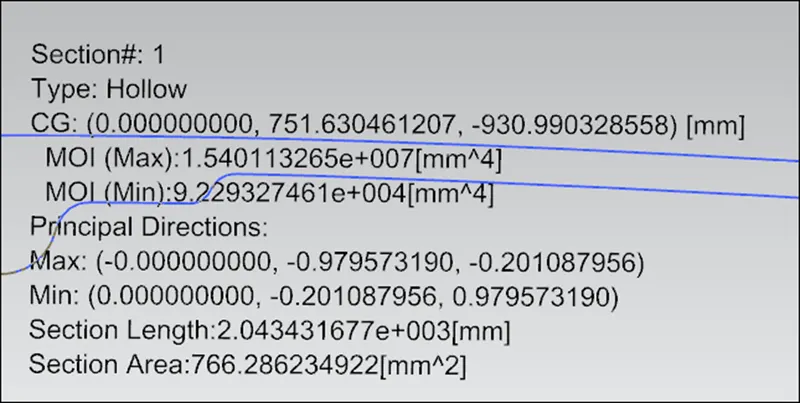
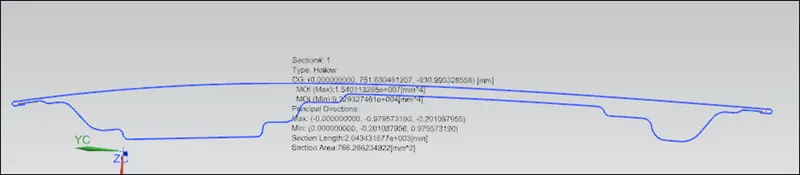
 Total length = 484 mm (nearest value/approx)
Y = 484/2 = 242 mm
Imin = 9.229327461X10^4
S = Imin/Y =9.229327461X10^4/242 = 381.37716781 mm^3
CASE-2:
In this case I have optimized the hood design by offsetting the inner panel to .5 mm. By doing this there is an increase/ change in section modulus values. After doing this again I have created new intersection curve and performed the section modulus calculation.
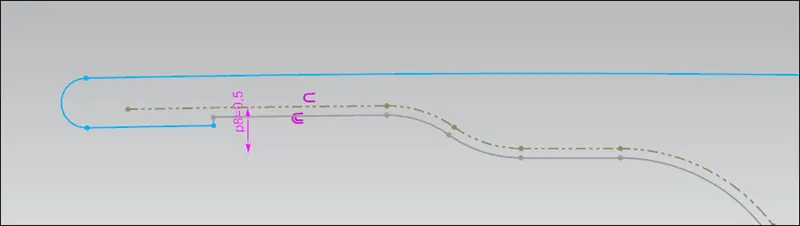
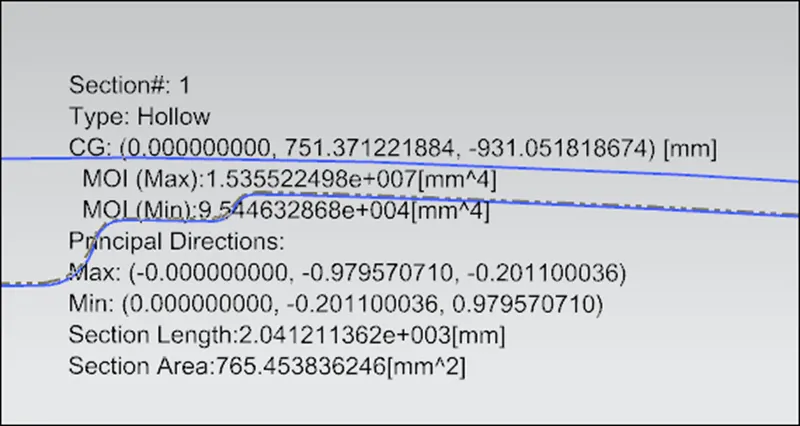
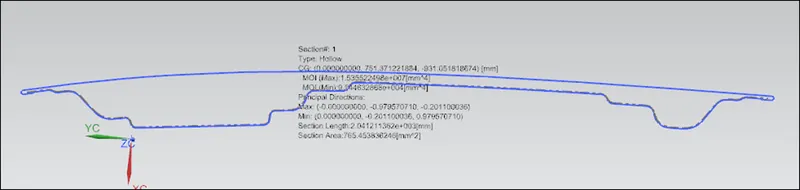
Total length = 484 mm (nearest value/approx)
Y = 484/2 = 242 mm
Imin = 9.544632868X10^4
S = Imin/Y =9.54632868X10^4/242 = 394.4063168595 mm^3
Change(Increase) in Section modules is 394.4063168595-381.37716781 = 13.0291490495 mm^3
CONCLUSION: Based on the inputs and outputs from case 1 and case 2 we come to a conclusion that, we are able to achieve higher moment of inertia and improve section modulus values by increasing the gap between inner and outer panel of a hood. Hence we can give more geometric constraints and features to inner and outer panel of a hood so that we can increase the stiffness of the master section.