Section Modulus calculation and optimization
Section Modulus
Section Modulus is a geometric property used to calculate the bending stresses in a structural member.
Mathematically,
It is defined as the ratio of the moment of inertia of a section about its centroidal axis and to the distance of the extreme layer from the neutral axis.
It is denoted by Z
Z = I/ymax
Mathematically By bending stress equation,
M/I = σmax/ymax
M = σmax × (I/ymax)
M = σmax × Z
Where,
I = Moment of Inertia (m⁴)
y = distance from NA to extreme layer (m)
The unit of section modulus is m³.
Types of Section Modulus
There are two types of section modulus:
- Elastic Section Modulus
- Plastic Section Modulus
Elastic Section Modulus
Elastic section modulus is calculated when we are to use the material behavior till the yield point.
For general design purposes, we use elastic section modulus.
Generally, elastic section modulus is denoted by Zₑ.
So,
Zₑ = I/ymax
Where,
I = Moment of inertia
ymax = Distance from NA to extreme layer
Plastic Section Modulus
The plastic section modulus is used for materials where the elastic yield is acceptable and the plastic behavior is considered to be an acceptable range.
It depends on the location of the plastic neutral axis. The PNA is the axis that bisects the cross-section such that the compressive force from the region in compression is equal to the tension force from the region under tension. So, for sections with a constant yield stress, the area above and below the PNA will be equal, but for mixed sections, this is not necessarily the case.
As we know S=I/Y
CASE 1
To calcuate the section modulus we use the section of our model calculate the inertia(I)
As we know S=I/Y
Distance between extreme end of model
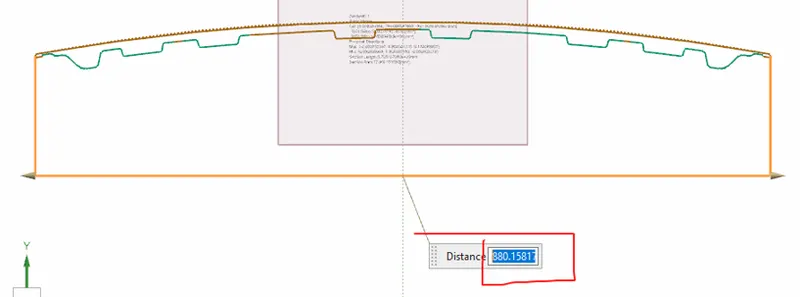
Y=880.16/2=440.08
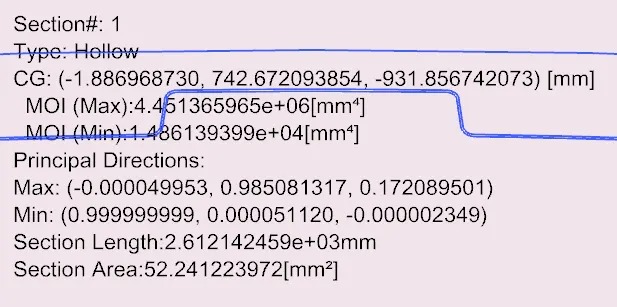
For Case 1
S=1.486x10`(1.486*10^4)/440.08`=33.7665
CASE 2
After doing some modification, offset the class B surface by 0.5mm we calculate the new section modulus
Y is same as the old since their is no change in the length of the model
so,
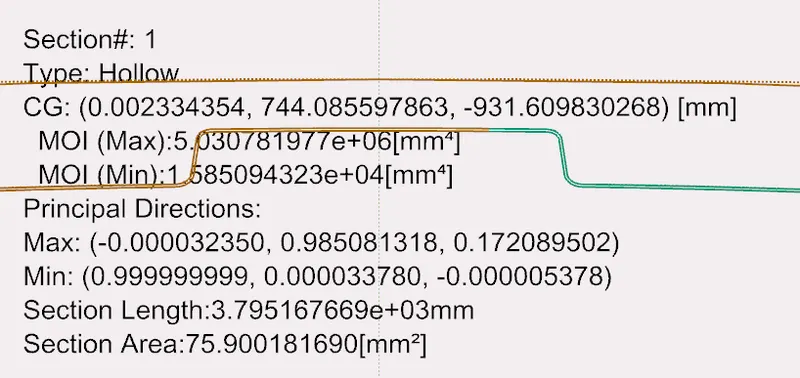
For Case 2
S = `(1.58509*10^4)/440.08`= 36.0182
Conclusion
We can see that a minor change in the cross sectional area can increase the moment of inertia & the section modulus.