Section Modulus calculation and optimization
Aim: To Calculate the Section Modulus of the Hood section.
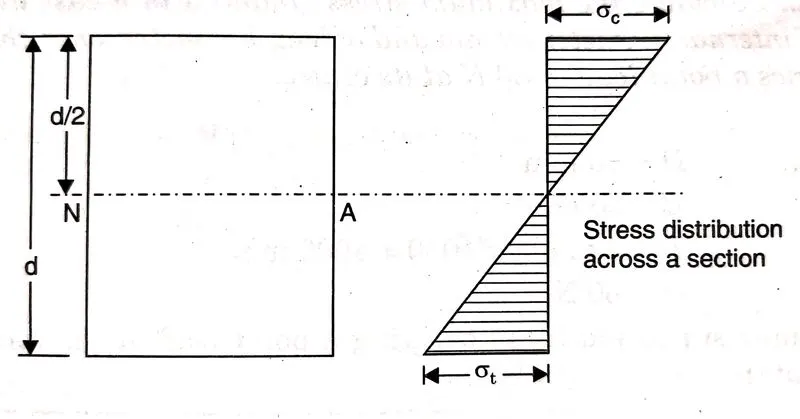
Neutral Axis:
- The centermost layer of any section of a component is called the Neutral axis.
- Neutral Axis doesn't get affected by any kind of load that is perpendicular to it which means there is no stress or strain on the neutral axis.
- The range of stress varies with respect to the distance from the neutral axis.
- The below figure shows the Neutral axis(dotted line) and in the Load situation the stress on either side of the neutral axis.
SECTION MODULUS:
Section modulus is defined as the ratio of the moment of inertia of a section about the neutral axis to the distance of the outermost layer from the neutral axis. It is denoted by the symbol S. Hence mathematically section modulus is given by,
- S=I/Y-max
- where
- I=Moment of Inertia about the neutral axis and
- Y-max = Distance of the outermost layer from the neutral axis.
we know Max Bending Moment(M)/ moment of inertia(I) = Stress(σ)/strain(Y)
The stress σ will be maximum when y is maximum. Hence above equation can be written as
- M/ I = (σ-max)/(Y-max)
- M= σ max*(I/Y-max)
But
- I/(Y-max)=Z
- M = σ max * Z
In the above equation, M is the maximum bending moment (or moment of resistance offered by the section). Hence moment of resistance offered by the section is maximum when section modulus Z is maximum. Hence section modulus represents the strength of the section.
Note: Section Modulus varies with respect to the shape of the cross-section.
Factors that influence the section modulus:
- Area - Area is directly proportional to section modulus
- Thickness of sheet metal- Thickness is also directly proportional to the section modulus
- Distance between the outermost layer to the neutral axis called Y. Y is inversely proportional to section modulus.
- Cross-sectional depth of the component - It is directly proportional to the sectional modulus.
Section Modulus Analysis using UGNX:
Procedure for an increase in the area:
Case-1: Increasing the area by offsetting the outermost layer.
At Zero Offset:
- Select the Part body on which we have to do analysis and create a cross-section of the part and make sure that the cross-section sketch is a closed profile.
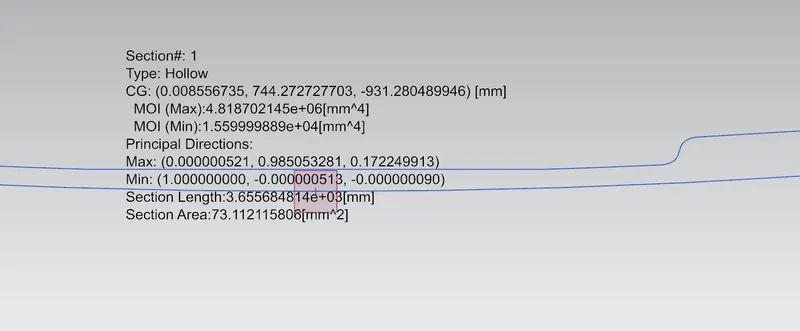
- Perform Section Inertia Analysis over the section that we have created and there we can find the result as shown below
- Create a CG point by using the point command and measure the distance between the point on the outermost layer and the CG point by using the measure command in analysis.
- Here the reason to take Y parallel to the x-axis is if we take the loading condition perpendicular to the x-axis then the Y value also increases as the Area increases but we have to keep one parameter constant for that we took the loading condition parallel to X-axis(this condition can be taken on a side impact).
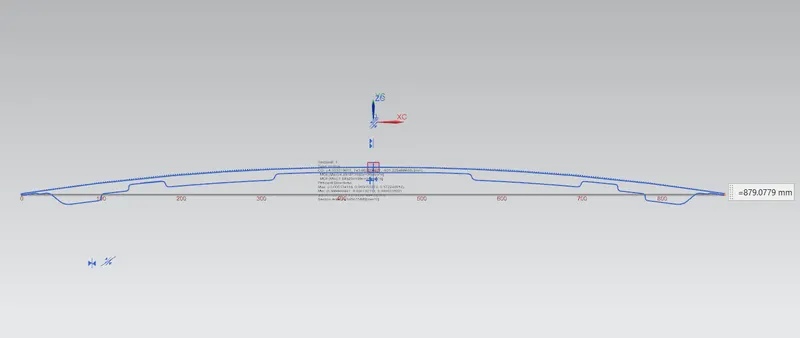
- The Distance we got here is 879/2=439.5mm
- According to the formula For section modulus
-
S = I/Y
-
Where,
S = Section Modulus
I = Moment of Inertia
y = distance between the neutral axis and the extreme end of the object
- MOI min/Y = (1.559999889x10^4)/439.5 = 35.4948780205mm^3
- MOI max/Y = (4.818702145x10^6)/439.5 = 10964.0549374 mm^3
- Section Modulus at MOI min = 35.4948780205 mm^3
- Section Modulus at MOI max = 239726.396161 mm^3
At 0.5 mm Offset:
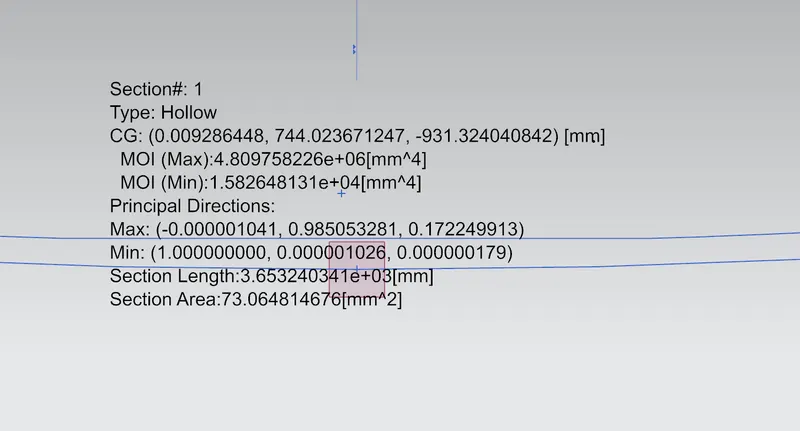
- MOI min/Y = (1.583204158x10^4)/439.5 = 36.0228477361 mm^3
- MOI max/Y = (4.891673592x10^6)/439.5 = 11130.0878089 mm^3
- Section Modulus at MOI min = 36.0228477361 mm^3
- Section Modulus at MOI max = 11130.0878089 mm^3
At 1 mm Offset:
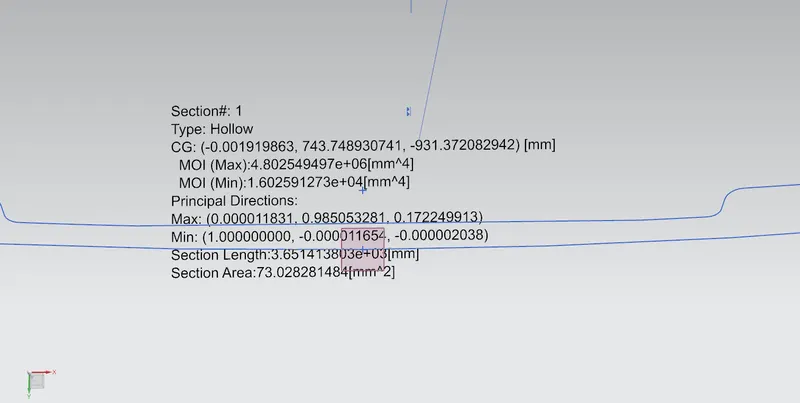
- MOI min/Y = (1.602591273x10^4)/439.5 = 36.463965256 mm^3
- MOI max/Y = (4.802549497x10^6)/439.5 = 10927.3026098mm^3
- Section Modulus at MOI min = 36.463965256 mm^3
- Section Modulus at MOI max = 10927.3026098 mm^3
-
S.No Case Y(mm) Section modulus at min MOI (mm^3) 1 At Zero Offset 439.5 35.49487802 2 At 0.5 mm Offset 439.5 36.01019638 3 At 1 mm Offset 439.5 36.46396526
Result: From the above analysis we can say that the section modulus increases with an increase in offset value nothing but an increase in Cross-sectional area.